U.S. China research ban risks tech innovation

Scientists and technology executives warn the White House risks undercutting U.S. innovation, supply chains and future profits if it broadens restrictions on research collaboration with China.
That matters because the biggest gains in the AI era are not just coming from selling chips and cloud services, but from controlling the research pipeline that turns public science into commercial platforms. Cutting U.S. researchers off from Chinese counterparts would not simply be a diplomatic gesture; it could slow advances in semiconductors, cloud infrastructure, materials science and the AI tools that now define market leadership.
The economic risk is larger than the politics suggests. Washington has already tightened export controls on advanced technology, but a research ban would go after the upstream engine that feeds the whole ecosystem. Universities and corporate labs use cross-border work to accelerate breakthroughs, share datasets and recruit talent. If that pipe narrows, the near-term hit would fall on American institutions first, while China would likely respond by pouring more money into domestic substitutes and regional partnerships.
For investors, the stakes are immediate. Microsoft, Alphabet and Nvidia sit at the center of the AI capex cycle, and any policy that raises the cost of innovation or fragments global research networks can squeeze margins and delay product development. Microsoft and Alphabet also have direct exposure to global enterprise demand and cloud adoption, where slower technical progress can ripple through future revenue growth. Nvidia, meanwhile, is already navigating export limits and a volatile geopolitical premium in its valuation.
The market is not pricing this as a one-way U.S. advantage. Tech stocks have already been whipsawed by policy risk, and the technical backdrop shows how quickly sentiment can reverse: Microsoft has rebounded to about $504 after plunging below $353 in late June, while Nvidia has recovered above $217 from a July trough near $190. Alphabet has also snapped back from the low $330s. Those moves suggest investors are willing to buy the AI trade on every dip, but they also leave the group exposed if Washington turns research policy into another drag on growth.
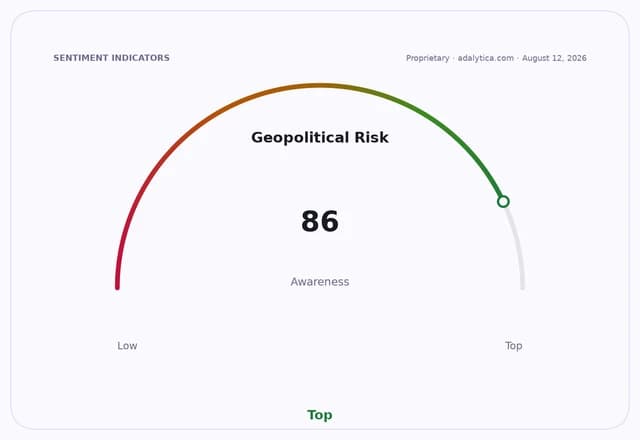
Adalytica’s Global Stability Sentiment reads at extreme greed, which is exactly when policy surprises tend to matter most. With investors leaning hard into the AI and mega-cap growth narrative, a sharper break with China on research would likely trigger a rotation toward defense, domestic infrastructure and companies less dependent on open scientific exchange.
Our thesis is that the market underestimates how much U.S. tech leadership still depends on global knowledge flows. A broad research ban would not just be a China story — it would be a cost-of-capital story for American innovation. The winners would be firms selling compliance, security and domestic supply-chain capacity; the losers would be the platform giants whose next decade of growth depends on a faster pace of discovery.
| Entity | Gains | Losses |
|---|---|---|
| U.S. defense and security contractors | ▲More spending on strategic decoupling | ▼Less pressure for open science |
| Microsoft, Alphabet, Nvidia | ▲Near-term policy insulation if limits stay narrow | ▼Slower innovation pipeline |
| China research institutions | ▲More domestic funding momentum | ▼Access to U.S. collaboration |
| U.S. investors in AI leaders | ▲Short-term dip-buying opportunities | ▼Higher policy risk premium |