U.S. consumer confidence improves as spending outlook rises
Americans are feeling better about the economy at the national, regional and household level, a shift that could support spending and keep the expansion on track even as growth cools from its post-pandemic pace.
That matters because consumer expectations are not just a mood reading; they influence whether households spend, save or defer purchases. When optimism improves across all three levels at once — the broader economy, local labor markets and personal finances — it can create the kind of self-reinforcing demand that businesses and markets watch closely.
In the latest Harris Poll, 32% of U.S. adults said they expect the economy to improve over the next year, up from 28% a month earlier and 26% a year ago. On household finances, 27% expect their situation to be better over the next six months, versus 22% last month. And in their own regions, 30% now describe the job market as good, while the share calling it bad has eased to 38% from 41% in August and 48% a year ago.
The backdrop is a labor market that still looks healthy enough to sustain confidence. The unemployment rate was 4.1% in the latest data, while nonfarm payrolls stood at 159.1 million, near record highs. That combination helps explain why consumer sentiment is stabilizing: Americans may not be exuberant, but they are seeing enough income security to feel comfortable about spending.

For investors, that is a bullish mix for cyclicals, retail and the broad market, even if the message is more incremental than euphoric. The S&P 500 ETF SPY has been trading above both its 50-day and 200-day moving averages, a sign the market is still leaning into the growth-and-earnings story despite recent volatility. Consumer discretionary ETF XLY remains more fragile, but that is exactly why the setup matters: if household confidence keeps improving, this is where upside can surprise first.
Consumer staples ETF XLP tells the other side of the story. When households turn more optimistic, they tend to rotate some spending away from defensive categories and toward travel, entertainment, apparel and big-ticket purchases. That does not mean staples collapse, but it does mean relative leadership can shift toward more economically sensitive names if the confidence trend holds.
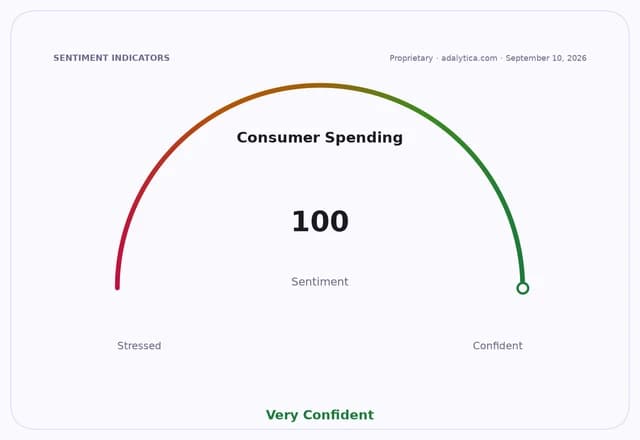
Adalytica’s Consumer Spending Sentiment gauge underscores the same point, with sentiment at 100 — labeled “Extreme Greed” — even as awareness sits in “Extreme Fear.” In plain English, the market is beginning to price a stronger consumer, but many investors remain cautious. That gap is where opportunity usually lives.
The larger narrative is straightforward: the consumer is not rolling over, and expectations are improving just enough to matter. If that holds into the next round of spending data, the winners should be retailers, leisure names, banks and the broader cyclical trade, while defensive leadership may look increasingly crowded. For now, the data argue for staying constructive on U.S. consumption and selectively owning the parts of the market most levered to household confidence.
| Entity | Gains | Losses |
|---|---|---|
| U.S. consumers | ▲Better spending mood | ▼Fear-driven caution |
| Cyclical stocks | ▲Higher demand hopes | ▼Defensive premium |
| SPY | ▲Broad-market support | ▼Recession bets |
| XLY | ▲Upside from spending rotation | ▼Stagnant discretionary demand |