U.S. households rely more on credit as savings thin

Household finances are becoming more dependent on credit as savings thin out, a shift that matters because it can keep spending running in the short term while quietly raising default risk across lenders and retailers.
The broad backdrop is a labor market that is still holding up, but not by enough to fully offset pressure on household balance sheets. U.S. nonfarm payrolls are projected to rise to 159,170.9 million in July from 158,984 million in June, while the unemployment rate is forecast at 4.18% from 4.2%. That is not a recessionary profile, but it is also not the sort of income growth that would allow consumers to rebuild savings quickly after years of inflation and higher borrowing costs.

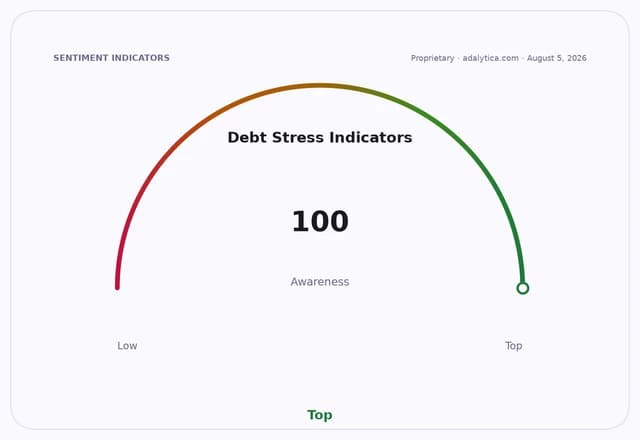
For investors, the more important signal is that credit is increasingly doing the work that cash buffers once did. That tends to support card volumes, loan growth and fee income for lenders in the near term, but it also means the first sign of stress is now likely to show up in delinquencies, charge-offs and tighter underwriting rather than in a sudden collapse in spending. Adalytica’s Household Debt Stress Sentiment stands at 64, down from 79 two days earlier and 100 on Aug. 2, a reminder that market attention to the issue has risen sharply even as the reading remains in neutral territory.
The earnings and trading backdrop from major consumer lenders points to the same dynamic. Capital One, Synchrony Financial and American Express have all reported enough recent resilience in spending and balances to keep investors interested, but their filings also show the industry is watching loan performance closely. Capital One said it “closely monitor[s] economic conditions and loan performance trends” because delinquency rates are a key credit quality indicator for its card, personal loan and retail banking portfolios. American Express reported net write-offs on card balances of $1.207 billion in the second quarter, up 8% from a year earlier, even as it said reserve releases helped offset part of the pressure. Synchrony said loan receivables rose 2.4% to $102.2 billion at June 30, helped by higher purchase volume and the Lowe’s commercial co-branded card portfolio.
That combination — stronger borrowing, weaker savings and still-manageable labor data — is exactly why the story matters economically. It suggests consumption may remain more durable than many feared, but on a less healthy foundation. Instead of financing purchases from income and accumulated deposits, households are using revolving credit, installment loans and buy-now-pay-later products to bridge the gap. That can prolong spending on discretionary goods and services, but it also increases the share of income committed to debt service just as interest rates remain elevated.
The market implications are mixed. Banks and card issuers can benefit if spending stays firm and credit losses remain contained. Shares of Synchrony, Capital One and American Express have all traded with signs of renewed strength recently, with standard technical indicators showing each stock rebounding from earlier weakness. But the bear case is that a prolonged dependence on borrowed money leaves lenders exposed if payroll gains slow, unemployment inches higher or consumers begin to rotate from card usage into delinquency. In that scenario, the same credit growth that supports revenue can quickly become a problem for reserves and earnings.
For now, the thesis is not that consumers have run out of money all at once. It is that the buffer has narrowed enough that borrowing is increasingly substituting for savings, making household demand more fragile and credit conditions more important to the cycle than headline spending data alone.
| Entity | Gains | Losses |
|---|---|---|
| Card lenders | ▲Higher balances and fee income | ▼Higher future charge-offs |
| Consumers | ▲Short-term spending capacity | ▼Savings and financial flexibility |
| Retailers | ▲Near-term sales support | ▼Risk of demand slowdown later |
| Equity investors | ▲Credit-driven earnings resilience | ▼Valuation risk if delinquencies rise |