U.S. industrial production rises 5.8% this year
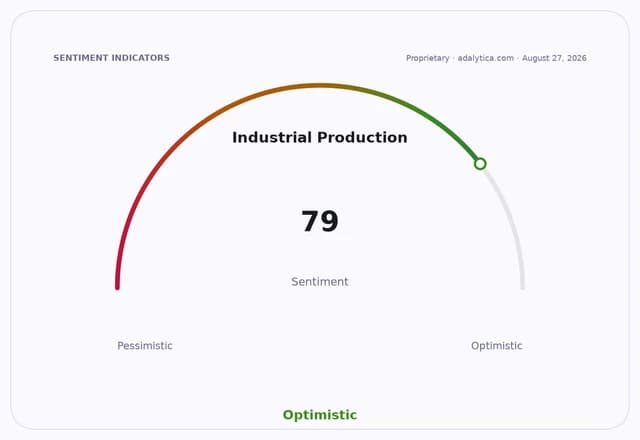
U.S. industrial production is running 5.8% above its level at the start of the year, a sign the factory sector is still expanding even as growth cools and markets debate how long the broader economy can avoid a downturn.
The latest reading points to an economy that is losing some momentum but not rolling over. Industrial production at 102.99 in July was up modestly from 102.51 in May and 102.79 in June, with the August forecast at 103.34 implying another small gain. That leaves output well above the 99.22 seen in January, underscoring that production has recovered far enough to keep industrial activity near multi-year highs rather than slipping into contraction.
That matters because industrial production is one of the cleanest gauges of cyclical demand. When factories, utilities and mines are producing more, it usually means businesses are still seeing orders, supply chains are functioning and capital spending has not frozen. For the U.S. economy, that helps offset pressure from slower hiring and tighter financial conditions. The unemployment rate has edged down to 4.1% from 4.3% in May, suggesting labor markets are still resilient enough to support output, even if the pace of expansion is far from robust.
For investors, the message is more nuanced. The industrials sector, tracked by the XLI ETF, has recovered strongly from the March selloff, rising to 180.34 on Aug. 26 from 146.55 in November and trading above both its 50-day and 200-day moving averages. That argues the market has rewarded companies leveraged to an improving production backdrop. Transportation shares, measured by IYT, have also rebounded sharply and sit above their long-term average, reflecting firmer freight and shipping demand. Materials, via XLB, have been more uneven but have also stabilized after a spring dip, helped by the same production rebound.
The bull case is that a steady rise in industrial output, even if modest, supports earnings for machinery, transport, chemicals and other cyclical sectors without forcing the Federal Reserve into a defensive posture. The bear case is that the gains are too narrow to last if consumer spending softens or if companies pull back on investment after a long period of resilience. The fact that industrial production has edged up month after month suggests the expansion is intact for now, but the pace is not strong enough to remove concerns about a late-cycle slowdown.
That leaves the next few months focused on whether output can keep climbing without a sharper rise in unemployment or a renewed drop in business confidence. If production holds above 103 and labor markets stay near 4%, cyclical assets should continue to find support. If not, this year’s 5.8% gain could prove to be a pause before a broader industrial slowdown.
| Entity | Gains | Losses |
|---|---|---|
| Industrial companies | ▲firmer output and order flow | ▼margin pressure if demand fades |
| XLI holders | ▲stronger cyclical earnings backdrop | ▼setback if growth cools |
| IYT and freight operators | ▲better shipping volumes | ▼weaker volumes if factories slow |
| Consumers and rate-sensitive sectors | ▲steadier labor market | ▼less benefit if industrial demand stalls |