US inflation rises on higher fuel costs
Higher fuel costs are pushing U.S. inflation further away from the Federal Reserve’s target, with consumer prices rising 3.3% in August from a year earlier as more expensive gas lifted the cost of daily life.
That matters because energy is seeping back into the inflation equation at a time when policymakers were hoping price pressures would keep easing. The latest reading suggests households are again paying more at the pump and in turn facing broader knock-on effects across transport, goods and services, making it harder for the Fed to justify rapid rate cuts.

A forecast in the data points to the headline consumer price index rising 0.35% in August after a 0.07% gain in July, while core inflation — excluding food and energy — is expected to rise 0.21% after a 0.22% increase. That combination points to inflation becoming less one-dimensional: gasoline is doing the heavy lifting on the upside, but underlying prices are still not cooling fast enough to restore confidence that inflation is on a clean path back to 2%.
Crude oil’s run toward $100 a barrel has been a key driver, with renewed Middle East tensions tightening the market and pushing West Texas Intermediate sharply higher in early September. The move has already fed through to U.S. energy equities, where the XLE energy sector ETF has climbed to about $64.89, well above its 50-day and 200-day moving averages, reflecting investor bets that higher crude prices will support producer and refining margins. By contrast, consumer staples stocks in the XLP ETF have slipped to about $84.12, suggesting markets are more cautious on companies that typically face limited pricing power when households absorb higher fuel bills.
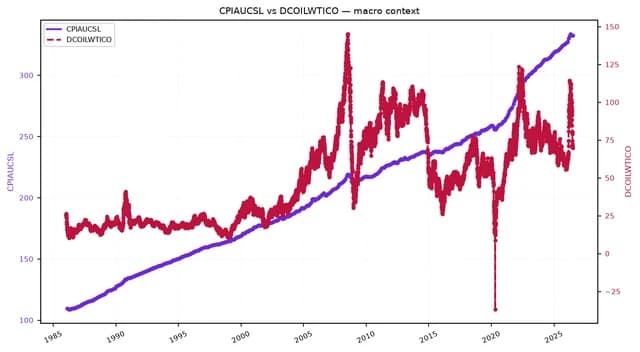
The macro picture is awkward for the Fed. Adalytica’s proprietary snapshot of confidence in the 2% inflation target has slipped, while long-term inflation expectations remain only neutral, indicating investors are not yet fully pricing in a lasting regime shift. Treasury sentiment in the same framework has strengthened, which is consistent with demand for duration if growth weakens, but that also underscores the policy bind: tighter energy-driven inflation can coexist with slowing demand.
For investors, the immediate question is whether the August spike proves temporary or becomes a second-round inflation problem. If oil stabilizes, the headline CPI may settle back toward the core trend. If geopolitical risk keeps crude elevated, the inflation pulse could linger into the fall, limiting bond rallies and keeping rate-sensitive equities under pressure. Winners in the near term are likely to be oil producers and refiners; losers are consumers, importers and any company that depends on lower fuel and freight costs to protect margins.
| Entity | Gains | Losses |
|---|---|---|
| Energy producers | ▲Higher realized prices | ▼Demand risk if oil spikes too far |
| Refiners | ▲Wider product margins | ▼Margin compression if crude volatility persists |
| Consumers | ▲Little near-term benefit | ▼Higher fuel and living costs |
| Fed / bond bulls | ▲Potential growth slowdown support | ▼Less room for rate cuts |