U.S. Job Openings Rise to 7.3 Million
U.S. job openings ticked up to 7.3 million, a sign the labor market is still resilient even as higher borrowing costs and sticky inflation continue to cool some parts of the economy.
That matters because the jobs market is still doing the Fed’s hardest job for it: keeping wages, spending and services demand elevated enough to make a rapid turn toward rate cuts less likely. Openings are not just a feel-good labor statistic; they are a live read on corporate hiring appetite, household income and the degree of slack in the economy. When vacancies remain above 7 million, employers are still competing for workers, which helps preserve wage power and consumer demand, but also keeps pressure on the central bank to avoid easing too early.

The latest reading suggests the slowdown that many investors have been waiting for is still more of a glide than a drop-off. Openings remain well below the 2021 peak above 11 million, yet the level is still historically elevated by pre-pandemic standards. The labor market backdrop is also consistent with an unemployment rate near 4.1%, a pace that points to an economy losing some heat without breaking. Payrolls continue to expand, and the combination of steady employment and still-large vacancy pools is exactly the kind of mix that can keep the expansion alive longer than skeptics expect.
For investors, the message is two-sided. A sturdy labor market supports cyclicals tied to spending, travel, services and industrial demand, while also limiting the odds of a sharp multiple expansion from falling rates alone. That helps explain why economically sensitive ETFs such as XLI and consumer discretionary names like XLY have remained in play even after bouts of volatility. But the real trade is in positioning for a “higher-for-longer” backdrop: companies with pricing power, labor leverage and exposure to capex rather than pure labor intensity are better placed than businesses squeezed by wage costs.
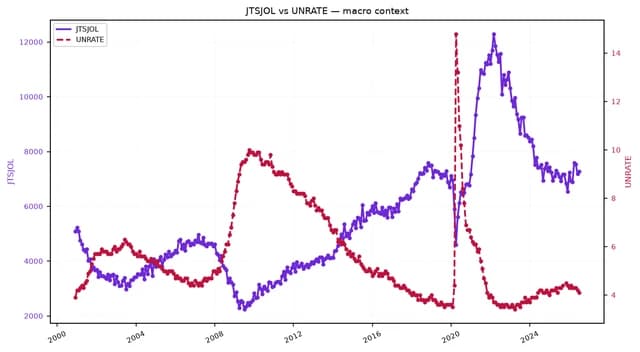
The broader narrative is not that the labor market is overheating, but that it is proving remarkably durable despite tighter financial conditions. That is bullish for revenue growth and corporate earnings at the margin, yet it also means the Fed is unlikely to be rushed into a dovish pivot by weakness in the jobs market. If openings hold near this range, investors should keep leaning into firms that benefit from steady nominal growth and avoid assuming rate cuts will be the next easy catalyst.
| Entity | Gains | Losses |
|---|---|---|
| Workers | ▲Strong bargaining power | ▼Faster easing hopes |
| Employers | ▲Stable demand outlook | ▼Higher labor costs |
| Fed | ▲More room to wait | ▼Less case for quick cuts |
| Cyclicals/XLI | ▲Solid activity backdrop | ▼Rate-sensitive rerating |