U.S. jobs data points to slower hiring

U.S. private and public employment are sending a clear warning: the labor market is no longer a one-way source of economic resilience, and that shift matters for growth, rates and earnings.
Nonfarm payrolls sentiment in Adalytica’s gauge has plunged to 3, or “Extreme Fear,” while the broader job market reading sits at 85, signaling a sharp divergence between headline optimism and underlying hiring stress. That’s the setup investors should care about. When payroll momentum weakens, wage pressure eventually cools, consumer spending loses a tailwind and the case for easy policy gets stronger.
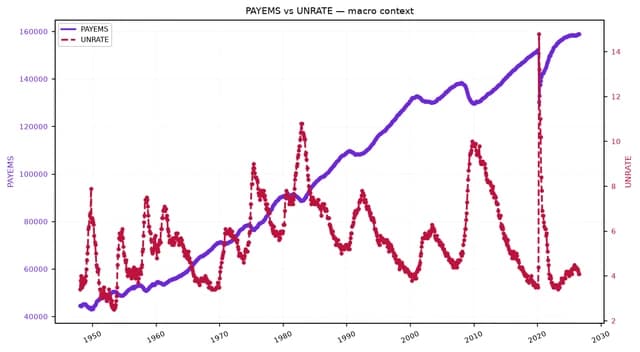
The hard data point in the same direction. U.S. nonfarm employment, measured by the Bureau of Labor Statistics’ PAYEMS series, has edged up to about 159.1 million in the latest available reading, but the pace is barely moving. Job openings have also drifted lower from their post-pandemic surge, with July vacancies at 7.27 million, down sharply from the 2021 peak above 11 million. The unemployment rate has held near 4.1% to 4.2%, which looks stable on the surface, but stable unemployment can mask a slower-moving deterioration in hiring appetite.
That is the part the market often misses. Late-cycle labor softening does not just show up in payroll prints; it shows up first in management behavior. Companies protect margins by freezing hiring, cutting back office staff and, eventually, announcing layoffs. The news flow already reflects that adjustment, with Porsche planning cuts affecting as many as 4,100 workers, while other employers across industries are recalibrating headcount. That is not just a company story — it is a capex and margin story, because labor is one of the biggest operating costs in the economy.
For investors, the implications are immediate. A softer jobs backdrop raises the odds that bond yields stay capped or fall, which favors duration-sensitive assets, rate-cut beneficiaries and quality growth names with long cash-flow runways. It also tilts the field toward sectors with pricing power and away from companies relying on aggressive consumer demand or heavy staffing expansion. If labor cools faster than inflation reaccelerates, the Fed gets room to ease — and that is usually when the market starts to re-rate the most interest-rate-sensitive corners first.
There is a second-order opportunity here as well. Public employment and management spending may be more resilient than private hiring in the near term, but the broader trend is toward lower labor intensity and more automation. That is bullish for software, workflow automation, AI infrastructure and industrial efficiency plays. The companies best positioned are not the ones adding the most workers; they are the ones extracting more output from fewer workers.
Adalytica’s sentiment gauges reinforce that tension. Consumer confidence sentiment is elevated even as payroll sentiment collapses, a classic late-cycle disconnect that can reverse quickly if hiring weakens further. When the labor market loses momentum, households usually notice only after the first few weak prints — and markets tend to price the turn before the headlines catch up.
The actionable takeaway: don’t treat this as a routine employment report cycle. Treat it as an inflection point in the labor-cost regime. I believe the best positioning is in rate-cut beneficiaries, productivity winners and automation enablers, while staying cautious on labor-heavy cyclicals and consumer names that need a still-strong jobs market to sustain upside.
| Entity | Gains | Losses |
|---|---|---|
| Rate-cut beneficiaries | ▲Lower yields | ▼Higher-for-longer risk |
| Automation and AI infrastructure | ▲Productivity demand | ▼Labor-intensive models |
| Quality growth stocks | ▲Valuation support | ▼Wage-cost pressure |
| Labor-heavy cyclicals | ▲— | ▼Margin compression |