US Lawmakers Press Lithuania to Back Taiwan

US lawmakers are pressing Lithuania to stand firm on Taiwan at a moment when the island’s diplomatic support remains a live test of Washington’s ability to rally allies against Beijing.
The appeal matters because Lithuania has become one of the most visible European flashpoints in the contest over Taiwan’s international space. For investors, the issue is less about one small country’s bilateral relationship than about whether the China–West dispute keeps widening into trade, industrial policy and supply-chain risk. With Adalytica’s US–China relations sentiment gauge in “Extreme Fear,” markets are already pricing a high level of geopolitical strain, while the broader global stability gauge sits at “Extreme Greed,” underscoring how quickly policy headlines can destabilize otherwise calm positioning.

Lithuania has been a particular irritant for Beijing since it allowed Taiwan to expand its representative presence, prompting Chinese retaliation that in past episodes has included trade pressure and customs disruption. That makes congressional support for Vilnius economically relevant well beyond diplomacy: it reinforces a signal to companies that the Taiwan issue is now a recurring source of policy risk across Europe, not just in Asia. For multinationals with manufacturing, logistics or sales exposure to China, the risk is not an outright rupture but a steady increase in compliance costs, planning uncertainty and the possibility of retaliatory measures whenever a government deepens ties with Taipei.
For Taiwan, any public backing from US lawmakers helps preserve the island’s external legitimacy at a time when China continues to argue it is not a sovereign state. That matters to investors in Taiwanese assets because diplomatic support can influence market confidence around trade access, technology partnerships and the durability of the island’s role in global semiconductor supply chains. Taiwan Semiconductor Manufacturing Co. remains central to that narrative: its shares have been volatile but resilient, closing at $422.06 on Aug. 11, above both its 50-day and 200-day moving averages, with RSI readings back near neutral after a sharp midsummer selloff. The stock’s recovery suggests investors are still willing to look through geopolitical noise as long as demand for advanced chips holds.
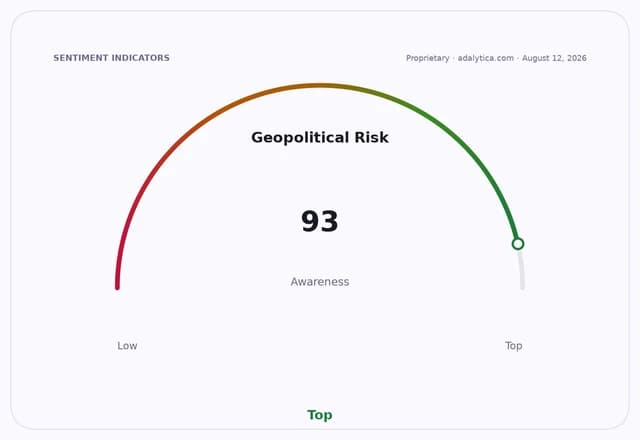
The contrast with Taiwan Semiconductor also highlights the market’s split view. The bullish case is that stronger ties between Taipei, Washington and European partners help diversify political support for Taiwan and reduce the odds of any near-term isolation. The bearish case is that each new show of support invites a sharper Chinese response, keeping a premium on firms exposed to cross-strait risk and leaving governments and companies to navigate an increasingly weaponized diplomatic environment.
US political backing for Lithuania is unlikely to shift the balance of power on its own, but it adds another layer to a broader pattern: the Taiwan question is increasingly being fought through alliances, trade relationships and public statements as much as through military deterrence. For investors, that means the main takeaway is not immediate market impact but the persistence of a geopolitical risk premium that can reprice European, Asian and technology assets quickly whenever Beijing chooses to respond.
| Entity | Gains | Losses |
|---|---|---|
| Taiwan | ▲diplomatic backing | ▼isolation pressure |
| Lithuania | ▲US support | ▼China retaliation risk |
| US lawmakers | ▲anti-China credibility | ▼escalation risk |
| Chinese authorities | ▲none | ▼diplomatic pushback |