US sanctions ICC President Tomoko Akane

The United States has sanctioned International Criminal Court President Tomoko Akane, and Europe is publicly lining up behind the court, sharpening a transatlantic split over international justice and the war in Gaza.
The move matters economically because it raises the risk of a broader diplomatic rift between Washington and key European allies at a time when markets are already sensitive to geopolitical shocks, sanctions policy and cross-border legal exposure. It also underscores how the ICC’s actions against Israeli Prime Minister Benjamin Netanyahu are spilling into relations between the US, Europe and Israel, with potential knock-on effects for trade policy, defense coordination and risk appetite.

The ICC condemned the sanctions as a “blatant attack” on its independence, while the US, backed by Netanyahu, has accused the court of being politically biased. Europe’s immediate support for Akane shows the dispute is not isolated to The Hague but is widening into a test of whether Western allies can maintain a common front on international law.
For investors, the immediate market read is a modest but real increase in geopolitical risk. That typically supports safe-haven demand and weighs on currencies and assets tied to global growth, even if the direct market impact is limited. FX markets reflected that caution, with the euro-tracking FXE ETF edging up to 107.78 and the euro still trading near its 50-day moving average, while broader risk gauges from Adalytica pointed to extreme fear in global stability and the US dollar.
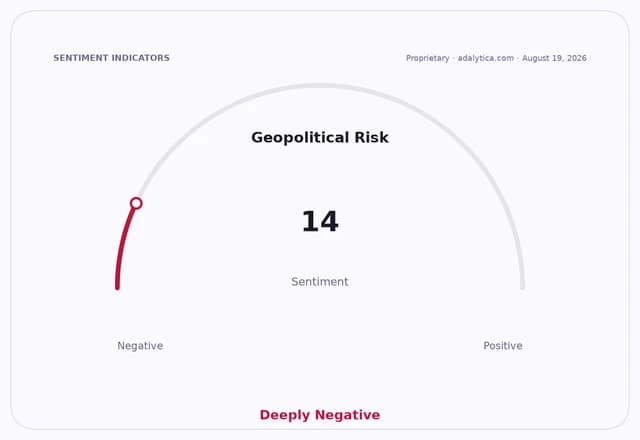
The episode also lands in a market environment where the S&P 500 is near record levels and vulnerable to abrupt swings if tensions widen beyond rhetoric. Any escalation that touches sanctions enforcement, European-US policy coordination or the legal standing of international institutions could add another layer of uncertainty for multinationals, defense firms and investors exposed to the Middle East.
The next catalyst is whether Brussels turns its political support for the ICC into a firmer policy response, and whether Washington broadens sanctions or leaves this as a narrowly targeted signal. The longer the dispute runs, the more it risks feeding into already fragile global stability expectations.
| Entity | Gains | Losses |
|---|---|---|
| ICC and Tomoko Akane | ▲EU political support | ▼US sanctions pressure |
| European Union | ▲Claims rule-of-law stance | ▼Transatlantic friction |
| United States | ▲Signals backing for Israel | ▼Diplomatic credibility in Europe |
| Global investors | ▲Short-term safe-haven demand | ▼Higher geopolitical uncertainty |