U.S. stock futures rise ahead of CPI report

U.S. stock futures rose Friday while oil prices eased, putting markets on edge ahead of an inflation reading that could shape Federal Reserve policy and repricing across stocks, bonds and currencies.
The S&P 500, Dow Jones Industrial Average and Nasdaq futures were all up 0.6%, even as traders weighed renewed fighting in the Middle East and the risk that energy costs could keep consumer prices sticky for longer. Brent crude slipped 3.6% to $103.74 a barrel after briefly topping $108, while U.S. benchmark crude fell 3.4% to $99.02, but both were still up about 8% for the week.

That tension between softer oil and hotter inflation expectations is the market’s central problem. The immediate economic threat is not just the next gasoline print, but the way higher fuel costs seep into freight, shipping, manufacturing and household budgets. Diesel prices hit an all-time average above $6 a gallon on Friday, a level that matters far more to the inflation outlook than headline crude alone because diesel is embedded in the cost of moving nearly everything.
The geopolitical backdrop only sharpens that risk. Yemen’s Houthi rebels seized a strategic island at the Bab el-Mandeb Strait, deepening concern over a chokepoint that helps govern traffic into the Red Sea. The International Energy Agency said Saudi oil output fell to a three-decade low last month because of Houthi attacks on its energy facilities. ING said oil flowing through the Strait of Hormuz remained “well below pre-war levels,” underscoring how fragile supply lines have become.
For investors, the bigger story is that inflation is once again dictating asset allocation. The government is expected to report headline CPI eased to 3.3% from 3.4%, still well above the Fed’s 2% target. That is enough to keep the central bank debating whether to lift rates next week, and enough to keep longer-term yields elevated. The 10-year Treasury yield was around 4.94%, up from 4.83% on Wednesday, as bond markets priced in a more persistent inflation pulse and heavier government borrowing.
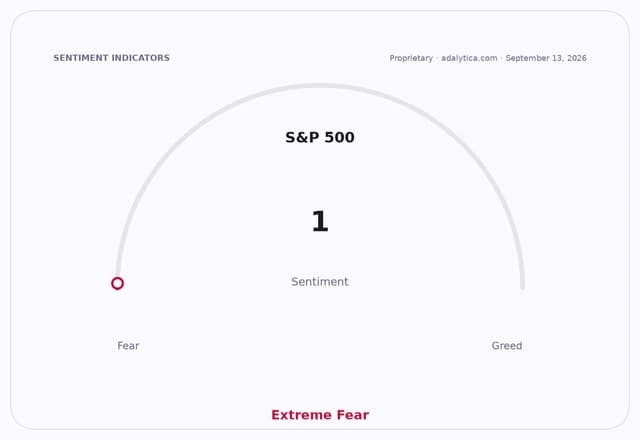
That has direct implications for equity valuations. Higher yields compress multiples, especially for the long-duration parts of the market that have driven much of this year’s gain. The S&P 500’s recent rebound leaves it vulnerable if CPI comes in hot and pushes the Fed toward a more hawkish stance. Adalytica’s S&P 500 trade signals show extreme fear, while its long-term inflation expectations gauge still points to elevated concern that the Fed’s 2% target may not be trusted as firmly as officials would like.
The investment takeaway is clear: the market is not just trading a single CPI print, it is trading whether inflation re-accelerates from energy and whether the Fed stays restrictive for longer. That favors energy producers, select commodity-linked names and inflation hedges, while pressuring rate-sensitive equities, long-duration bonds and highly valued growth stocks if yields keep climbing. If Friday’s report confirms inflation remains sticky, the next move may be less about relief and more about a renewed scramble for protection.
| Entity | Gains | Losses |
|---|---|---|
| Energy producers | ▲Higher realized prices | ▼Consumer demand |
| Inflation hedges | ▲Renewed demand | ▼Real yields |
| Long-duration bonds | ▲None | ▼Price pressure from higher yields |
| Rate-sensitive growth stocks | ▲None | ▼Multiple compression |