U.S. Stocks Enter Key Week as Yields Stay High

U.S. stocks are edging into a pivotal week with investors balancing a recent rebound against the risk that the next macro data and policy signals could reset expectations for rates and earnings.
The market backdrop is one of uneasy stability rather than conviction. The S&P 500 ETF SPY closed at 764.11 on Aug. 24, holding well above its 200-day moving average of 705.45, while the Nasdaq-100 tracking ETF QQQ ended at 707.99, also above its 200-day average. The Russell 2000 ETF IWM, however, finished at 297.95, only modestly above its 200-day level of 269.41, underscoring that smaller companies remain more exposed to financing costs and a slower-growth backdrop.

The bigger issue for investors is not the day-to-day drift in equities but the macro crosscurrents underneath it. The 10-year Treasury yield was around 4.69% on Aug. 20, with a forecast near 4.675% for Aug. 21, keeping borrowing costs elevated by historical standards. At the same time, the labor market is still cooling only gradually, with the unemployment rate forecast at 4.09% for August after June and July readings of 4.2% and 4.1%, while inflation remains sticky enough to keep the Federal Reserve on alert. Core pricing pressure may have eased from the peak, but the CPI series still points to an economy where disinflation is incomplete and policy easing is not assured.
That matters because equities have been trading on the assumption that growth can stay intact while yields avoid another leg higher. The recent technical setup reflects that tension. SPY’s RSI was 41.1 on Aug. 24, down sharply from 62.9 four days earlier, suggesting the rally has lost momentum even though the index remains above its long-term trend. QQQ’s RSI slipped to 37.8 from 58.0 over the same stretch, indicating a pullback in large-cap technology sentiment after the sector had led the summer advance. IWM’s RSI at 43.3 points to a market that is still functioning, but without the kind of broad conviction that would normally carry a week heavy with Fed scrutiny and economic releases.
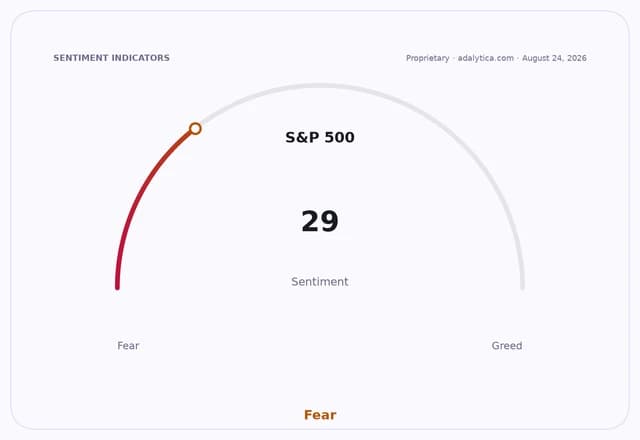
The bond market’s message is equally important. Adalytica’s U.S. Treasury bonds trade signal shows sentiment at 6, or “Extreme Fear,” with awareness at 100, suggesting a market that is highly attuned to rate risk even as conviction remains poor. The U.S. dollar is showing a similar strain, with Adalytica sentiment at 1, also “Extreme Fear,” while awareness sits at 100. That combination usually signals a market waiting for a catalyst rather than one that has fully priced it.
For investors, the key question is whether the week’s events confirm the soft-landing narrative or force a rethink on rates and valuation. A benign inflation print or dovish Fed communication would support cyclicals, small caps and rate-sensitive parts of the market, while easing pressure on long-duration growth stocks. A hotter-than-expected reading, or any sign that the labor market is not cooling enough to justify near-term cuts, would likely push yields higher and tighten financial conditions further, especially for smaller firms and unprofitable tech names.
The broader narrative is that U.S. equities are not being driven by a fresh earnings shock or a single corporate headline, but by the market’s attempt to price a delicate macro balance: inflation that has cooled but not vanished, growth that is slowing but not breaking, and Treasury yields that remain high enough to cap risk appetite. If that balance holds, stocks can consolidate near record territory. If it does not, the summer rebound could prove fragile.
| Entity | Gains | Losses |
|---|---|---|
| Large-cap growth stocks | ▲Lower yields and easier policy | ▼Higher discount rates |
| Small-cap stocks | ▲Softer financing conditions | ▼Elevated borrowing costs |
| Treasury bonds | ▲Safe-haven demand | ▼Rising inflation surprises |
| U.S. dollar | ▲Stronger growth scare demand | ▼Softer rate expectations |