US Treasuries Get Buyback Support, Stablecoin Bill Demand

Long-dated US Treasuries are getting a clearer backstop from the government just as stablecoins are emerging as a growing source of demand for short-term bills, sharpening a divide in the bond market that matters for borrowing costs, bank balance sheets and investors’ duration bets.
The Treasury’s buyback program for long-term debt has doubled, helping to support liquidity in older issues and ease pressure in the 10-year sector, while the front end is seeing fresh inflows from digital-asset cash pools that need a home in highly liquid government paper. The combination points to a market where policy support, private-sector cash management and crypto adoption are all starting to shape Treasury demand at different points on the curve.
That split matters economically because it affects how the US finances itself. Stronger demand for short maturities can help keep the government’s funding machine running smoothly even when private investors are cautious about duration, while buybacks of long bonds can improve market functioning and reduce trading frictions in the less liquid corners of the Treasury market. It also reinforces the idea that the Treasury curve is being pulled by two different forces: one driven by fiscal management and another by the plumbing of the digital-asset economy.
The move comes against a backdrop of still-elevated yields. The 10-year Treasury was around 4.64% to 4.70% in recent sessions, with the two-year near 4.17% to 4.24%, leaving the curve only modestly positive after a long period of inversion. That suggests investors still want compensation to hold longer-dated debt, even as the Treasury’s buyback operations help support secondary-market liquidity. Long-duration exchange-traded funds have reflected that tension: TLT, which tracks longer Treasury bonds, has been trading below both its 50-day and 200-day moving averages, while the conventional RSI readings and MACD remain only modestly constructive, signaling a market still searching for a durable trend.
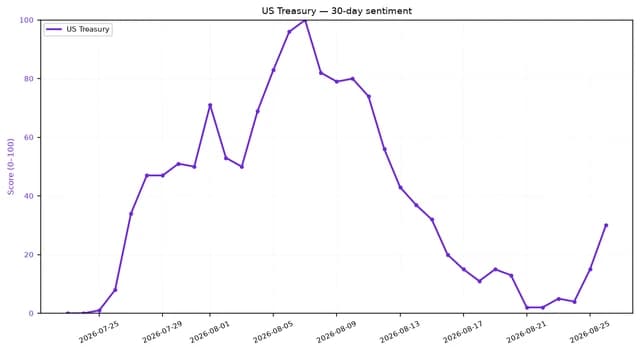
Stablecoins add a different kind of demand. Reserves backing those tokens are typically parked in short-dated Treasury bills and other cash-like instruments, turning crypto growth into a structural bid for the front end of the curve. That matters because it broadens the buyer base at a time when traditional cash investors are scrutinizing yield and liquidity trade-offs more carefully. It also gives the government another source of demand for bills that is less tied to bank deposit behavior and more tied to the velocity of digital transactions.
For investors, the implications are twofold. Bond bulls can point to Treasury buybacks and evidence that some large market participants are turning more constructive on long rates as support for duration. Bond bears, however, can argue that stablecoin demand concentrates in short paper and does little to relieve pressure on the long end, where fiscal supply, term premium and inflation risk still dominate. The result is a curve that may stay uneven even if the front end enjoys recurring support.
The broader narrative is that Treasury demand is fragmenting by maturity. Long bonds are leaning on official support, bills are gaining a new buyer class, and intermediate maturities sit somewhere in between. If stablecoin adoption keeps expanding and Treasury buybacks remain active, the market could become more segmented, with greater implications for curve positioning, funding conditions and the relative appeal of long-duration assets versus cash substitutes.
| Entity | Gains | Losses |
|---|---|---|
| US Treasury | ▲Better market liquidity | ▼Less reliance on long-bond buyers |
| Stablecoin issuers | ▲Easier reserve placement | ▼Greater scrutiny of reserves |
| Bill investors | ▲New demand source | ▼Lower reinvestment yields over time |
| Long-duration bond holders | ▲Buyback support | ▼Persistent term-premium risk |