U.S. Treasury 3-year note auction draws solid demand

The U.S. Treasury’s $58 billion sale of three-year notes drew average but adequate demand, with investors accepting a 4.474% yield that landed almost exactly where the issue was trading beforehand.
That tight pricing matters because it suggests the market is still willing to finance Washington’s borrowing needs without demanding a meaningful concession, even as Treasury yields remain elevated and the Fed’s policy rate sits at 3.63%, keeping short-dated debt attractive for cash-rich buyers.

The auction’s bid-to-cover ratio came in at 2.72 times, above the 2.62 average, while domestic buyers took 26.9% of the issue, well above their 20.4% norm. Indirect bidders, a proxy for overseas demand, bought 64.2%, just under average, and dealers were left with 10.9%, below the historical 14.1%.
For investors, the result reinforces the view that Treasury supply is still being absorbed, though not with the kind of aggressive bidding that would point to strong conviction. That leaves yields vulnerable to the next macro catalyst, especially inflation data and Federal Reserve expectations, with the 10-year Treasury yield near 4.78% and the two-year at 4.37%.
The tone of the auction also matters for rate-sensitive ETFs and bond portfolios. IEF and TLT were both firmer in recent sessions, but technical readings show momentum has softened, with TLT slipping back toward its 50-day moving average and RSI readings cooling, suggesting the market is not yet pricing a sustained rally in longer-dated bonds.
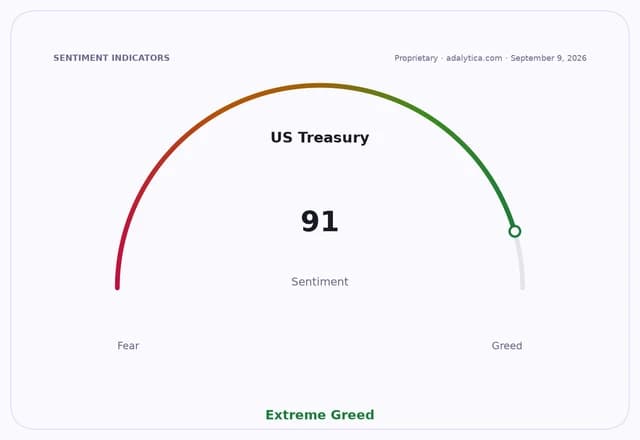
Adalytica’s Treasury bond trading signal remains in “Extreme Greed” territory, underscoring how crowded the view on Treasury strength has become even as market expectations for Fed moves stay neutral. The next test comes with the Treasury’s remaining auctions this week and any shift in inflation or policy expectations that could force buyers to demand a higher yield.
| Entity | Gains | Losses |
|---|---|---|
| Treasury buyers | ▲Higher yields, solid allotment | ▼Little concession on pricing |
| U.S. Treasury | ▲Funding raised efficiently | ▼Must keep issuing into high-rate market |
| Bond investors | ▲Attractive carry | ▼Mark-to-market risk if yields rise |
| Treasury dealers | ▲Smaller allocation | ▼Less inventory to distribute |