US Treasury Auctions Face Demand Test

US government borrowing costs are still elevated enough to make tomorrow’s two Treasury auctions a live test of investor appetite, with the 10-year yield near 4.7% and the 2-year around 4.2% ahead of fresh supply.
The auctions matter because they come at a time when the market is still trying to reconcile sticky inflation, a heavy funding calendar and the Federal Reserve’s higher-for-longer policy stance. At current levels, the Treasury market is pricing borrowing costs that remain close to multi-decade highs by recent standards, keeping pressure on rate-sensitive assets and the broader cost of capital.
The 10-year yield was last seen at 4.63% on Aug. 13, with a forecast of 4.652% for Aug. 14, while the 2-year stood at 4.15%, leaving the curve modestly positive at about 51 basis points. That slope suggests traders still expect some easing over time, but not enough to pull long-term yields materially lower in the near term. For the Treasury, that makes demand at auction crucial: weak bids can push yields higher and deepen volatility across bonds, mortgages and equities.
Bond ETFs have already reflected the strain. The iShares 20+ Year Treasury Bond ETF, TLT, closed at 82.04 on Aug. 14, below its 50-day moving average of 84.08 and 200-day average of 85.24. Its relative strength index was 38.9, a reading that points to persistent technical weakness but not yet a full capitulation. The iShares 7-10 Year Treasury ETF, IEF, ended at 93.04, also below its 50-day and 200-day averages, indicating that investors remain wary of locking in duration ahead of supply.
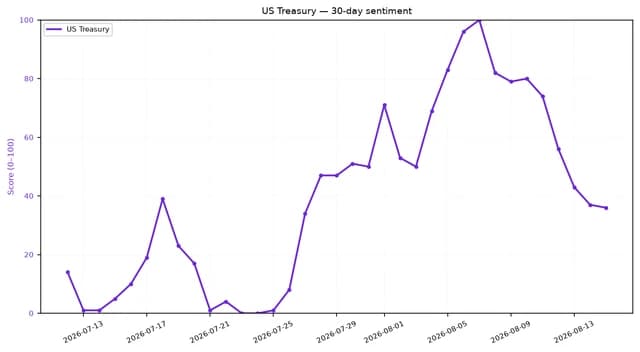
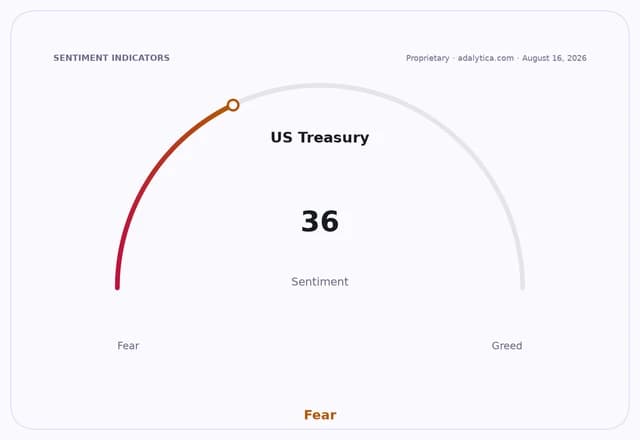
Adalytica’s Treasury bond trade signals show sentiment on TLT at 36, described as neutral, but awareness at 88, labeled extreme greed, implying the issue is drawing intense attention even as conviction remains mixed. The dollar signal is also neutral, underscoring that the next move in yields could spill quickly into foreign exchange and broader risk assets.
For investors, the key question is whether domestic and foreign buyers will absorb the new supply without forcing concessions in yield. A solid auction would help stabilize the curve and support long-duration bonds, while a poor one would likely reinforce the view that term premium is rising as the market demands more compensation to hold long-dated US debt.
The broader implication is that Treasury auctions are no longer routine funding events; in the current rate environment, they are market-moving data points. Tomorrow’s sales will help determine whether the recent backup in yields is settling into a new range or has room to climb further.
| Entity | Gains | Losses |
|---|---|---|
| Treasury | ▲funds deficit smoothly | ▼pays up if demand is weak |
| Bond buyers | ▲higher yields if auction tails | ▼mark-to-market losses if yields rise |
| TLT and IEF holders | ▲rally if bids are strong | ▼pressure if supply clears poorly |
| Equities and mortgage borrowers | ▲relief if yields fall | ▼higher discount and financing costs |