USD/JPY Outlook Ahead of Fed, ECB and BOJ Meetings

A rare three-way policy week from the European Central Bank, the Federal Reserve and the Bank of Japan is setting up the biggest near-term catalyst for USD/JPY, with the yen’s recent rebound, Treasury yields and risk assets all hanging on the outcome.
The dollar has already slipped more than 7 yen since the start of September, leaving USD/JPY near 153.5 and traders waiting for confirmation that the Fed, ECB and BOJ are all moving in directions that matter for the carry trade. That makes this more than a foreign-exchange headline: it is a test of whether the market’s long-running dollar strength and yen weakness regime is finally starting to crack.

The most important shift is in expectations around interest-rate differentials. Europe’s central bank may raise rates by 25 basis points on inflation pressure from higher energy costs, while the Fed is widely expected to tighten again after stronger-than-forecast US jobs data. Japan, meanwhile, is edging toward further normalization, with BOJ policymaker Masuichi Masuichi saying more rate increases are needed to complete that process.
That combination matters because USD/JPY is not just a currency pair; it is one of the market’s cleanest expressions of global yield spreads. If the Fed delivers another hike while the BOJ keeps signaling gradual normalization, the yen may stabilize rather than resume a one-way decline. If the BOJ sounds more hawkish than expected, the move could accelerate, especially with the pair already below its 50-day moving average of 159.84 and its 200-day moving average of 158.41. Momentum indicators reinforce the pressure: RSI readings have fallen to about 23, a level that often reflects an oversold market, but not one that prevents further near-term moves if policy surprises line up against the dollar.
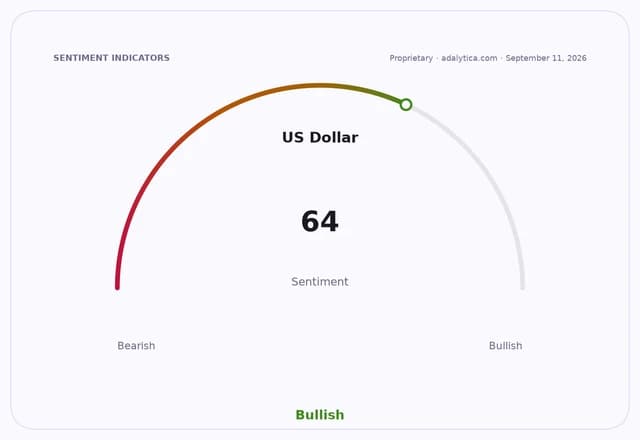
For investors, the consequences extend well beyond FX desks. A stronger yen tends to weigh on Japan’s exporters and can compress overseas earnings translations, while easing pressure on imported energy and commodities. It also changes the funding math that has powered carry trades across global assets. The recent slide in USD/JPY has coincided with a sharp bid in safe havens, and Adalytica’s US Dollar Trade Signals show sentiment still neutral even after a 3% drop over the past week, suggesting the market has not yet fully repositioned for a deeper dollar correction.
Gold is one of the clearest beneficiaries. When rates rise but real policy credibility improves, gold can still hold up if investors conclude the dollar cycle is past its peak and central banks are nearing the end of their hiking runway. That helps explain why the metal and Bitcoin both rallied hard in August: they are increasingly being treated as alternative stores of value in a world where policy risk remains elevated and fiat currency volatility is back in focus. Adalytica’s FX safe-haven gauge shows extreme fear in recent days, a backdrop that usually supports bullion demand.
Bitcoin is the higher-beta expression of the same trade. Its latest move around $77,000 shows it remains sensitive to dollar and liquidity expectations, but the bigger thesis is that looser financial conditions down the road and persistent geopolitical strain can keep capital flowing into hard assets. The token’s 50-day and 200-day moving averages, both around $70,000, are still well below spot, underscoring that the long-term trend remains intact despite short-term volatility.
The market is underestimating how much this central-bank week can reset positioning. If the ECB, Fed and BOJ all lean hawkish, the easy dollar trade may pause, but the more important outcome is likely a continued grind lower in USD/JPY as Japan inches away from ultra-loose policy. That would keep pressure on exporters, support gold, and leave Bitcoin as the market’s most aggressive hedge against a late-cycle policy pivot.
For investors, the actionable takeaway is clear: this is the week to watch for a break in the dollar-yen regime, with gold exposure and select Bitcoin-linked assets positioned to benefit if the BOJ moves toward normalization faster than the market expects.
| Entity | Gains | Losses |
|---|---|---|
| Japanese yen | ▲Higher rate expectations | ▼Dollar strength |
| Gold | ▲Safe-haven demand | ▼Higher real yields |
| Bitcoin | ▲Hedge flows, liquidity hopes | ▼Dollar rebound |
| Japanese exporters | ▲None | ▼FX translation pressure |