USDCAD Near 1.3817 as Canada Resilience Supports CAD
The US dollar’s near-term path against the Canadian dollar is being driven less by sentiment and more by a narrower macro spread: Canada’s economy is proving resilient while US rate markets are still repricing the outlook, keeping the 1.3817 level in play for traders.
That matters because the pair is a clean expression of two of the market’s most important forces right now — relative growth and relative yields. US 10-year Treasury yields have steadied around 4.65%, with the latest forecast at 4.652%, while the 10-year minus 2-year curve has inched back to about 0.51 percentage point, a sign the market is still trying to balance slower growth expectations against the possibility that policy stays restrictive for longer. For currency investors, that combination usually supports a stronger dollar in the short run, but only if domestic data and risk appetite do not offset it.
Against that backdrop, the Canadian dollar has been firming. The currency’s broader proxy, the iShares MSCI Canada ETF, has risen to 70.38 from 69.39 earlier in the month, while technical readings show it above both its 50-day and 200-day moving averages and with RSI stretched to 78.5, indicating momentum has improved sharply. In FX terms, that does not guarantee further gains, but it does show CAD is not trading like a weak commodity-linked currency in the near term.
The fundamental case for CAD has some support. Canada’s manufacturing revenue hit a record C$235.1 billion in the second quarter of 2026, according to the news context, suggesting domestic activity is still expanding despite trade pressure. That resilience matters because Canada’s currency often benefits when investors see the economy absorbing external shocks better than expected. It also helps explain why the market is willing to test lower USDCAD levels even as the US dollar remains underpinned by higher yields.
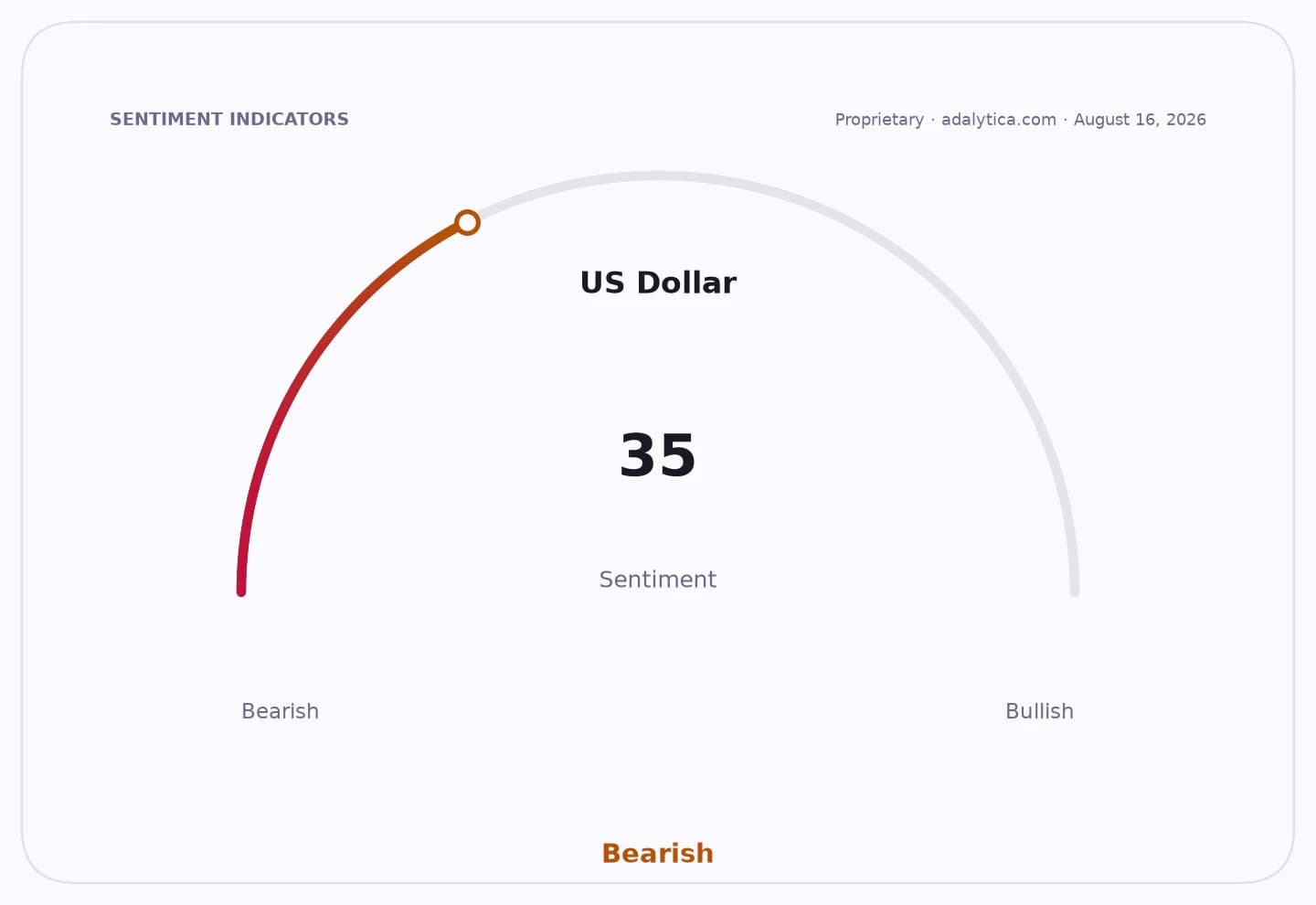
Adalytica’s US dollar trade signals point in the same direction. The dollar snapshot shows sentiment at 35, labeled neutral, down 13 points on the day and 49 points over seven days, while awareness remains elevated at 72, implying the move is attracting attention even as conviction fades. The Chinese yuan sits on the other side of the broader risk equation with stronger sentiment, and the S&P 500’s broadening rally suggests investors are comfortable moving beyond defensive dollar positioning. That backdrop is not directly a Canada story, but it does reduce the urgency of holding safe-haven dollar exposure.
For investors, the key question is whether 1.3817 becomes a magnet or a floor. A break lower would reinforce the view that CAD strength is more than a short-covering bounce and could extend if US yields ease or Canadian data continue to outperform. A failure to hold that level, by contrast, would suggest the dollar still has enough yield support to reassert itself, especially if market volatility picks up or tariff headlines revive demand for US assets.
The near-term narrative is straightforward: Canada’s improving economic backdrop and firmer risk tone are meeting a US dollar that is still supported by yields but losing some momentum. That keeps the pair balanced around 1.3817, with the next move likely to come from whether rates or growth surprises dominate.
| Entity | Gains | Losses |
|---|---|---|
| Canadian dollar | ▲Near-term momentum | ▼USD buyers |
| US dollar | ▲Higher yields support | ▼Broad risk-on flows |
| Canada economy | ▲Strong manufacturing | ▼Exporters facing tariffs |
| USDCAD bears | ▲Lower pair target | ▼Breakout traders |