Vietnam Reaffirms UNCLOS, Pressuring China Exposure

Vietnam’s reaffirmation that the U.N. Convention on the Law of the Sea is the sole legal basis for maritime zones is more than a diplomatic anniversary statement: it is a direct challenge to China’s expansive claims in the South China Sea and a reminder that the region’s most important legal dispute is still unresolved a decade after the 2016 arbitration ruling.
That matters because maritime law is not an academic debate in Asia’s busiest shipping lane. It shapes who controls fisheries, offshore energy blocks, undersea cables and sea routes that carry a huge share of global trade. The stronger the push to anchor claims in UNCLOS, the harder it becomes for Beijing to normalize faits accomplis through patrols, dredging and island-building. The message from Hanoi, backed by a broader coalition of countries, is that China’s claims remain politically contested and legally isolated even as it keeps testing boundaries on the water.
For investors, the significance is twofold. First, sustained friction in the South China Sea is a structural tailwind for defense, maritime surveillance, cybersecurity and critical infrastructure spending across Asia. Second, it raises the geopolitical discount on China-exposed assets even when headlines fade. The market has been quick to treat these flare-ups as noise, but the latest stance from Vietnam underscores that the legal and strategic contest is hardening, not healing.
That backdrop helps explain the divergent behavior in emerging markets. China-linked exposure remains under pressure: FXI has slid to about 33.48, well below its 200-day moving average around 37.33, while the 50-day average near 34.74 points to a market still leaning defensive on Chinese equities. EEM, by contrast, has held up far better at 66.90, above both its 50-day and 200-day averages, suggesting investors are willing to own emerging markets selectively while avoiding the more geopolitically fraught China trade. Technical readings also reflect the split: FXI’s RSI near 52 shows no decisive recovery, but the broader downtrend remains intact.
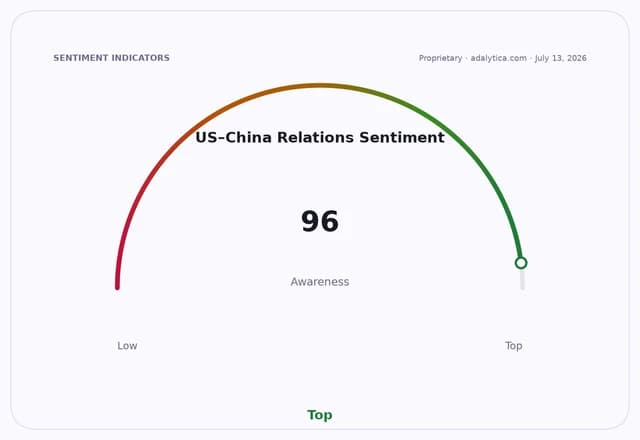
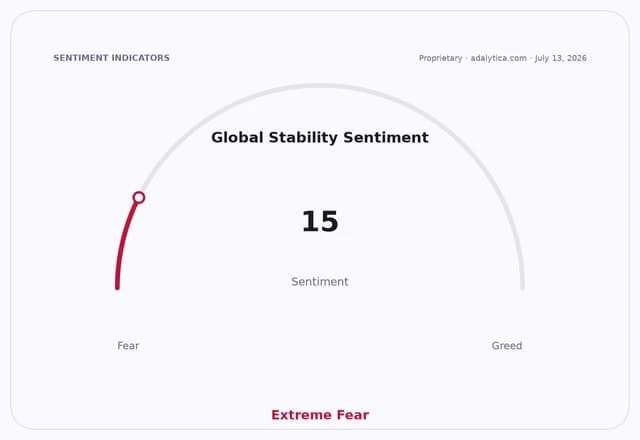
The message from Adalytica’s Global Stability and US-China Relations gauges is even clearer: fear around geopolitical stability is elevated, and US-China sentiment has collapsed into extreme fear. That kind of backdrop rarely stays confined to one dispute. It feeds through supply chains, capital allocation and risk premia, especially for companies tied to ports, shipping, offshore drilling, semiconductors and Asian manufacturing corridors that depend on uninterrupted sea lanes.
The market is still missing the second-order winners. I believe the best positioned names are not the headline-sensitive China proxies, but the toll roads of the new geopolitical order: defense contractors, naval systems suppliers, marine surveillance providers, LNG and energy infrastructure plays, and select Asian industrials tied to supply-chain resilience. ETFs with broad emerging-market exposure may keep working, but the real asymmetric upside sits in companies that benefit when governments spend to deter coercion rather than simply react to it.
Vietnam’s message is therefore not just about the past ruling’s symbolism. It is a forward signal that the South China Sea dispute will keep channeling capital toward security, redundancy and hard infrastructure. Investors who wait for a clean resolution are likely to miss the bigger trade: a prolonged standoff that keeps raising the value of geopolitical insurance.
| Entity | Gains | Losses |
|---|---|---|
| Vietnam and UNCLOS-aligned states | ▲Legal backing, diplomatic leverage | ▼Risk of Chinese retaliation |
| Defense and maritime security firms | ▲Higher procurement demand | ▼Little downside |
| China’s maritime claims | ▲None | ▼Greater isolation, higher risk premium |
| China-exposed equity proxies like FXI | ▲Selective trading bounce only | ▼Persistent valuation drag |