Visa Breaks Out as Payments Demand Holds Up
Visa is breaking out to record territory, and the move matters because it says investors are still willing to pay up for the highest-quality toll roads on the global consumer economy even as spending sentiment remains fragile.
Shares of Visa closed at $384.14 on Aug. 25, just below their intraday high of $384.20, after a powerful run that has lifted the stock well above both its 50-day and 200-day moving averages. The technical backdrop is supportive: the stock’s RSI reading of 64.9 shows momentum without yet looking stretched, while the MACD remains positive. In market terms, that is what leadership looks like.
The economic case is straightforward. Visa makes money when consumers and businesses keep transacting, and the latest company filings showed U.S. net revenue rising 12% in the latest quarter, supported by cross-border ecommerce and travel-related activity. That combination is important because it points to a payments cycle with multiple legs: domestic spending, international travel, and online commerce. When those engines are all working at once, Visa has historically translated volume growth into durable earnings power.
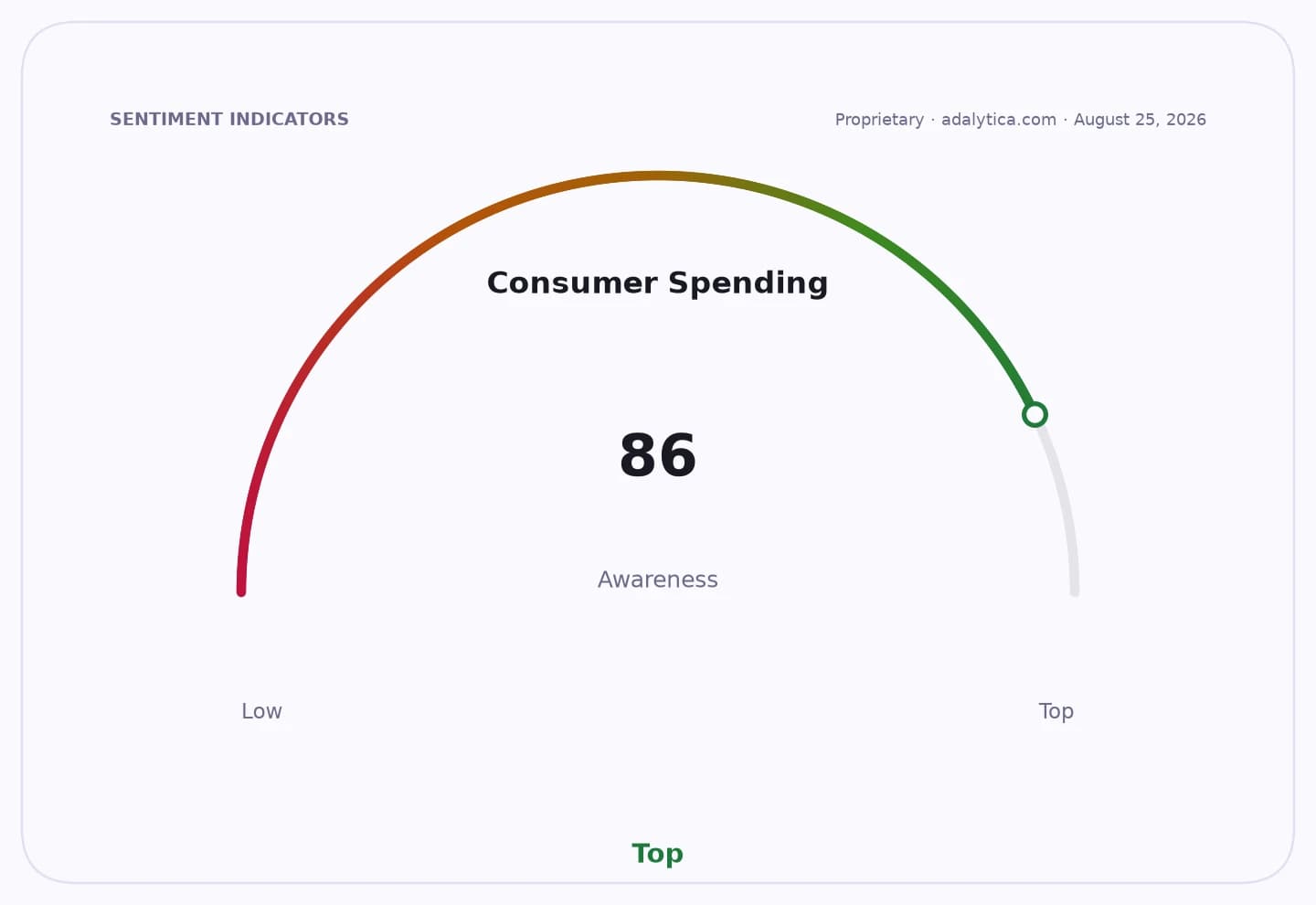
What the market is really pricing in is not just a good quarter, but the idea that payment networks remain insulated from the kind of demand shocks that hit lenders, merchants and consumer discretionary names first. That’s where the investing opportunity sits. Visa does not need a booming economy to win; it needs only stable employment, steady transaction counts and a continued shift away from cash. In a world where consumer sentiment can swing sharply — Adalytica’s consumer spending gauge is now in “Extreme Fear” even as awareness remains elevated — the resilience of card rails becomes more valuable, not less.
That makes Visa a cleaner way to play the consumer than direct retail, and arguably a better structural bet than many fintech names that still rely on heavy incentives, credit risk or balance-sheet exposure. Mastercard, which has also shown robust payment-network growth in recent filings, remains the closest comparator, but Visa’s scale and brand dominance keep it at the center of the secular move from cash to digital payments. PayPal has staged a sharp rebound too, yet its path is more complicated because it faces more direct competition and a less pristine growth profile.
The broader thesis is that investors are underestimating how much payment infrastructure benefits from the next phase of global commerce: more cross-border travel, more ecommerce, more account-to-account digitization and more embedded payments. Those are multi-year tailwinds, not quarter-to-quarter noise. If spending broadens and international activity keeps recovering, Visa should keep compounding with far less drama than the average large-cap growth stock.
For investors, the takeaway is simple: Visa’s breakout is not just a chart event. It is the market reaffirming that premium franchises tied to the movement of money deserve a premium multiple when the macro backdrop is uncertain. I believe pullbacks remain opportunities to build exposure to Visa as a secular winner in digital payments, especially if consumer spending stabilizes into year-end.
| Entity | Gains | Losses |
|---|---|---|
| Visa | ▲Higher transaction volumes | ▼Cash-dependent payment flows |
| Mastercard | ▲Sector multiple expansion | ▼Smaller share of card growth |
| PayPal | ▲Rising digital commerce tide | ▼Margin pressure from competition |
| Cash-heavy merchants | ▲Fewer payment frictions | ▼Lost interchange and network leverage |