Walmart Pullback Draws Retail Investors After Earnings

Retail investors are moving back into Walmart after a sharp post-earnings reset, betting the world’s biggest retailer can keep winning even as the stock gives up altitude from its 2026 peak.
That matters because Walmart sits at the center of two powerful forces investors care about most right now: resilient consumer demand and the hunt for earnings visibility. In a market where consumers are strained and discretionary names are wobbling, Walmart’s ability to keep traffic, protect share and monetize its scale is exactly the kind of defensive growth story that can attract fresh money when sentiment gets washed out.

The setup is notable. Walmart shares closed at $102.73 on Aug. 27, down from $105.38 two days earlier and well below the Feb. 6 high of $130.35. The stock is now trading under its 50-day moving average of $112.06 and below the 200-day average of $118.03, a sign the market has already punished the name despite its long-term operating strength. Technical readings also show the selloff is stretched, with RSI at 32.1, near oversold territory, while the stock’s MACD remains negative.
For investors, that combination is the real story: a fundamentally high-quality retailer has been repriced as if growth is broken, even though Walmart remains one of the clearest beneficiaries of a cautious consumer. The company has been leaning into higher-margin businesses, including digital advertising, and has repeatedly highlighted operating leverage as it expands beyond low-margin merchandise. Its e-commerce contribution at U.S. Walmart and Sam’s Club also remains a meaningful offset to price pressure in core retail.
The broader retail tape reinforces the point. Target has been much more volatile, while Costco has held up better but is now also off its recent highs. Walmart, by contrast, looks like the classic “buy the dip” large-cap consumer defense: not the fastest stock in the group, but the one with the strongest mix of scale, traffic and earnings durability if spending weakens further.
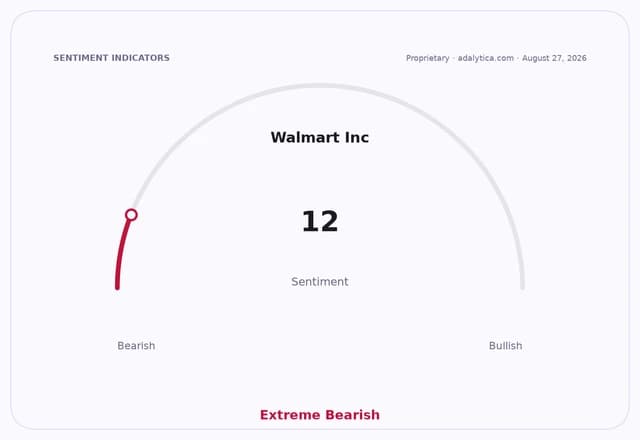
Adalytica’s Walmart Earnings Sentiment gauge is flashing “Extreme Fear” even as awareness remains “Extreme Greed,” a classic setup for bargain hunters to step in before sentiment normalizes. That disconnect is exactly where opportunity often appears in mega-cap retail: when the business stays solid but the tape gets punished faster than the fundamentals.
My view is that the market is underestimating how much value Walmart can compound from here if consumer stress persists. If households keep trading down, Walmart keeps taking share. If inflation stays sticky, Walmart’s supply-chain muscle and pricing power matter. And if management keeps scaling higher-margin digital and advertising revenue, the earnings mix improves in a way the market can re-rate quickly.
For investors looking for a defensive compounder with an asymmetric rebound setup, Walmart belongs on the watchlist now. The near-term catalyst is simple: any sign that post-earnings selling has been overdone could pull capital back into one of the market’s most reliable secular winners.
| Entity | Gains | Losses |
|---|---|---|
| Walmart | ▲Retail inflows, valuation reset | ▼Short-term momentum traders |
| Bargain hunters | ▲Lower entry point | ▼Late buyers near highs |
| Consumer-staples peers | ▲Sector rotation support | ▼Slower relative inflows |
| Target | ▲Less direct pressure from rotation | ▼Share against Walmart share gains |