Walmart Sales Miss Highlights E-commerce and Ads Mix

Walmart’s latest sales miss is drawing more attention to the retailer’s changing business mix than to the headline number itself, as investors look past a softer near-term read on spending toward a company increasingly powered by e-commerce, advertising and grocery.
The stock has still held near the top of its range, with shares at $106.49 on Aug. 24 after touching $131.46 in April and $103.59 last week, reflecting a market that is still paying for Walmart’s defensive scale even as momentum indicators cool. The 50-day moving average has slipped to $113.06, while the shares sit below that level and the 200-day average of $117.98, a sign the post-earnings move has not fully repaired the longer-term technical damage.
What matters economically is that Walmart is no longer just a barometer for cheap-staples demand. The company’s 10-Q said it is focusing on expanding higher-margin businesses such as digital advertising and on growing operating income faster than net sales, underscoring a shift from pure traffic and ticket growth toward mix-driven profitability.
That shift is important for a company whose core role in the economy is to absorb pressure from households stretched by prices and interest rates. A sales miss can still point to cautious consumers, but Walmart’s ability to lean on online fulfillment, marketplace services and ads helps cushion margins and makes the business less dependent on discretionary spending than peers.
Investors are watching the same transition in its rivals. Target has rallied sharply, with shares at $169.89 on Aug. 24 and up more than 70% from its May low, while Amazon has also remained strong at $262.07 despite recent volatility. The contrast highlights how retail winners are increasingly being judged not just on store sales, but on how much profit they can squeeze from digital ecosystems and omnichannel reach.
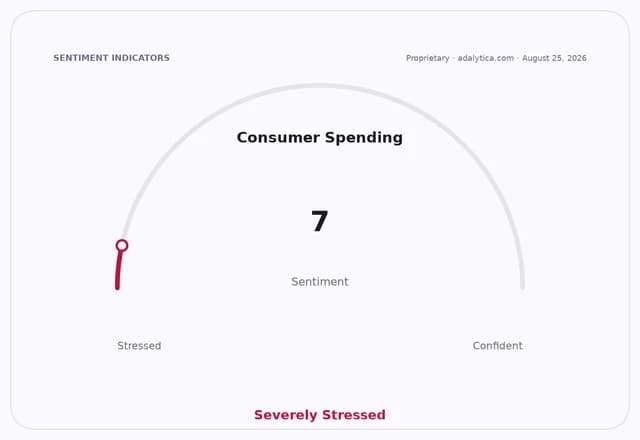
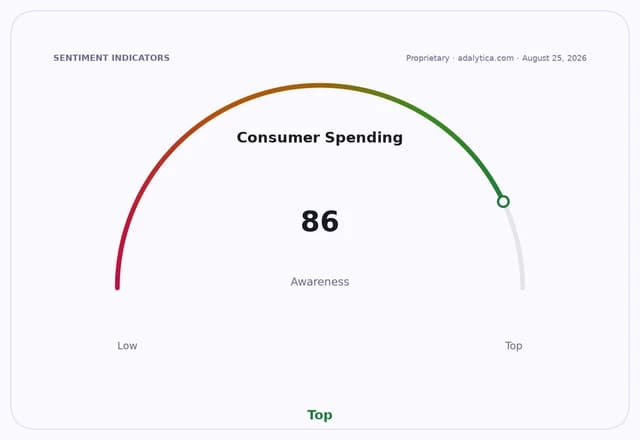
Walmart’s own sentiment gauge on Adalytica.com remains in “Extreme Greed” territory at 86, though it slipped 7 points on the day after surging 71 points over the past week, suggesting expectations are still elevated even after the sales disappointment. At the same time, a consumer spending sentiment snapshot on Adalytica shows “Extreme Fear,” reinforcing the view that the demand backdrop is fragile even if the retailer’s operating model is improving.
The next test is whether Walmart can turn that mix shift into clearer margin leverage when it updates investors again. If digital and advertising growth keep offsetting slower store sales, the miss may look less like a warning and more like evidence that Walmart’s profit engine is changing.
| Entity | Gains | Losses |
|---|---|---|
| Walmart | ▲Higher-margin mix | ▼Store-sales purity |
| Long-term investors | ▲Better earnings resilience | ▼Near-term sales growth |
| Digital ad and e-commerce units | ▲Faster growth | ▼Low-margin legacy retail |
| Target and Amazon | ▲Sector validation | ▼Pressure to match profitability mix |