War Risk Boosts Inflation Hedges, Pressures Long Bonds

The biggest market message from a still-uncertain war backdrop is that inflation risk is being priced in faster than the conflict itself is being resolved, and that is pushing investors toward gold and inflation protection even as bond markets remain wary.
That matters because geopolitical shocks do not have to end in a lasting supply disruption to affect portfolios. The prospect of higher energy, shipping and insurance costs can lift headline inflation before policymakers respond, forcing central banks to keep rates higher for longer. For equities, that is usually a headwind for duration-sensitive growth stocks and a tailwind for energy producers, commodities and real-asset exposures. For fixed income, it means tighter tolerance for long-duration bonds.
The latest price action reflects that tension. Gold proxy GLD was trading at $377.01 on July 10, still far above its 50-day moving average of $401.13? No — the more important signal is that it remains in a volatile but elevated range after a sharp spring pullback, with RSI at 41.6 and the price sitting below its 200-day moving average of $410.86, showing the market is consolidating rather than abandoning the trade. TIP, the inflation-protected Treasury ETF, closed at $108.13, near both its 50-day and 200-day moving averages and up steadily from earlier in the year, suggesting demand for inflation hedges remains intact even without a fresh breakout. VNQ, the real estate ETF, has also recovered to $97.32, helped by the view that inflation-linked assets can preserve income streams if consumer prices re-accelerate.
The macro backdrop is not one of runaway inflation yet, but it is one of renewed sensitivity. US CPI data in the context point to 333.979 in May, with a forecast of 336.0641 for June, keeping the disinflation story alive but vulnerable to an energy shock. Treasury yields have already moved higher: the 10-year note was at 4.55% on July 7 and the 2-year at 4.19%, leaving only a modest gap between them and reinforcing the market’s belief that policy rates will stay restrictive. That configuration typically punishes long-duration assets while supporting cash flow today over cash flow tomorrow.
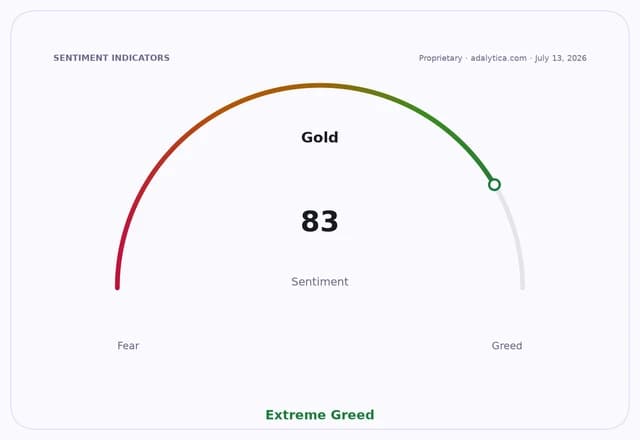
Adalytica’s gauges echo the same split. The Gold Fear & Greed Index shows sentiment at 83, or greed, while awareness remains at 9, marked extreme fear, a combination that often appears when investors are crowding into a hedge but remain uneasy about the underlying risk. By contrast, TLT’s signals show extreme fear, with sentiment at 14 and a 30-day slide of 81 points, underscoring how quickly appetite for long-dated Treasuries can evaporate when inflation fears reappear. Five-year breakeven and long-term inflation expectation gauges are both in fear territory at 22, implying the market is alert to inflation risk even if it has not priced in a full-blown regime shift.
For investors, the narrative is straightforward: war uncertainty is not just a geopolitical issue, it is an inflation trade. If energy markets tighten or shipping lanes become more expensive, the first beneficiaries are likely gold, TIPS, commodity producers and selected real-asset names. The losers are long-duration bonds, rate-sensitive growth stocks and leveraged balance sheets that depend on cheaper refinancing.
The key risk for bulls is that inflation may prove transitory again if the conflict remains contained and supply chains absorb the shock. The bull case for gold and inflation hedges is that central banks cannot easily look through a renewed energy impulse, especially with policy already restrictive and growth uneven. Investors will be watching oil prices, Treasury breakevens, and whether CPI surprises higher in coming releases — because in this market, the war may still be uncertain, but the inflation impulse is what could move portfolios first.
| Entity | Gains | Losses |
|---|---|---|
| Gold / GLD | ▲Safe-haven demand | ▼If war risk fades |
| TIPS / TIP | ▲Inflation protection demand | ▼If CPI cools further |
| Long Treasuries / TLT | ▲None | ▼Rising yields, inflation fear |
| Rate-sensitive equities / VNQ | ▲Inflation-linked income appeal | ▼Higher discount rates |