WTI crude holds near $83 on Middle East risk
WTI crude is pressing against a key technical ceiling near $83 a barrel as geopolitical risk in the Middle East keeps the oil market firmly in bull territory.
The move matters because oil is once again trading less on supply-demand math alone and more on the risk premium embedded in a fragile geopolitical backdrop. That is lifting near-dated prices, tightening sentiment around global energy flows and forcing investors to reassess how much of the recent run in crude can persist if disruption fears around the Strait of Hormuz linger.
West Texas Intermediate settled at $83.84 on Aug. 12 after closing at $82.13 on Aug. 10 and $83.20 on Aug. 11, according to the price data, keeping the contract just above the 50-day moving average near $80 and well above the 200-day average around $76.6. Brent, the international benchmark, has climbed to $88.90 on Aug. 3 in the supplied data and was cited in the news context at $84.79, underscoring that the broader crude complex remains bid even after recent volatility.
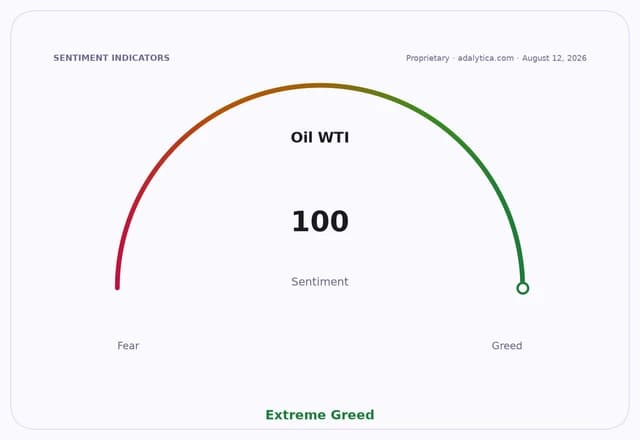
Technically, the tape still favors the bulls. WTI has reclaimed levels above the conventional 50-day moving average and is holding near the upper end of its recent range, while the RSI has cooled to 39.1 from overbought readings earlier this year, leaving room for another leg higher if buyers force a clean break above $83 and then challenge the next resistance zone. The market is also trying to digest a sharp swing in oil sentiment: Adalytica’s trade-signal snapshot on USO shows extreme greed, with sentiment at 100 and awareness at 74, while the global stability gauge sits at extreme greed as well. That is exactly the kind of backdrop that can keep momentum funds and trend followers aligned with the move.
The macro overlay is supportive too. The 10-year Treasury yield around 4.72% suggests financial conditions are not loose, but oil is rising anyway because geopolitics is doing the heavy lifting. The dollar’s recent cooling, with Adalytica’s USD awareness sliding 32 points over seven days, also helps commodity pricing at the margin. When the market is worried about the Strait of Hormuz, the marginal buyer of crude is not making a long-term demand call — it is paying up for supply security.
That has direct implications for investors. Higher crude prices improve cash flow for upstream names such as Chevron, ConocoPhillips and Occidental, while also supporting oil-service demand if producers decide to protect output with more capital spending. The beneficiaries are not just the drillers and producers; tanker rates, storage plays and energy infrastructure assets can all gain if volatility stays elevated and physical flows face even a modest risk premium.
For now, the market is telling a simple story: the path of least resistance for oil remains higher as long as WTI stays above the low-$80s and Brent holds a geopolitical premium. If bulls can punch through $83 decisively, the trade shifts from a tactical bounce to a breakout attempt with fresh upside for energy equities. Traders should treat pullbacks as a test of whether this is only a risk flare-up — or the start of a more durable repricing in the crude complex.
| Entity | Gains | Losses |
|---|---|---|
| WTI bulls | ▲Breakout momentum | ▼Sideways traders |
| Oil producers | ▲Higher realized prices | ▼Refiners’ margins |
| Energy equities | ▲Cash-flow upside | ▼Commodity shorts |
| Importers and consumers | ▲— | ▼Higher fuel costs |