WTI near $87 as inflation risk rises
Inflation risk is back in the market’s crosshairs as crude oil holds near $86 a barrel, Treasury yields sit close to 4.7% and investors are once again being forced to price in the possibility that geopolitics and China can push prices higher.
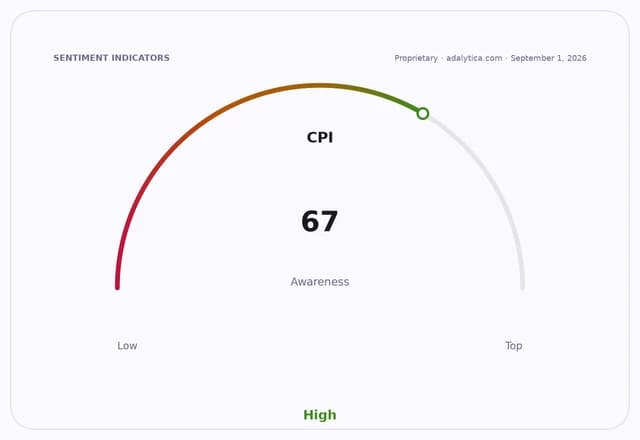
That matters because the disinflation story that supported bonds, equities and rate cuts this year is vulnerable to a classic three-way shock: supply disruption in the Middle East, tighter sanctions around Iran and a Chinese import pattern that can tighten the global crude balance even when demand elsewhere is softening. West Texas Intermediate has eased to $86.91 on Sept. 1 from $94.77 in March, but it remains well above levels that would reassure policymakers, and U.S. inflation expectations are no longer moving decisively lower. Confidence in the Federal Reserve’s 2% inflation target has dropped sharply in Adalytica’s INFL2 gauge, which now shows fear at 30, down 40 points over the past month.
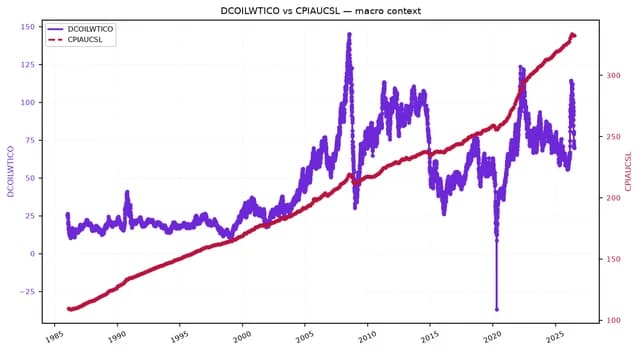
The market is effectively saying that the next inflation impulse may not come from wage growth alone. Oil has always been the most immediate transmission channel from geopolitics to consumer prices, and this year’s volatility has underscored how quickly energy can spill into transport costs, freight, airline margins and ultimately headline CPI. Brent and WTI are not just commodities in this environment; they are shorthand for the durability of the soft-landing narrative. A move back toward the spring peak near $95 a barrel would complicate the Fed’s path and keep real yields elevated, even if growth cools.
That is why the latest move in U.S. crude futures matters beyond the energy trade. WTI touched $83.40 on Aug. 28 before rebounding to $86.91 on Sept. 1, leaving it above the 50-day and 200-day moving averages, a technical setup that suggests the market has not broken the uptrend even after recent pullbacks. USO, the oil ETF, remains elevated at $133.70 after briefly reaching $152.96 in May, while the U.S. dollar proxy UUP has stabilized near 28.12. A firmer dollar can mute some import-price pressure, but it does not offset an oil shock large enough to feed headline inflation and inflation expectations.
China is central to the narrative. Beijing has reduced some crude imports, including Dar Blend sour crude, but the broader effect has been to deepen the market’s sensitivity to policy, sanctions and reserve management rather than to eliminate price pressure. If China leans on strategic reserves while maintaining its role as a major buyer of sanctioned barrels, the result is a more fragmented oil market, not a safer one. That fragmentation can keep prices supported even when visible end-user demand looks uneven.
For investors, the implications are straightforward. Higher oil prices typically favor integrated producers, refiners and service companies with pricing power, while pressuring transportation, consumer discretionary and rate-sensitive assets. Chevron, Exxon and peers may still face timing effects and margin volatility quarter to quarter, but a persistent crude bid improves cash generation, dividend coverage and buyback capacity. On the losing side are duration-heavy assets: long-dated Treasuries, growth stocks that depend on lower discount rates and sectors with thin margin buffers.
The broader risk is that inflation becomes sticky again just as markets had started to assume the hardest part of the cycle was over. The 10-year Treasury yield at 4.73% already reflects a market that is wary of renewed price pressure. If oil remains near current levels or rises further on war risk or China-driven demand shifts, the Fed may be forced to keep policy restrictive for longer, and investors will have to pay more for protection against a second inflation wave.
| Entity | Gains | Losses |
|---|---|---|
| Oil producers | ▲Higher realized prices | ▼None if volumes hold |
| Refiners and energy services | ▲Stronger margins, more spending | ▼Feedstock volatility |
| Treasury bulls | ▲Slower growth narrative | ▼Higher inflation risk |
| Consumers and rate-sensitive stocks | ▲Lower fuel costs if oil falls | ▼Higher headline CPI |