AI is accelerating faster than education systems can adapt, and that gap is becoming an economic and investable divide.
AI skills gap boosts education and training themes

The real story here is not just that artificial intelligence is moving quickly — it is that the human capital needed to use it productively is not keeping pace. That matters because the next phase of AI will not be won only by the best models, but by the economies and companies that can deploy them at scale through skilled workers, better math and reading foundations, and disciplined adoption. The countries that fall behind on education risk becoming consumers of foreign AI rather than producers of the productivity gains it creates.
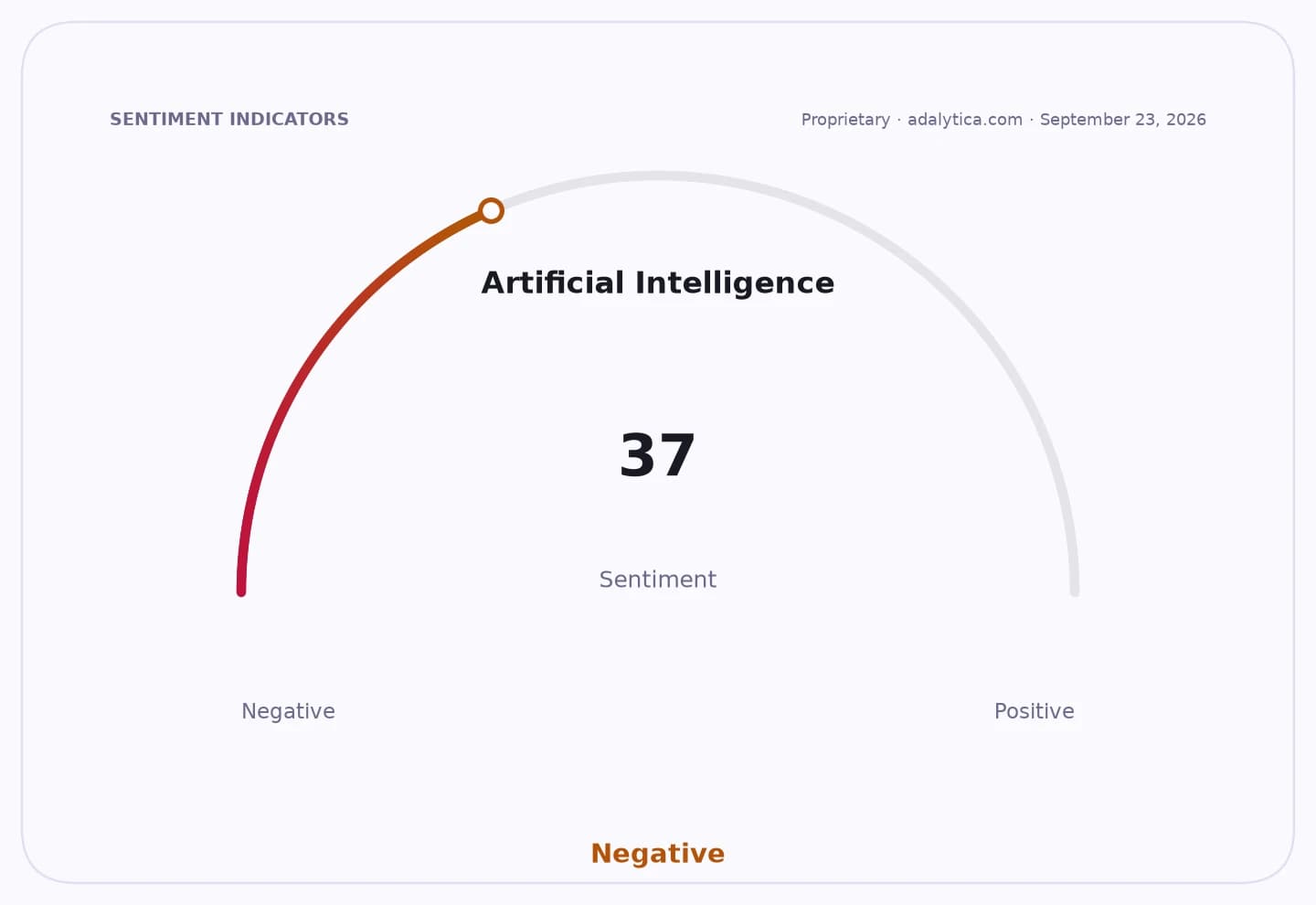
Sentiment IndicatorsⓘProprietary · adalytica.com · September 13, 2026
This is a snapshot — live sentiment, awareness and momentum for 130+ markets update continuously in the dashboard.Open AlphaPulse
Colombia is a stark example. The country’s PISA results show deep structural weakness: 71% of students did not reach minimum proficiency in mathematics, alongside major gaps in reading and science. In a decade, the education system effectively lost almost a year of learning. That is not a social statistic alone; it is a growth constraint. It means fewer engineers, weaker managers, lower adoption of advanced software, and less ability to absorb the automation wave that is reshaping everything from finance to manufacturing.
Meanwhile, the AI cycle is still compounding. OpenAI’s move toward autonomous agents and the reported $22 million programming model that helped mathematicians tackle Navier-Stokes underscore how fast capability is advancing. The U.S.-China race is pushing that even harder, and the market underestimates how much the bottleneck has shifted from chips alone to talent, training and organizational readiness. AI can lift productivity, as recent U.S. employment data suggests in roles that complement the technology, but only if the workforce can work alongside it.
That is why the biggest opportunity is not in treating AI as a distant threat to labor, but as an infrastructure race in education, software and skills. Microsoft’s latest filing explicitly points to training in generative AI and digital learning resources, while its stock has rallied back toward the mid-$490s after a sharp summer drawdown, with the shares still below their 200-day moving average. Nvidia remains central to the compute buildout, but its gains will increasingly depend on the pace of enterprise adoption and the broader ecosystem of users who can turn chips into revenue. Alphabet, with its own AI investment and TPU efforts, sits in the same toll-road position.
The market is already pricing the obvious winners in semiconductors and cloud. It is less prepared for the second-order beneficiaries: education technology, corporate training, workforce software, cloud platforms and the service providers that help countries and companies close the skills gap. If the world’s educational systems continue to lag, AI’s upside will concentrate further in a handful of nations and firms with the capital, data and talent to exploit it.
For investors, the thesis is simple: the AI trade is broadening from hardware into human capital. The winners will be the companies selling the tools, platforms and training that let workers and institutions keep up. The losers will be countries and employers that assume the technology alone will do the job. Position for the enablers now; the skills gap is becoming one of the defining investment themes of the AI era.
| Entity | Gains | Losses |
|---|---|---|
| Microsoft, Alphabet, Nvidia | ▲AI adoption and enterprise demand | ▼Cyclical skepticism on capex |
| Education technology and training providers | ▲Skills-gap demand | ▼Slow reform in public systems |
| Colombia and other lagging economies | ▲None immediately | ▼Productivity, competitiveness |
| Human workers in AI-complementary roles | ▲Higher productivity, wage leverage | ▼Routine tasks and low-skills jobs |