Alphabet’s next leg higher now hinges less on search growth than on whether nearly $200 billion of artificial intelligence spending can start to produce measurable cash returns.
Alphabet faces AI capex and cash flow test

That is the central tension in the Google parent’s latest setup: demand for AI infrastructure is clearly real, but investors are no longer willing to reward revenue growth alone when capex is accelerating, free cash flow has turned negative and the company still gives limited visibility into the economics of its AI buildout. Alphabet’s shares have already fallen about 15% from their mid-May peak, even as advertising revenue grew 14.4% in the second quarter and Cloud revenue jumped 82%.
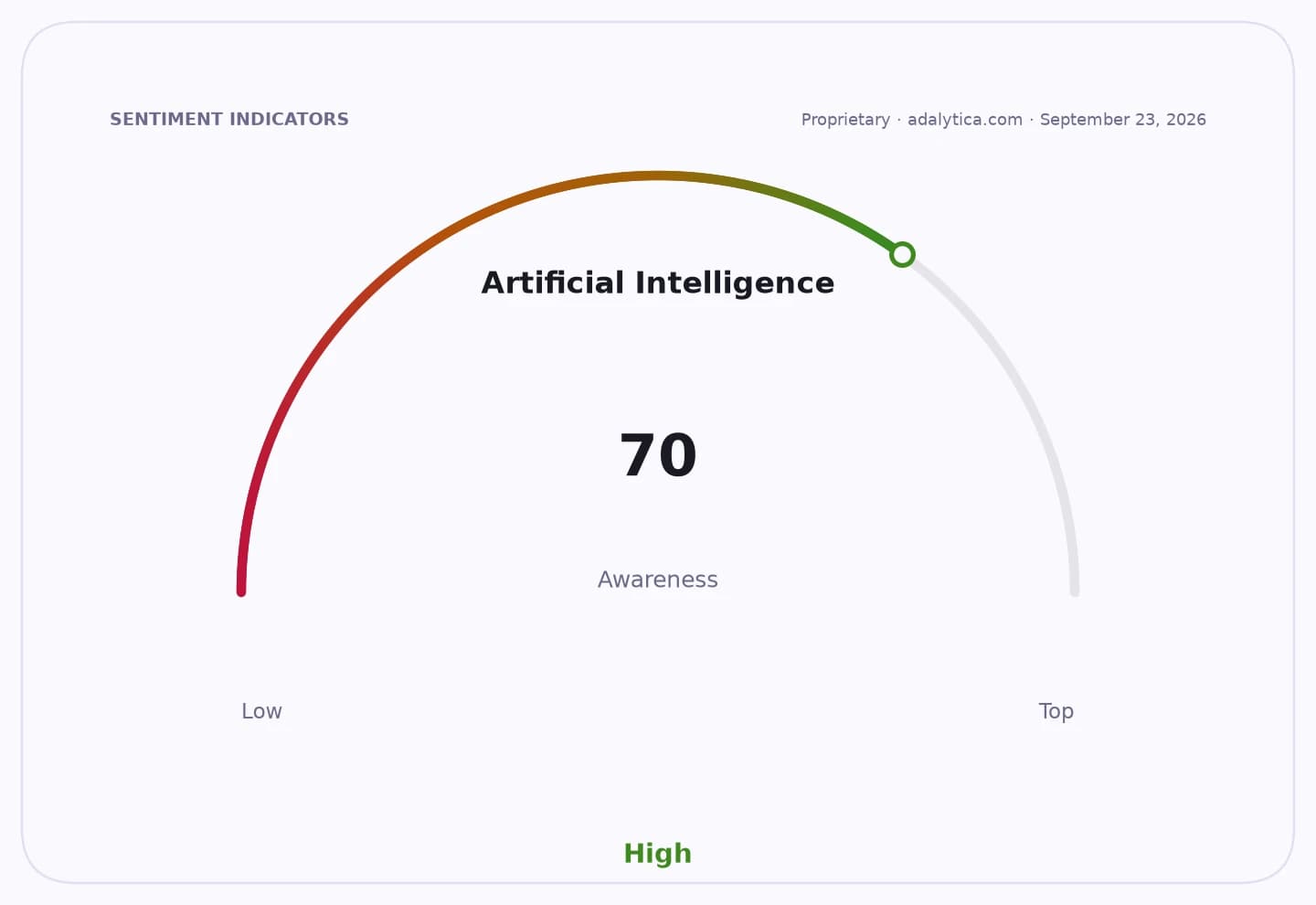
Sentiment IndicatorsⓘProprietary · adalytica.com · September 19, 2026
This is a snapshot — live sentiment, awareness and momentum for 130+ markets update continuously in the dashboard.Open AlphaPulse
The market’s concern is not that Alphabet is losing ground operationally. It is that the cost of defending and expanding its AI franchise is rising faster than the near-term proof that the spending will pay off. Alphabet has raised its 2026 capex outlook to $195 billion-$205 billion, a level that puts the company in the same conversation as the heaviest infrastructure spenders in tech. It also reported negative free cash flow of $5.9 billion, its first such reading on record, after operating cash flow rose by about $11.3 billion year on year but investment spending increased by roughly $22.5 billion.
That gap matters because it is changing the stock’s valuation framework. For years, Alphabet could rely on dominant search economics and strong ad cash generation to absorb investment cycles. Now the burden is on management to show that AI infrastructure, model training and cloud capacity are not just protecting the franchise but expanding its return on capital. The company has not disclosed core AI profitability metrics such as AI revenue, return on invested capital or payback periods, leaving investors to use proxies that are helpful but incomplete.
Cloud is the clearest evidence that the spending is finding a market. Revenue reached $24.8 billion in the quarter, operating margin widened to 35.6% from 20.7%, and backlog rose to about $514 billion, with Alphabet saying it expects to recognize just over half of that over the next 24 months. Those numbers suggest contracted demand is already in the pipeline and that some of the infrastructure being built is not speculative capacity but capacity tied to customers already waiting to consume it.
That is why investors remain willing to stay constructive, even after the pullback. The bull case is that Alphabet is building into a durable AI and cloud demand cycle, with stronger margins and a large backlog eventually converting into better cash generation. The bear case is that the company is front-loading enormous capital commitments before it can prove the payback, leaving free cash flow pressured and execution risk elevated, especially after delays around Gemini development and leadership changes at DeepMind added to market unease.
The stock’s valuation shows how much proof is still needed. At about $342.87, GOOGL trades roughly 23.1 times estimated 2027 earnings, below the multiple implied by its all-time high of $408.61. A return to that peak would require either a richer multiple, higher earnings, or both. Analysts are still broadly positive, with a Strong Buy consensus and an average target of $427.08, but the market is clearly waiting for more than broad optimism about AI adoption.
The key question for the next several quarters is whether cash flow starts to catch up with investment, not whether Alphabet slows its spending immediately. If Cloud keeps scaling, margins hold and backlog converts into revenue without eroding profitability, the company may not need a perfect outcome to regain its highs. If not, the market is likely to keep treating Alphabet’s AI buildout as a costly promise rather than a compounding asset.
| Entity | Gains | Losses |
|---|---|---|
| Alphabet / GOOGL | ▲AI-led revenue growth | ▼Free cash flow pressure |
| Google Cloud | ▲Backlog conversion | ▼Margin compression risk |
| Long-term investors | ▲Re-rating on proof of ROI | ▼Higher execution uncertainty |
| Short-term bears | ▲Valuation reset narrative | ▼If cash flow improves faster than expected |