Moving from formal private payroll jobs into self-employment or informal work in Argentina typically means taking a meaningful hit to pay, with a new analysis finding the biggest downgrade cuts real take-home income by 27.8%.
Argentina formal jobs shift to informality
That is more than a household budgeting issue. It shows Argentina’s labor market is absorbing job destruction from the formal sector by pushing workers into lower-quality work rather than creating productive new employment, a pattern that weakens consumption, erodes tax collection and reduces future pension contributions.
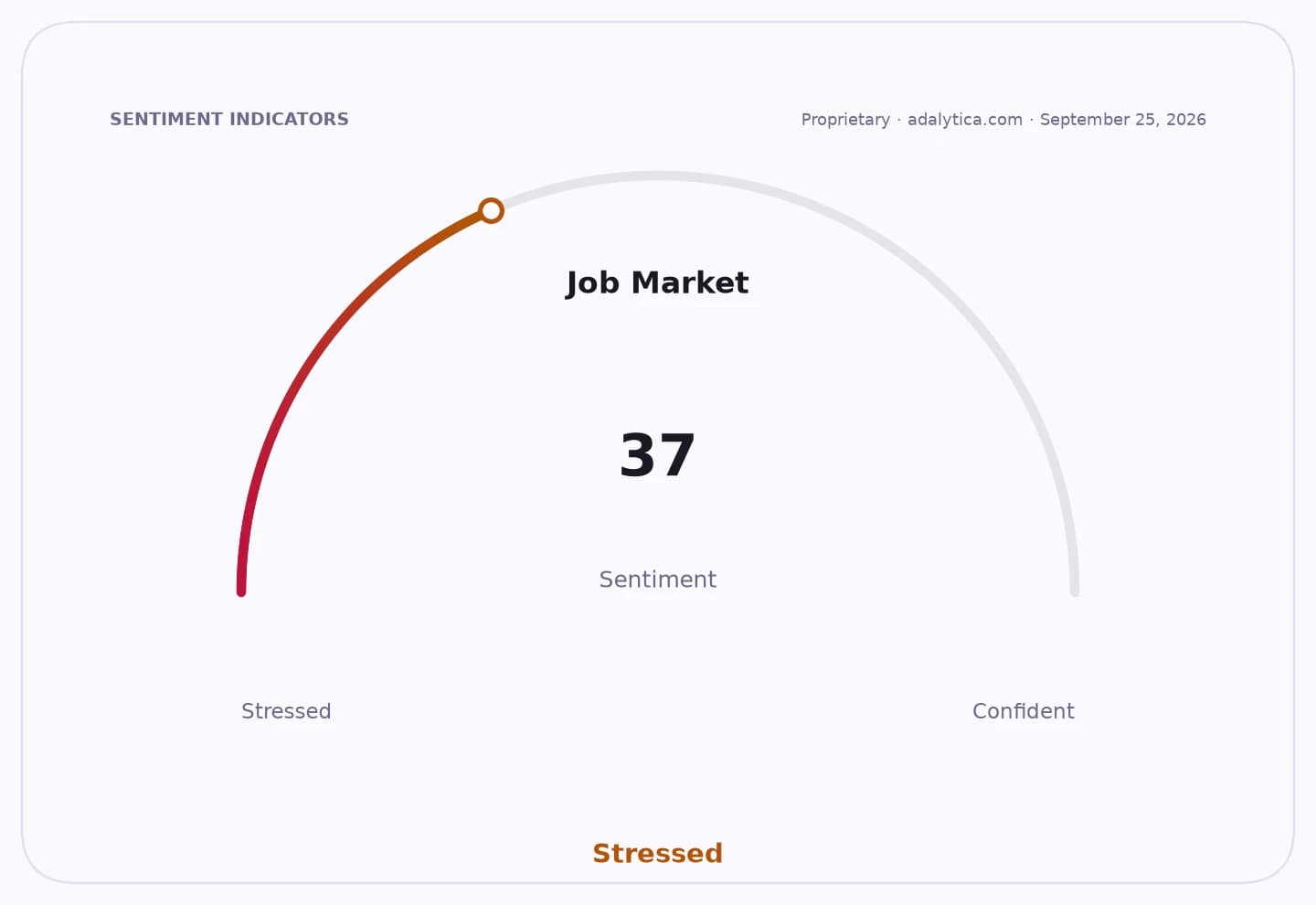
Sentiment IndicatorsⓘProprietary · adalytica.com · September 25, 2026
This is a snapshot — live sentiment, awareness and momentum for 130+ markets update continuously in the dashboard.Open AlphaPulse
The study, by CP Consultora using a panel of the National Institute of Statistics and Census’ household survey data from 2023 to 2025, tracks individual workers as they move between categories. It finds that the steepest loss comes when someone leaves a registered private wage job and becomes self-employed. The average real income drop in that switch was 27.8%.
The reverse move is where the gains are concentrated. Workers who left self-employment and entered formal private payroll jobs saw average income rise 34.4%, while informal salaried workers who were “blanqued,” or brought into the formal system, gained 31.6%. Even public employees who moved into registered private jobs improved their pay by 15% on average.
The point matters because the expansion is happening in the lower-quality end of the labor market. An Institute for Public Thinking and Policies report cited in the article said registered private payroll employment fell 3.7% from the fourth quarter of 2023, or about 238,000 jobs, while formal public employment dropped 2.5%, about 86,500 jobs. Over the same period, monotributo self-employment rose 7.9%, adding roughly 161,000 people, and informal self-employment climbed 18%, or about 497,000 workers.
The broader message is that Argentina’s labor market is not simply becoming more flexible; it is becoming more precarious. Workers who move out of registered employment lose not only income but also health coverage, retirement contributions, paid leave and job security. That makes the shift economically regressive even when it appears to keep people employed.
For policymakers, the findings underscore a dilemma. Bringing down labor costs or easing formal hiring rules may help create jobs at the margin, but if the formal sector keeps shrinking and workers keep falling back into informality, the economy loses purchasing power and the state loses revenue. For investors, the risk is that weak labor quality limits consumer spending and keeps macro recovery fragile, even if headline employment numbers look stable.
The key question now is whether Argentina can reverse the move toward informality enough to make job growth compatible with higher wages. If not, the country may keep adding workers — but still be making them poorer.
| Entity | Gains | Losses |
|---|---|---|
| Formal private employers | ▲Lower labor costs | ▼Weaker skilled labor pool |
| Self-employed workers | ▲More flexibility | ▼Lower real income |
| Informal employers | ▲Easier hiring | ▼Lower productivity |
| Argentine consumers | ▲Some employment retention | ▼Purchasing power |