Asia’s listed REIT market has entered a more expansionary phase, with mainland China and India accounting for most of the growth as investors continue to favor income-producing real estate with clearer capital recycling and institutional governance.
Asia REIT market grows on China and India
The region’s 289 active REIT products had a combined market value of $279.4 billion as of March 31, 2026, up 18% from the end of 2024, according to Cushman & Wakefield. The numbers point to a market that is no longer just stabilizing after the interest-rate shock, but broadening geographically and structurally as new listings deepen liquidity and widen the asset pool.
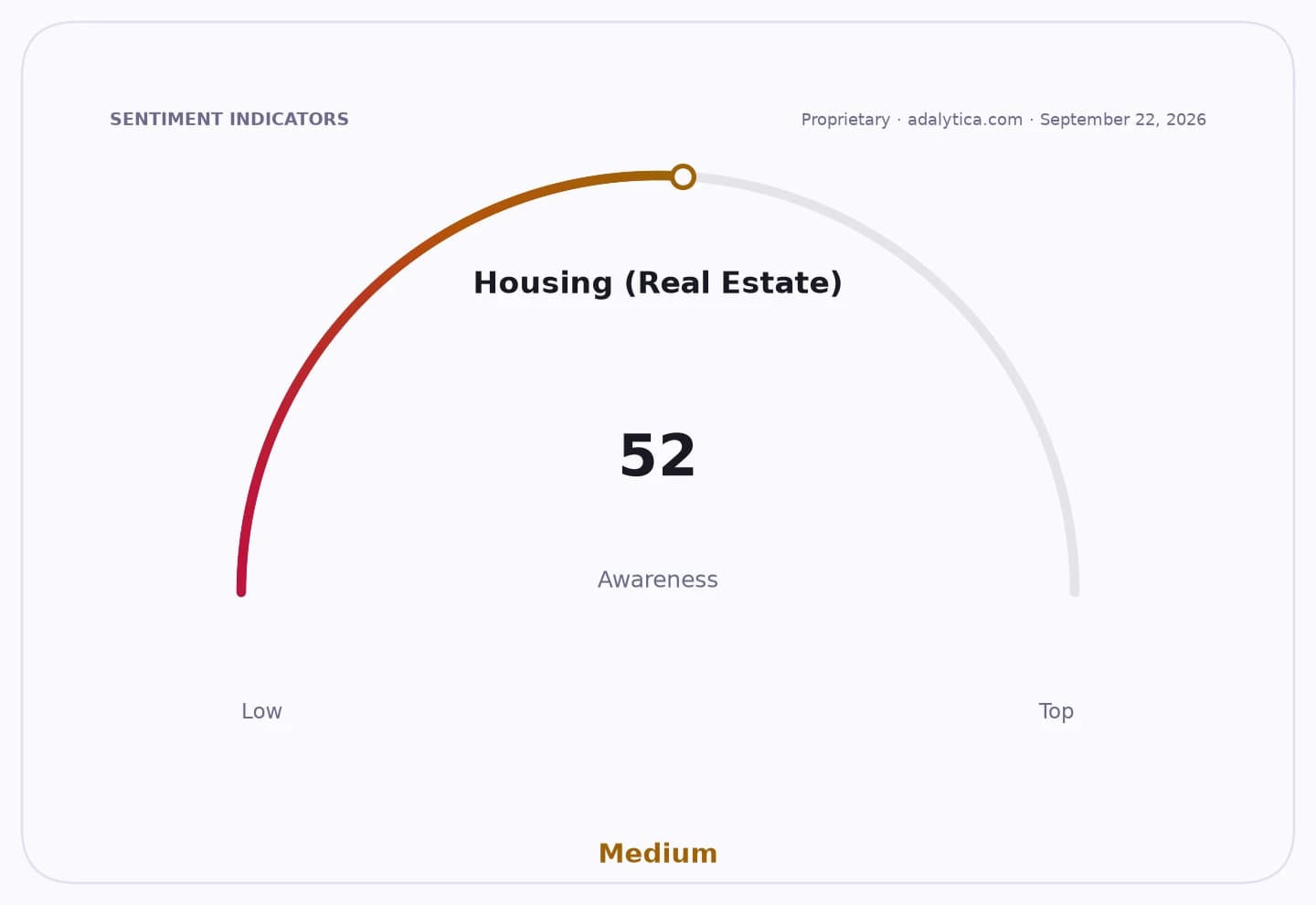
Sentiment IndicatorsⓘProprietary · adalytica.com · September 26, 2026
This is a snapshot — live sentiment, awareness and momentum for 130+ markets update continuously in the dashboard.Open AlphaPulse
The most important shift is in China, where the mainland contributed 21 of Asia’s 27 new REIT listings over the period, making it the dominant source of incremental issuance. That matters because issuance, not just price appreciation, is what turns REITs from a niche funding tool into a durable capital market. China’s pilot program for commercial real estate REITs, launched in late 2025, expands eligible assets beyond infrastructure into offices, malls, hotels, outlets and mixed-use properties, creating a new channel for developers and asset owners to recycle capital.
That broadening of scope increases the supply of assets that can be monetized through listed structures, but it also raises the bar for underwriting. As Cushman & Wakefield’s Andrew Chan noted, the market is moving into a more sophisticated phase in which investor familiarity is no longer enough; asset quality, operating capability and ESG disclosure are becoming more important to valuation.
India is now the other major engine. Market value there rose 62% to $17.7 billion from $11 billion at end-2024, overtaking Hong Kong to become Asia’s fourth-largest REIT market. New listings, including Knowledge Realty Trust and Bagmane Prime Office REIT, added 53.7 million square feet and accounted for about three-quarters of the new space brought into India’s six listed REITs over the period. High occupancies, firm demand from multinational occupiers and the continued rise of global capability centres are helping make the market feel more institutional than emerging.
For investors, the implication is that Asia REIT exposure is becoming more diversified and less dependent on mature markets such as Japan, Singapore and Hong Kong, which still grew but at a slower pace. Japan benefited from recovering office fundamentals and hotels; Singapore from acquisitions; Hong Kong from valuation recovery and liquidity measures. Yet the growth leadership has clearly shifted south and west toward China and India, where issuance pipelines and structural demand are stronger.
That matters in a higher-rate world because REITs trade on the interaction between yield, growth and balance-sheet discipline. The region’s expansion suggests managers are finding ways to grow despite tighter financing conditions, while investors are favoring sectors with visible cash flow and asset-backed income. Data centres and hospitality REITs remain especially visible as AI-driven digital infrastructure demand and tourism recovery support new capital deployment.
The bull case is that Asia REITs are moving into a more liquid, institutionally credible market with better diversification, deeper pipelines and stronger capital recycling. The bear case is that a growing market can also mean richer supply, tighter underwriting and more dependence on execution at the asset level. For now, the growth story belongs to China and India, and investors will likely keep rewarding managers that can combine scale, occupancies and disciplined capital allocation.
| Entity | Gains | Losses |
|---|---|---|
| Mainland China REITs | ▲New listings and liquidity | ▼Limited to quality execution |
| India REITs | ▲Larger market scale | ▼Higher expectations on asset quality |
| Mature Asia REITs | ▲Steady stabilization | ▼Relative growth leadership |
| Investors | ▲Broader yield options | ▼Weaker issuers and overvalued assets |