ASML is Europe’s most valuable chip weapon, yet its dominance in extreme ultraviolet lithography still does not amount to true technological sovereignty — and that gap is where the real investment story lies.
ASML Sales Growth and 2026 Outlook Raise
The Dutch company is the only manufacturer in the world of EUV machines, the indispensable tools used to make the most advanced semiconductors. That gives Europe a strategic foothold in the AI supply chain just as governments from Paris to Brussels are talking up industrial independence, but the chain remains globally fragmented: American software, Japanese materials and Taiwanese chip fabrication still sit at the heart of the industry.
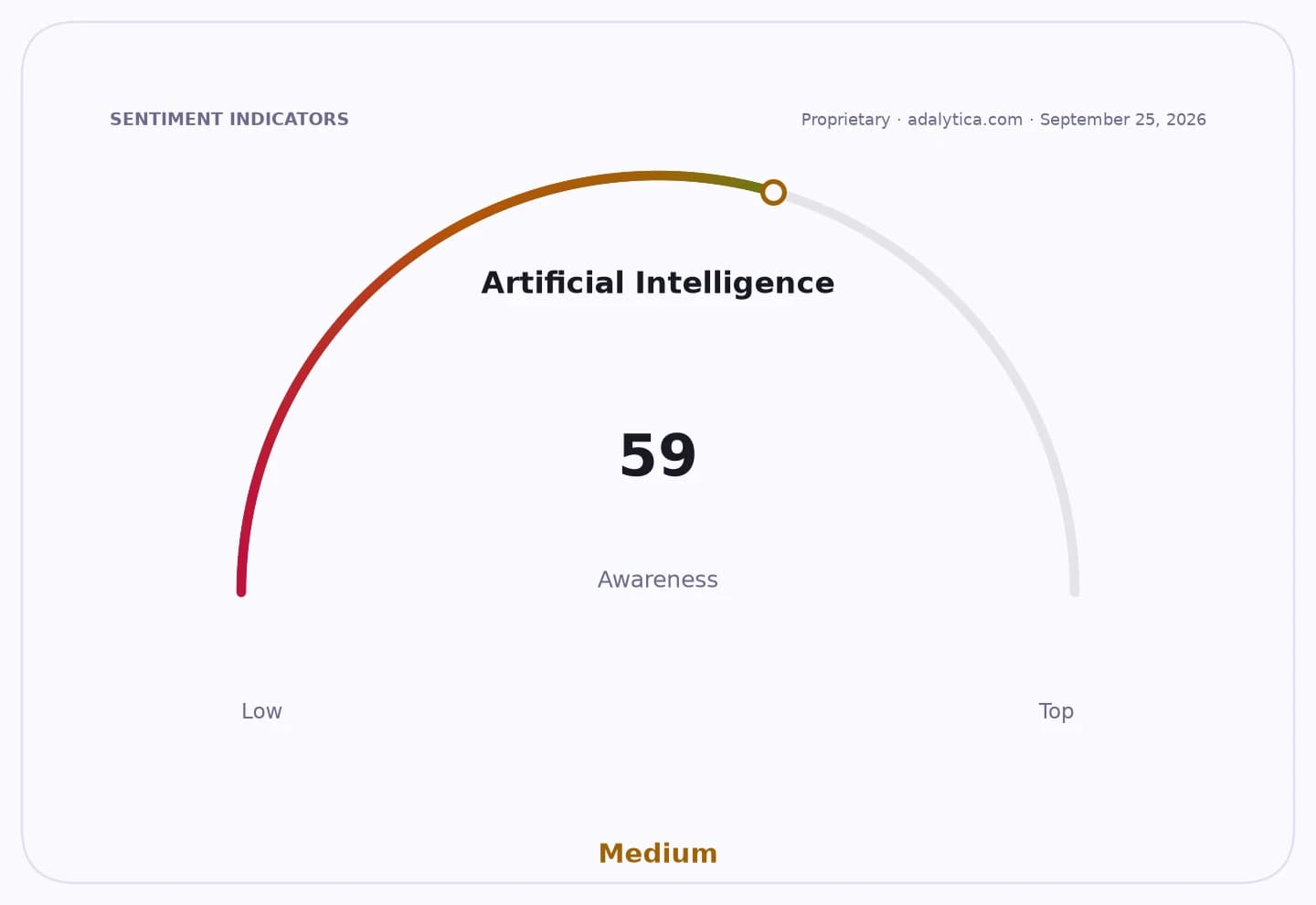
Sentiment IndicatorsⓘProprietary · adalytica.com · September 25, 2026
This is a snapshot — live sentiment, awareness and momentum for 130+ markets update continuously in the dashboard.Open AlphaPulse
That matters economically because AI is not becoming a software-only boom; it is a capital-intensive hardware cycle built on bottlenecks. Whoever controls the bottleneck controls pricing power, capacity allocation and, ultimately, the pace of deployment. ASML sits at the center of that equation. Its Q1 2026 sales of €8.8 billion and net income of €2.8 billion, followed by €9.3 billion in Q2 sales and €2.9 billion in profit, show that demand for its tools is not a geopolitical abstraction — it is flowing through into real earnings. The company also raised its 2026 outlook to €43 billion to €45 billion in sales, with gross margins of 54% to 56%, confirming that AI capex is still feeding the semiconductor equipment cycle.
For investors, that makes ASML less a cyclical supplier than a toll road on the AI buildout. The stock’s recent action reflects that leverage: even after a strong run, it remains above its 200-day moving average, and the 50-day moving average is still providing support. That is the kind of setup long-duration investors want when a company has monopoly-like economics and exposure to one of the decade’s biggest infrastructure spends.
The bigger narrative is that Europe can matter in AI without owning the full stack. ASML is the proof. It is the continent’s strongest negotiating card in a world where advanced chips are becoming a matter of industrial policy and national security, but it cannot on its own deliver sovereignty because the rest of the ecosystem sits elsewhere. That makes the company strategically essential, but it also underlines why the market should keep looking through ASML to the broader winners of the AI hardware cycle: chipmakers, foundries, advanced packaging, power infrastructure and data-center buildout.
The next catalyst is straightforward: as AI model training and inference demand more advanced nodes, the capex pipeline should keep favoring the same handful of critical suppliers. ASML remains the cleanest way to own the scarcity value in that chain, and the market is still underestimating how durable that scarcity can be.
| Entity | Gains | Losses |
|---|---|---|
| ASML | ▲Monopoly pricing power | ▼Commoditization risk elsewhere |
| Europe | ▲Strategic relevance in AI | ▼False sovereignty narrative |
| Taiwan foundries | ▲Advanced-node demand | ▼Geopolitical dependency |
| U.S. chip software/materials firms | ▲Continued ecosystem control | ▼Europe’s autonomy push |