Australia’s new peak union leader has put artificial intelligence at the center of the country’s labor debate, warning that the technology is already eliminating whole jobs and giving employers a powerful new tool for surveillance and management.
Australia unions raise AI job loss concerns
That matters because the fight over AI is no longer just about productivity or profit margins. It is becoming a real wage-and-jobs issue, with implications for consumer spending, workplace bargaining and the pace at which companies can cut costs without triggering backlash.
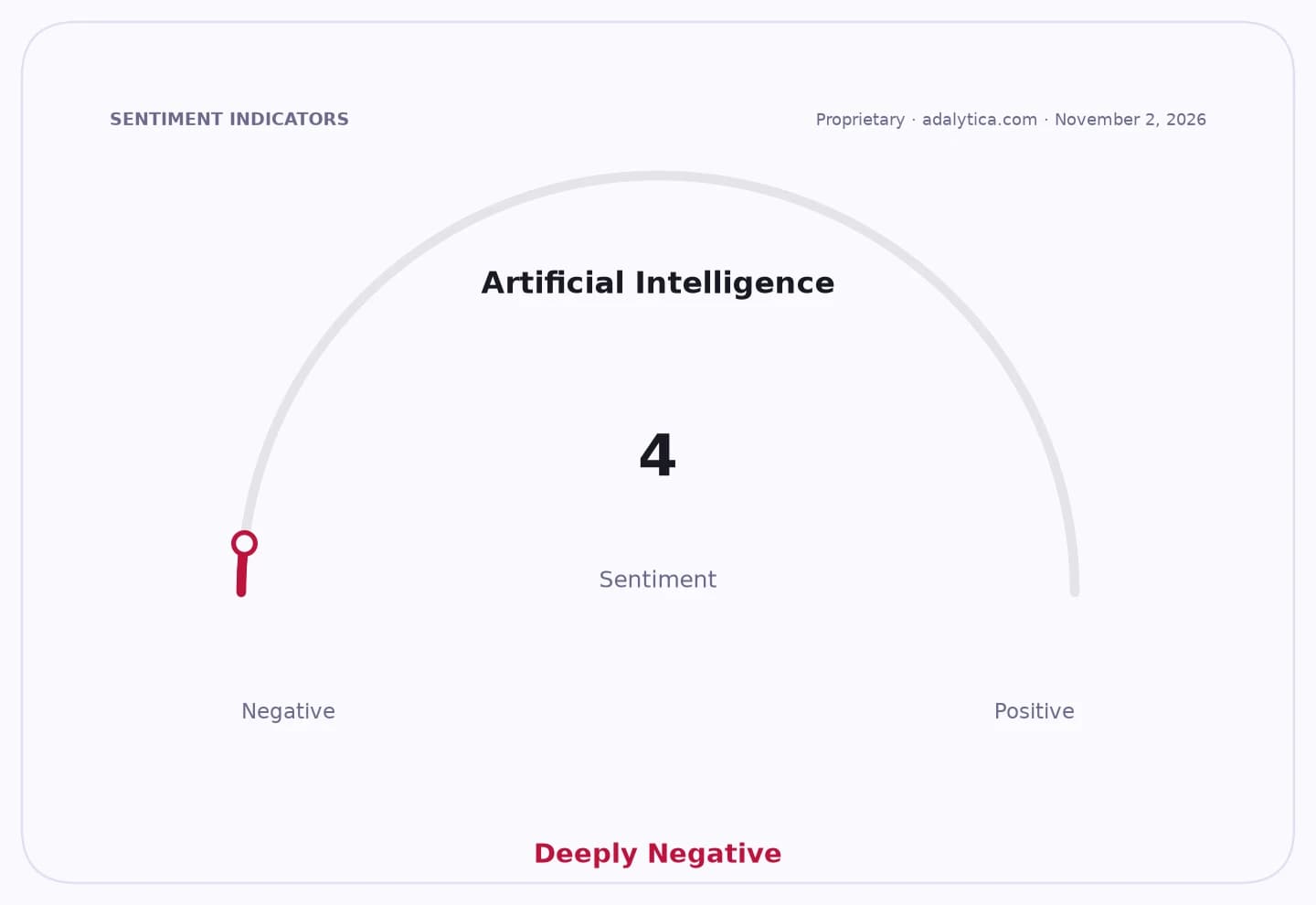
Sentiment Indicators
Emma Kingdon, who takes over as president of the Australian Council of Trade Unions in December, said AI was not simply changing tasks but “automating entire jobs” in some cases. She also raised concerns about AI being used to monitor workers and make decisions on rosters, framing the issue as a broader challenge to job security and workplace rights.
Her warning lands at a sensitive moment for workers. Cost of living remains the top concern for Australian households, while employers are leaning harder on technology to offset labor costs. Kingdon singled out National Australia Bank’s plan to axe 2,500 jobs as “outrageous” in the middle of a cost-of-living squeeze, underscoring how AI-driven efficiency drives are increasingly colliding with job losses in the real economy.
For investors, that tension cuts both ways. On one hand, AI can support margins by reducing headcount and automating routine work, which is why management teams from banks to global tech firms are pushing adoption so aggressively. On the other, faster automation raises the risk of labor unrest, tougher regulation and reputational damage for companies that move too quickly without consultation.
The concern is not hypothetical. The International Monetary Fund has warned that AI could affect up to 40% of jobs globally, and similar warnings are now showing up in company planning. Barclays has already announced thousands of job cuts tied in part to increased reliance on AI, a sign that the efficiency story is moving from slideshows into payrolls.
Kingdon’s appointment also signals a generational shift inside the union movement. She is among the youngest people ever elected to lead the ACTU, and her background in retail, fast food, finance and broader organizing suggests a more campaign-driven approach to a technology that many workers see as moving faster than protections.
That matters for long-term investors because Australia, like other developed economies, is entering a period where AI adoption will not just shape software spending and chip demand. It will also influence wage growth, labor relations and government policy. Canberra has already created an Office of AI and is looking at mandatory requirements for large AI data centres, hinting that oversight is likely to tighten as the technology spreads.
For companies, the message is simple: AI may be a margin tailwind, but it cannot be treated as a back-office project anymore. The winners will be the businesses that use automation to lift productivity while still retaining trust with employees, customers and regulators. For investors, that means watching not just who is spending on AI, but who can deploy it without creating a costly backlash. In a market obsessed with the upside of artificial intelligence, the labor side of the story may prove just as important.
| Entity | Gains | Losses |
|---|---|---|
| Employers using AI | ▲Lower labor costs | ▼Higher union pushback |
| Workers and unions | ▲Stronger bargaining case | ▼Job insecurity |
| AI vendors and adopters | ▲Faster deployment demand | ▼Scrutiny over workplace use |
| Australian policymakers | ▲Chance to shape rules | ▼Pressure to act quickly |