Larry Ellison argued that artificial intelligence can make the U.S. richer even as robots displace workers, saying the missing piece is a tax system that captures more of the value created by automation and redistributes it to households.
Oracle AI World: Ellison backs automation tax
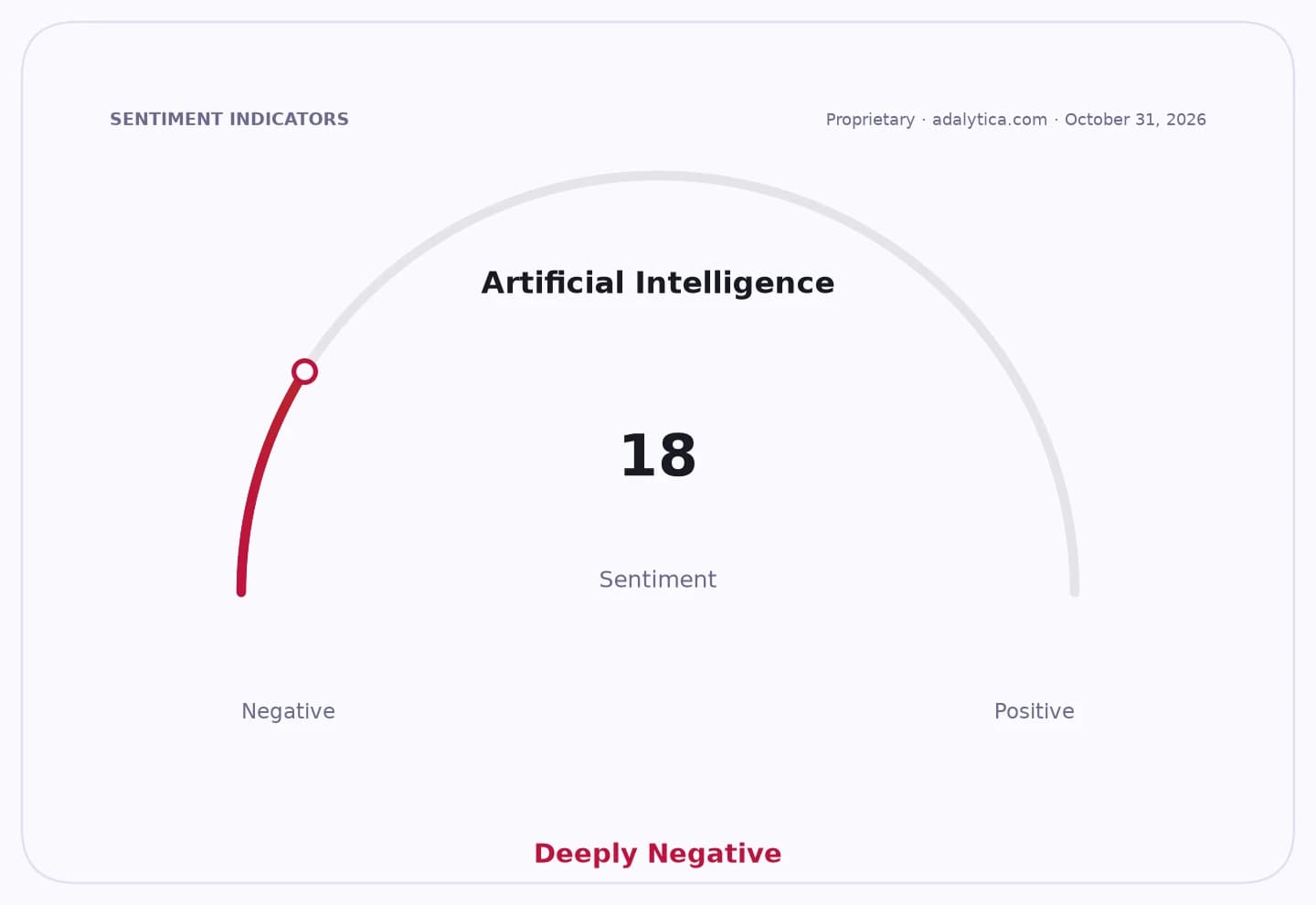
Artificial Intelligence
His comments, delivered at Oracle AI World in Las Vegas, go beyond the usual Silicon Valley optimism and get to the heart of the economic debate over AI: whether the gains from higher productivity will lift living standards broadly or concentrate further in capital owners and highly skilled workers. Ellison’s answer was clear. If machines do more of the work, governments should tax the value they create rather than labor income, helping fund what he called a “universal high income.”
Sentiment Indicators
That framing matters because the AI boom is moving from a purely corporate investment story to a policy question. Companies are already using automation to reshape hiring, and the debate has sharpened as some firms cut staff while others rehire or slow adoption after seeing limits in deployment. The backdrop is one of still-tight labor markets and a U.S. economy that has kept expanding even as businesses search for efficiency gains. In that environment, AI is increasingly being judged not only by whether it boosts profits, but by whether it can sustain growth without widening inequality.
Ellison tried to soften the alarm around mass unemployment, calling the idea that AI will replace everyone “kind of nonsensical.” But he also acknowledged that automation will take over some jobs, pointing to rideshare services and other routine tasks. He used examples such as robotic surgeons and autopilot systems to argue that technology can raise output rather than simply destroy work.
For investors, the significance is twofold. First, Ellison’s comments reinforce the thesis that AI adoption is still in an early, capital-intensive phase that can support infrastructure spending, software demand and productivity-led margin gains across large-cap technology. Second, they underscore the rising political risk around AI taxation, regulation and labor displacement, which could eventually shape how much of the economic upside flows to shareholders versus governments and workers.
The market backdrop suggests investors are already balancing those forces. Oracle’s shares have been volatile in recent months, while Microsoft and Nvidia have also seen sharp swings as enthusiasm over AI spending collides with questions about valuation, execution and the sustainability of the trade. At the same time, sentiment gauges tied to AI and Microsoft have fallen into extreme fear even as broader equity positioning remains relatively constructive, showing how quickly the narrative can turn from exuberance to caution.
Ellison said the transition will take more than a decade, implying a gradual rather than abrupt labor shock. That timeline matters for policymakers and investors alike: it gives governments time to think through tax and transfer systems, but it also means the debate over who captures the gains from AI is only beginning.
| Entity | Gains | Losses |
|---|---|---|
| AI infrastructure providers | ▲Higher demand for compute and software | ▼Greater scrutiny on returns |
| Workers in automatable roles | ▲Potential productivity tools | ▼Job displacement pressure |
| Governments | ▲New tax base from automation | ▼Less reliance on labor taxes |
| Oracle and peers | ▲AI narrative support | ▼Policy and margin uncertainty |