Bitcoin is still alive, still liquid and still drawing institutional money, even after a brutal year of volatility that has revived speculation over whether the world’s largest cryptocurrency could fade within the next five to 10 years.
Bitcoin Holds Above Key Moving Averages
That outcome looks far less likely right now than it did during the recent selloff. Bitcoin closed at $84,405.71 on Oct. 21, rebounding from an Oct. 20 finish of $82,941 and extending a recovery from a Feb. 5 low of $62,702, while market measures show it has clawed back above its 50-day moving average of $81,709.94 and remains well above the 200-day average of $72,735.84.
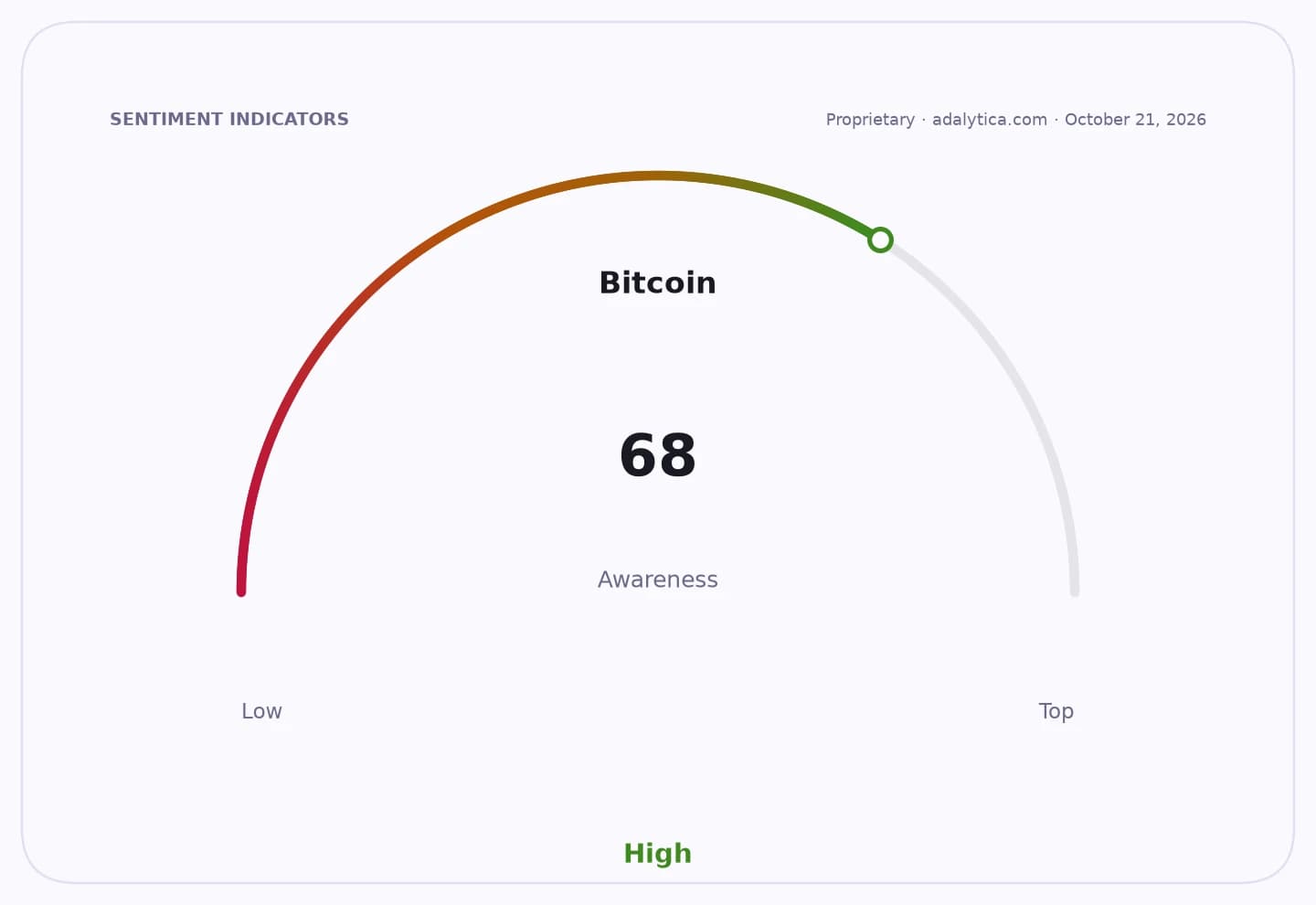
Sentiment IndicatorsⓘProprietary · adalytica.com · October 21, 2026
This is a snapshot — live sentiment, awareness and momentum for 130+ markets update continuously in the dashboard.Open AlphaPulse
The move matters because Bitcoin’s survival case is no longer being decided only by retail traders or crypto-native speculators. The coin is increasingly tethered to rates, liquidity and broader risk appetite, with the latest data showing it still trading like a macro asset rather than a fringe payment experiment. Adalytica’s Bitcoin Fear & Greed Index is at 11, or extreme fear, but awareness remains high at 74, suggesting the market is watching closely even as conviction is shaken.
That tension is showing up across the crypto complex. Binance reportedly stepped in with a $1 billion Bitcoin purchase to steady markets during panic selling, while contract open interest has been contracting, a sign that leveraged positioning has been washed out. At the same time, the recent slide in Bitcoin has come alongside a spike in volume, including a $110.9 billion session on Nov. 4 and $125.5 billion on Feb. 5, underscoring that large capital is still moving through the market rather than abandoning it.
For investors, the question is less whether Bitcoin can survive a single drawdown and more whether it can keep its place in portfolios as a durable macro asset. That case has been strengthened by signs of institutional resilience: banks and brokerages including Deutsche Bank and Charles Schwab have been increasing crypto exposure, while Bitcoin’s trading pattern continues to track Treasury real rates, making it more relevant to macro investors than ever.
The bearish counterargument remains real. Bitcoin’s sharp drop to $62,702 earlier in the year, the extreme fear reading, and repeated whipsaws in momentum indicators all point to an asset still vulnerable to rate shocks, regulatory scrutiny and liquidation cascades. But the current price action suggests the market is not pricing in disappearance so much as a highly volatile, more institutionalized version of survival.
MicroStrategy shares, long used as a proxy for Bitcoin exposure, have also stabilized with Bitcoin’s rebound, closing at $154.71 on Oct. 21 after a steep earlier decline, while Coinbase rose to $178.79, highlighting how closely crypto equities remain tied to Bitcoin’s credibility. If Bitcoin keeps holding above key support and institutions keep adding on weakness, the “could it disappear?” debate is likely to shift toward how large and how regulated it becomes, not whether it survives.
| Entity | Gains | Losses |
|---|---|---|
| Bitcoin holders | ▲Support holds, survival narrative strengthens | ▼Volatility and liquidation risk |
| Binance / market makers | ▲Stabilization role, trading relevance | ▼Less leverage, thinner speculative flows |
| Coinbase / crypto equities | ▲Higher activity, sentiment rebound | ▼Revenue pressure if fear returns |
| Bitcoin skeptics / shorts | ▲Fewer collapse signals | ▼Disappearance thesis weakened |