Bitcoin’s drop back to about $64,100 shows the crypto market is still trading as a high-beta extension of Big Tech sentiment, with Nvidia’s sharp selloff helping to unwind one of the year’s most crowded risk-on trades.
Bitcoin Falls to $64,100 as Nvidia Sells Off

The move matters because Nvidia has become more than a semiconductor stock: it is a proxy for the AI spending boom, and when it breaks down, the pain tends to spill into everything that has been bid on the assumption that liquidity, growth and speculative appetite will stay abundant. Bitcoin, which has increasingly traded alongside technology shares rather than as a pure macro hedge, is now feeling that de-risking directly.
Sentiment Indicators

Nvidia shares have fallen to $162.85 from above $220 in late October, with the stock’s relative strength index at 19.1, deep in oversold territory, and the shares now trading well below their 50-day moving average of $214.63. That kind of technical damage has echoed across risk assets. Bitcoin, meanwhile, has fallen from more than $80,000 on Nov. 4 to $64,108.44, a decline of roughly 20% in less than two weeks, while its 50-day moving average sits near $79,348. The crypto has also slipped below its lower Bollinger Band, a conventional technical indicator that often reflects elevated downside momentum.
The scale of the retreat is significant because it comes after a period when investors had treated both Nvidia and Bitcoin as beneficiaries of the same macro trade: abundant risk capital chasing artificial intelligence, digital assets and momentum stocks. That correlation works both ways. When sentiment turns, the fastest money exits first, and assets with no cash flows or high-duration growth assumptions tend to absorb the largest moves.
Bitcoin
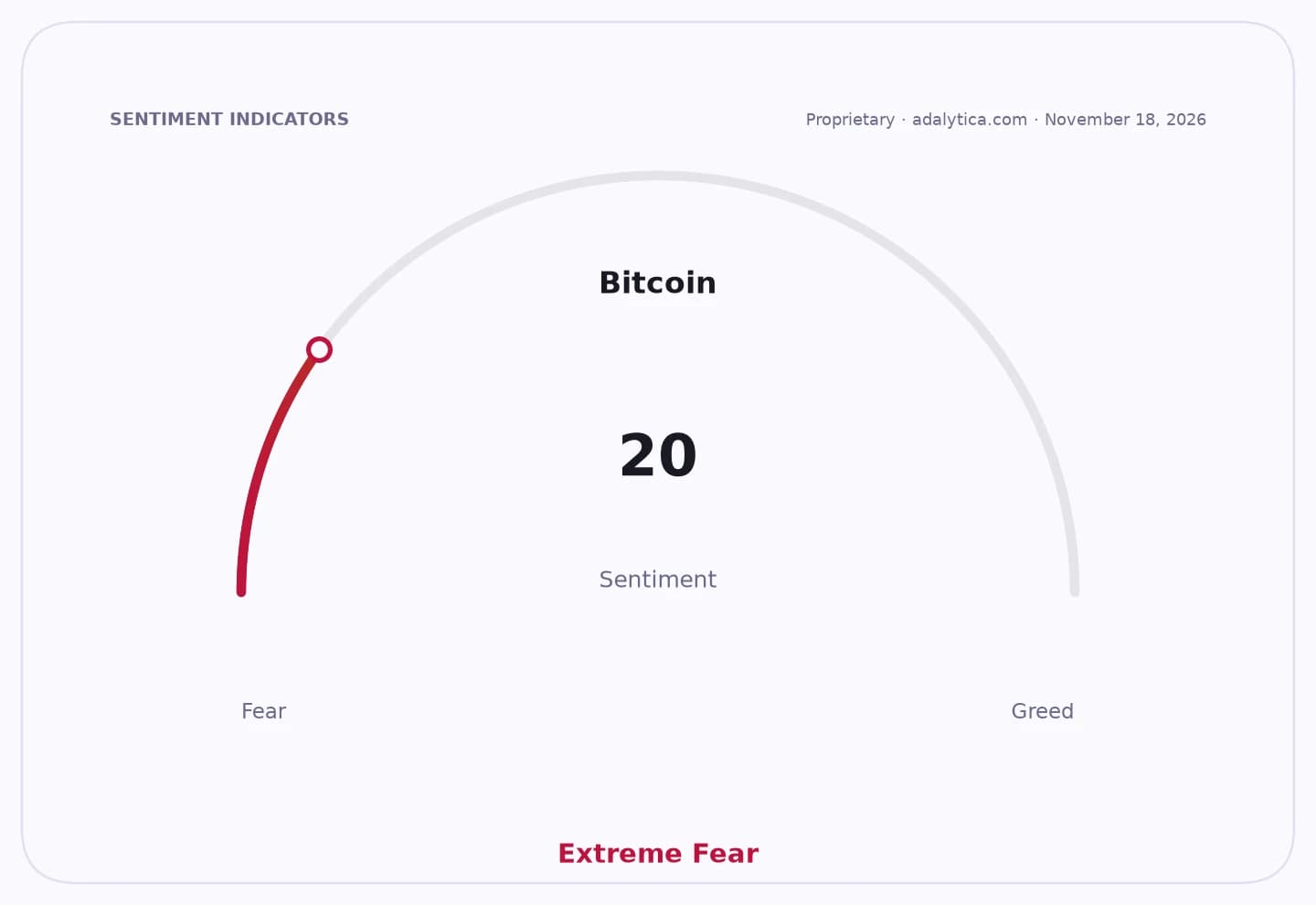
Adalytica’s Bitcoin Fear & Greed Index puts sentiment at 31, in neutral territory but still sharply lower than recent peaks, while its 30-day change shows a 25-point decline. That suggests the market has moved from euphoria to caution, but not yet to capitulation. For investors, that is important: Bitcoin may still have room to stabilize, but the absence of panic also leaves it vulnerable to more selling if equities extend lower or if ETF outflows continue.
The broader signal is that the market is repricing the entire AI and crypto complex at once. Nvidia’s weakness undermines the narrative that tech spending will stay exceptional, while Bitcoin’s drop shows that digital assets remain tethered to the same liquidity cycle. Bulls can argue that both assets are oversold and that the 200-day moving average on Bitcoin, near $72,861, could become a rebound target if risk appetite improves. Bears will point out that momentum has turned hard negative, miners are under pressure, and the market is still searching for a catalyst that can reverse the de-risking.
For now, the key question is whether this is a short, technical flush or the start of a broader unwind in the AI-led risk trade. If Nvidia stabilizes, Bitcoin can probably find support; if not, crypto may remain one of the clearest places where investors are voting against the durability of the entire high-beta story.
| Entity | Gains | Losses |
|---|---|---|
| Cash-heavy traders | ▲Lower entry points | ▼Missed momentum upside |
| Short sellers | ▲Downside profit potential | ▼Short-covering risk |
| Bitcoin holders | ▲Possible rebound if risk stabilizes | ▼Mark-to-market losses |
| Nvidia bulls | ▲Potential oversold bounce | ▼Broken trend and sentiment damage |