Hackers are increasingly using artificial intelligence to target banks, financial firms and insurers, raising the stakes for a sector that sits at the center of payments, credit and customer data flows.
CERT-In warns of AI cyberattacks on BFSI
India’s Computer Emergency Response Team, or CERT-In, said the BFSI sector is facing an escalating cyber campaign in which attackers are using AI to sharpen phishing, automate reconnaissance and scale intrusion attempts. The warning matters because financial institutions are among the most systemically important parts of the economy: a successful breach can disrupt transactions, undermine trust and force firms to spend more on defenses, insurance and incident response.
Sentiment Indicators
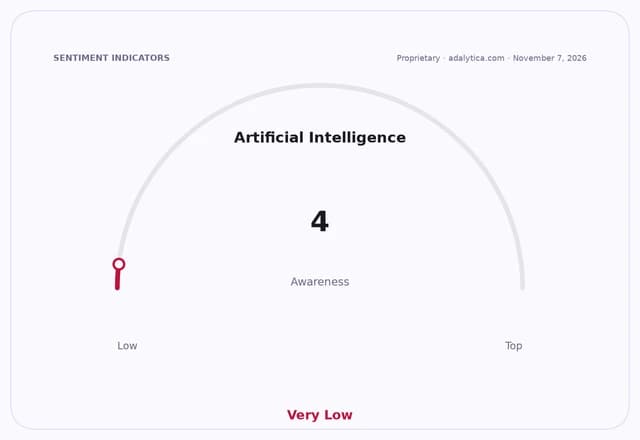
The new threat is especially significant because AI lowers the cost and raises the speed of attacks. Security teams that once had to contend with blunt phishing emails and repetitive malware now face campaigns that can be personalized, rapidly adapted and deployed at scale. That raises the odds of compromise across banks, non-bank lenders, payment firms and insurers, particularly those with large customer bases and complex third-party networks.
For investors, the message is twofold. First, cybersecurity spending is likely to remain structurally elevated across financial services as firms add monitoring, identity protection and response tools. Second, the threat reinforces the investment case for cybersecurity vendors positioned to benefit from higher demand for detection, response and threat intelligence. Palo Alto Networks, CrowdStrike and Fortinet have all been volatile in recent months, but their products sit directly in the path of this trend.
The market backdrop reflects both opportunity and uncertainty. CrowdStrike and Palo Alto Networks have seen sharp swings this year as investors alternated between enthusiasm for AI-driven security tools and concern that AI could also commoditize parts of the software stack. Recent technical readings for those stocks show momentum has cooled materially from earlier highs, with Palo Alto and Fortinet both trading below their 50-day moving averages and posting weak RSI readings, while CrowdStrike has also slipped under its 50-day average. That suggests the sector is still trying to reconcile long-term demand tailwinds with near-term valuation and execution risk.
The warning from CERT-In also fits a broader international pattern. Officials in Europe have been flagging the growing use of AI in hostile cyber operations, and security vendors have been racing to embed their own AI into defensive products. OpenAI has recently tightened policies around safer AI infrastructure, while CrowdStrike has said it is developing defensive AI models to counter AI-powered attacks. The arms race is increasingly becoming a feature of the cybersecurity market rather than a side issue.
For banks and insurers, the economic implications go beyond direct loss events. More frequent attempts mean higher compliance costs, greater pressure on margins and potentially tighter controls around digital onboarding, payments and cloud outsourcing. For regulators, it raises the odds of stronger mandates on reporting, resilience testing and vendor oversight. For investors, the key question is whether the rising threat environment translates into durable revenue growth for security providers or simply higher spending with little pricing power.
The near-term catalyst is whether AI-enabled attacks begin to produce larger, more visible incidents in the BFSI sector. If they do, boards and regulators are likely to move faster, benefiting vendors that can prove efficacy in detection and response. If not, the risk is that security spending keeps rising while buyers delay bigger platform commitments. Either way, CERT-In’s warning underscores that AI is now part of both sides of the cyber battlefield.
| Entity | Gains | Losses |
|---|---|---|
| Cybersecurity vendors | ▲Higher demand for defense tools | ▼Greater scrutiny on execution |
| BFSI firms | ▲Stronger resilience over time | ▼Higher security and compliance costs |
| Hackers using AI | ▲Faster, cheaper attacks | ▼More defensive automation |
| Regulators | ▲Stronger case for oversight | ▼Pressure to respond to incidents |