China’s listed companies delivered their strongest profit growth in about five years in the June quarter, but the market sold off anyway because investors no longer trust earnings alone to drive a sustained rerating.
China Stocks Fall Despite Strong Q2 Profit Growth

The disconnect is stark. Profit growth for companies listed in China rose 25.7% year on year, yet the CSI 300 fell about 9% over the quarter and the STAR 50, dominated by technology names, dropped nearly 29%. The move shows the market is pricing in macro weakness and liquidity risks rather than looking only at headline earnings.
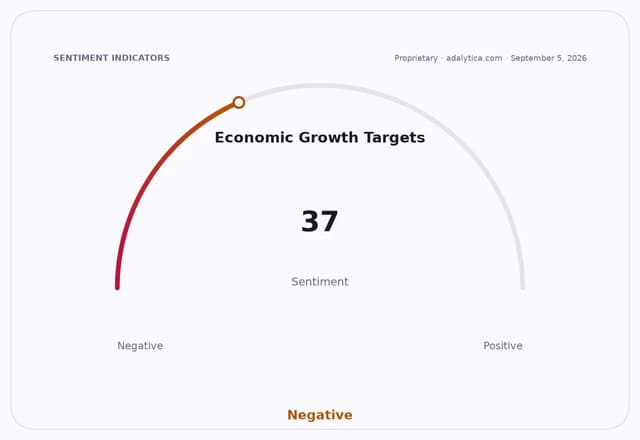
Sentiment IndicatorsⓘProprietary · adalytica.com · September 5, 2026
This is a snapshot — live sentiment, awareness and momentum for 130+ markets update continuously in the dashboard.Open AlphaPulse
One reason is that much of the good news had already been absorbed. The STAR 50 surged 76% in June and the CSI 300 gained 12% during the quarter, leaving limited room for further upside once earnings were published. In other words, valuation and positioning got ahead of fundamentals.
The bigger issue is that China’s economy is still struggling to provide a broad-based earnings backdrop. Domestic demand remains soft, the property market is still weak and investors see little sign of a forceful policy response. That matters because earnings growth concentrated in a handful of companies, especially in artificial intelligence and chips, does not carry the same market power as a cyclical recovery across banks, consumers, industrials and property-linked names.

That concentration also helps explain why individual winners did not lift the market. CXMT Corp reported better-than-expected profit growth, but its share price was volatile. Hygon Information Technology, Cambricon Technologies and Eopolink Technology also posted strong earnings growth yet still saw their shares fall. AI-related stocks have been bid up to record highs, but investors now want evidence that heavy spending on technology will translate into returns rather than just capital intensity.
“Earnings growth is no longer feeding through to stocks,” Union Bancaire Privee managing director V.S. Ling said, adding that investors doubt the durability of that growth and remain uncertain about returns on AI investment as financing costs rise. That is a crucial point for asset allocators: higher profits matter less if they are not repeatable, broad-based or accompanied by improving margins and policy support.
The market backdrop reinforces that caution. Chinese benchmark ETFs such as FXI, MCHI and ASHR have all traded below their 200-day moving averages in recent sessions, underscoring the absence of a sustained trend despite periodic rebounds. Adalytica’s China Economic Growth Target Sentiment gauge has also remained in fear territory, reflecting investor unease over the growth outlook rather than enthusiasm for the latest earnings print.
The result is a market narrative built around skepticism, not celebration. Bullish investors can point to the strongest profit growth in years and the emergence of a handful of genuine AI beneficiaries. Bears argue that China is still stuck with weak domestic demand, a fragile property sector, rising financial costs and an earnings recovery too narrow to justify higher index levels.
For investors, the key question is whether earnings momentum spreads beyond a small cluster of technology names or whether the rally remains a tactical trade in an otherwise slow-growth market. Until there is clearer evidence of a broader economic rebound or a stronger policy push, China’s indices may keep discounting good earnings as a temporary exception rather than the start of a durable upswing.
| Entity | Gains | Losses |
|---|---|---|
| AI chip and tech leaders | ▲Strong profit growth | ▼Valuation skepticism |
| Broad China equities | ▲Selective earnings strength | ▼Macro weakness and de-rating |
| Investors seeking policy stimulus | ▲More room for support bets | ▼Confidence in near-term growth |
| Short-term rally chasers | ▲Tactical volatility opportunities | ▼Limited follow-through upside |