Javier Solana’s defense of Spain’s NATO commitment is less a narrow Spanish political exchange than a sign of how Donald Trump’s pressure campaign is forcing Europe to recast defense spending as an economic and industrial priority.
Europe Defense Shift Favors Local Contractors

The former NATO secretary general and Spanish foreign minister said Spain is “doing everything that needs to be done,” pushing back against criticism that Madrid is not carrying enough of the alliance’s security burden. The remark lands at a sensitive moment: NATO governments are reaffirming collective defense while Europe prepares a $50 billion weapons program aimed at reducing reliance on the United States, including long-range precision weapons and production of U.S.-designed arms on European soil.
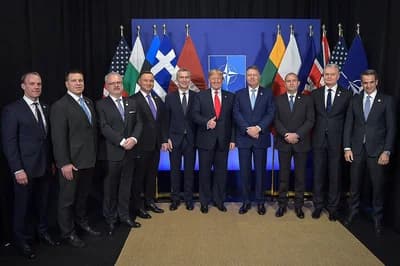
The economic stakes are large. Defense spending is no longer being treated merely as an insurance premium paid to Washington for protection. It is becoming a tool of industrial policy, with governments trying to expand domestic production capacity, secure supply chains and keep more procurement money inside Europe. That shift could reshape budget priorities across the continent, particularly for countries such as Spain that have faced repeated U.S. pressure over burden sharing.
Trump’s criticism matters because it changes the negotiating logic inside NATO. European governments still want the U.S. security guarantee, especially with the war in Ukraine and wider instability from the Middle East to the Western Pacific reinforcing demand for air defense, missiles, ammunition and surveillance systems. But they are increasingly trying to prove that the alliance is not a one-way dependency. Solana’s message is therefore political cover for Madrid and a broader argument that contribution should be measured by capability, readiness and strategic alignment, not only by headline spending ratios.
For investors, the result is a more complicated defense trade. European rearmament supports long-term demand for companies such as BAE Systems and Airbus, particularly if procurement is routed through European programs rather than U.S. imports. Airbus’s U.S.-listed shares recently traded above both their 50-day and 200-day moving averages, a conventional technical sign that investors are still rewarding parts of the European aerospace and defense complex despite volatility. BAE’s U.S.-listed shares, by contrast, have pulled back below those same moving averages after earlier strength, suggesting the sector’s political tailwind is not eliminating stock-specific or valuation concerns.
U.S. contractors are not excluded from the story. Lockheed Martin remains central to NATO air power and missile defense, and U.S.-designed arms may still be produced in Europe under the new approach. But the strategic direction is clear: Europe wants more control over what it buys, where it builds and how quickly it can replenish stocks. Lockheed’s shares have recently traded below their 200-day moving average, a conventional market signal that investors are weighing the benefits of elevated defense demand against budget uncertainty, supply-chain pressures and the risk that European procurement becomes more localized.
Corporate filings from major U.S. defense groups underline the same tension. Northrop Grumman and RTX have warned that heightened global instability is supporting demand, while also noting that policy shifts, licensing delays, sanctions risk and geopolitical disruptions can affect sales. Lockheed has highlighted both major modernization opportunities and risks tied to rare earth minerals, a reminder that rearmament depends not just on political will but on industrial inputs that can be constrained by global supply chains.
Solana’s intervention also points to the political challenge ahead. Spain and other European allies must convince Washington that they are credible security partners while convincing their own voters that higher defense outlays will not simply crowd out social spending. That is why the European weapons program is so important: it gives leaders a domestic economic argument for rearmament by linking NATO commitments to factories, engineering jobs and strategic autonomy.
The next test will be whether Europe can turn pledges into production. If Trump keeps pressure on NATO allies, Madrid’s defense of its record will matter less than whether Spain and its partners can deliver capabilities fast enough to satisfy Washington, deter adversaries and persuade markets that Europe’s defense buildout is a durable investment cycle rather than another summit promise.
| Entity | Gains | Losses |
|---|---|---|
| European defense contractors | ▲Local procurement tailwind | ▼Valuation pressure |
| U.S. defense primes | ▲Licensing and NATO demand | ▼European localization |
| Spain and NATO doves | ▲Broader contribution argument | ▼Spending-ratio scrutiny |
| Trump and NATO hawks | ▲Leverage over allies | ▼European autonomy |