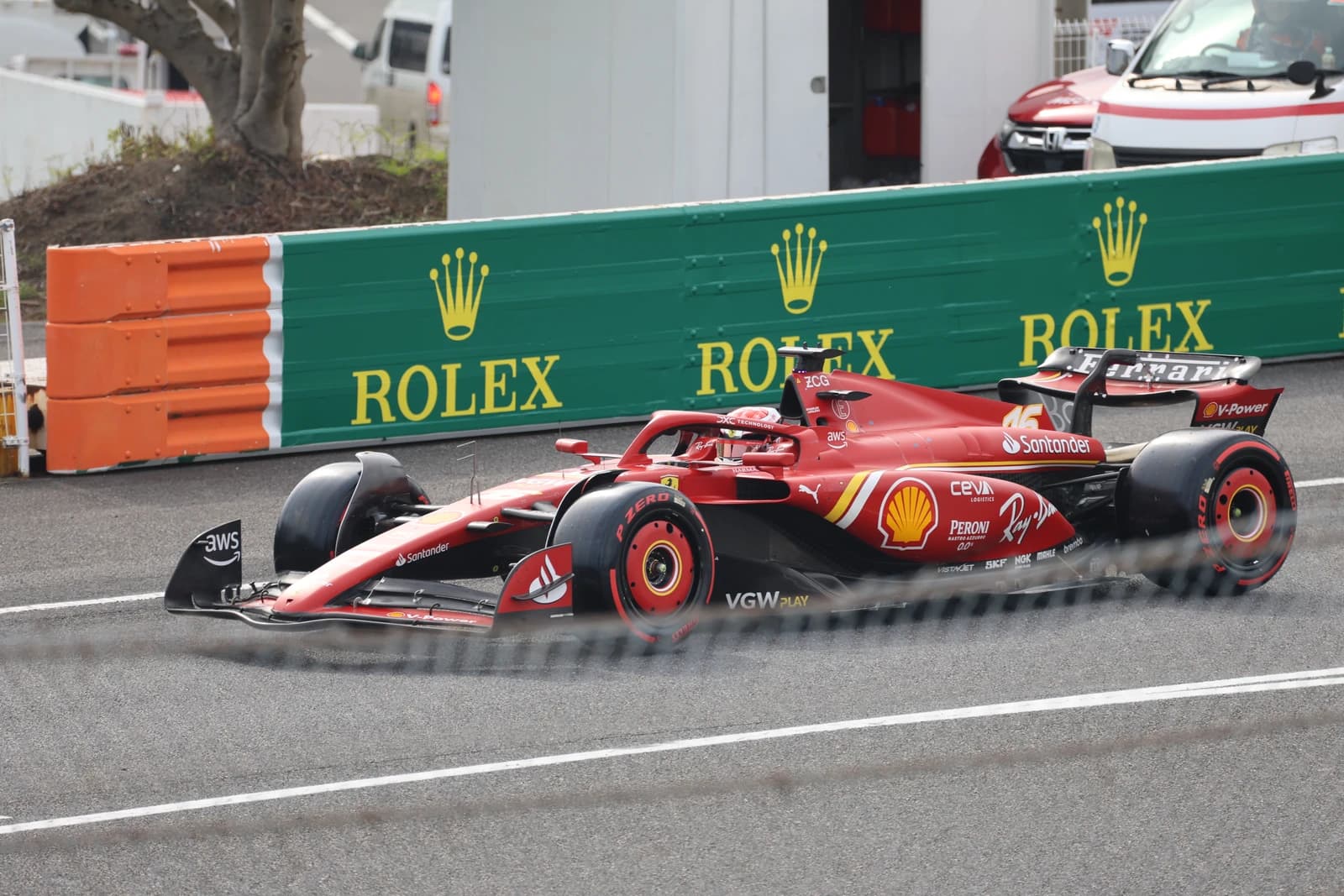
Lewis Hamilton’s Las Vegas Grand Prix unravelled into a Ferrari internal collision, a 10-second penalty and a points loss that underscored how costly mistakes can be in Formula One’s tightest title fights.
Ferrari Collides in Las Vegas Grand Prix
The most important development was not Max Verstappen’s win, impressive as it was, but Ferrari’s self-inflicted damage at a race where the field stayed tightly bunched for much of the night. Hamilton was penalised for leaving the track and gaining an advantage in his battle with Lando Norris, then was spun by Charles Leclerc in a separate Ferrari-to-Ferrari clash that left both drivers compromised and exposed the team’s persistent operational fragility.
That matters because Las Vegas produced a race in which track position, battery deployment and pit timing were decisive, while overtaking was plentiful enough to punish any error immediately. In a contest with more than two dozen lead changes and hundreds of overtakes, Leclerc’s 10-second penalty for the Hamilton collision and Hamilton’s earlier sanction effectively turned Ferrari from a contender into a casualty. When margins are this thin, a single misjudged move can cost multiple places and points.
For investors and sponsors, the significance is broader than one chaotic Sunday. Ferrari remains one of Formula One’s most valuable commercial assets, but race-day execution is what converts brand power into championship results and fan engagement. Another high-profile intra-team collision reinforces the perception that Ferrari is still struggling with discipline under pressure, a reputational cost that matters in a sport where partner value, media exposure and on-track credibility are tightly linked.
The race also highlighted the competitive balance at the front of Formula One. Verstappen’s victory, his 75th, came after he held off repeated Mercedes challenges in a race he called unlike anything he had seen before. But Mercedes’ late errors — George Russell crashing while pushing for the lead and Kimi Antonelli fading after battery deployment issues — opened the door for McLaren’s Lando Norris and Oscar Piastri to salvage a surprise double podium.
That sequence matters economically because it shows how much the championship battle is still being shaped by marginal gains and mistakes rather than outright pace alone. In that environment, teams with cleaner strategy and more consistent execution can outperform faster cars, while those that misfire can lose ranking, prize money and momentum in a single evening. The Las Vegas street circuit amplified that dynamic, with slipstream effect, energy management and tyre conservation all magnifying the cost of indecision.
Ferrari now faces the familiar problem of explaining why its cars keep colliding when the competitive window is already narrow. Leclerc accepted fault and called the incident embarrassing for the team, while Hamilton, furious over the radio earlier in the race, stopped short of publicly escalating the dispute. That may calm the immediate fallout, but it does little to change the underlying narrative: Ferrari still looks more vulnerable to pressure than the rivals it is trying to catch.
For the next races, the key question is whether Ferrari’s performance ceiling is being limited more by machinery or by governance. Las Vegas suggested the latter remains a serious drag.
| Entity | Gains | Losses |
|---|---|---|
| Verstappen/Red Bull | ▲Race win and momentum | ▼Little from chaotic field |
| McLaren | ▲Surprise double podium | ▼Missed chance at victory |
| Ferrari | ▲— | ▼Penalty, collision, lost points |
| Mercedes | ▲Raw pace shown | ▼Late-race errors and podium slip |