France’s top planning body is urging a sweeping overhaul of the country’s labor model, arguing that financing the welfare state will require people to work longer, retrain more often and move more easily across careers as aging and weaker productivity gains erode the old postwar formula.
France Planning Body Urges Longer Work Lives

The report, presented by former labor chief of staff Antoine Foucher for the High Commission for Planning, is economically significant because it puts France’s pension and social-protection debate squarely at the center of its growth problem. It says the social model built during the 1945-1975 “Trente Glorieuses” is “clearly at an end” and proposes a new pact built on skills investment, longer activity spans and benefits more closely tied to the individual.
Sentiment IndicatorsⓘProprietary · adalytica.com · September 13, 2026
This is a snapshot — live sentiment, awareness and momentum for 130+ markets update continuously in the dashboard.Open AlphaPulse
The most immediate plank is a push to massively expand training and apprenticeships, with a goal of lifting the number of apprentices to 1.5 million by 2035, roughly matching Germany. By 2050, the report wants a universal right to retraining, giving each worker at least one six-month to one-year entitlement to switch professions, a move that would support labor mobility but also require sustained public and employer funding.
On retirement, the report says France must either adopt a points-style pension system that lets people phase activity across life or raise contribution periods by three to four years. Foucher said that for someone who started work at 18, retirement would shift from 61 to 64, while a worker entering at 23 or 24 could be looking at 70.
That matters for investors because it points to a longer-term reallocation of labor, wage and tax burdens across the economy. French equities and domestically exposed sectors are sensitive to any reform that could change labor supply, hiring costs and household purchasing power, while banks, insurers and asset managers are watching closely for implications for savings, retirement products and long-duration liabilities.
The report also argues for a more person-based social-protection system to fit patchier careers and a bigger share of self-employed workers. In the short term, it says the only way to improve take-home pay from work is to narrow the gap between gross and net pay by broadening the tax base that funds the system, underscoring the fiscal trade-offs facing Paris.
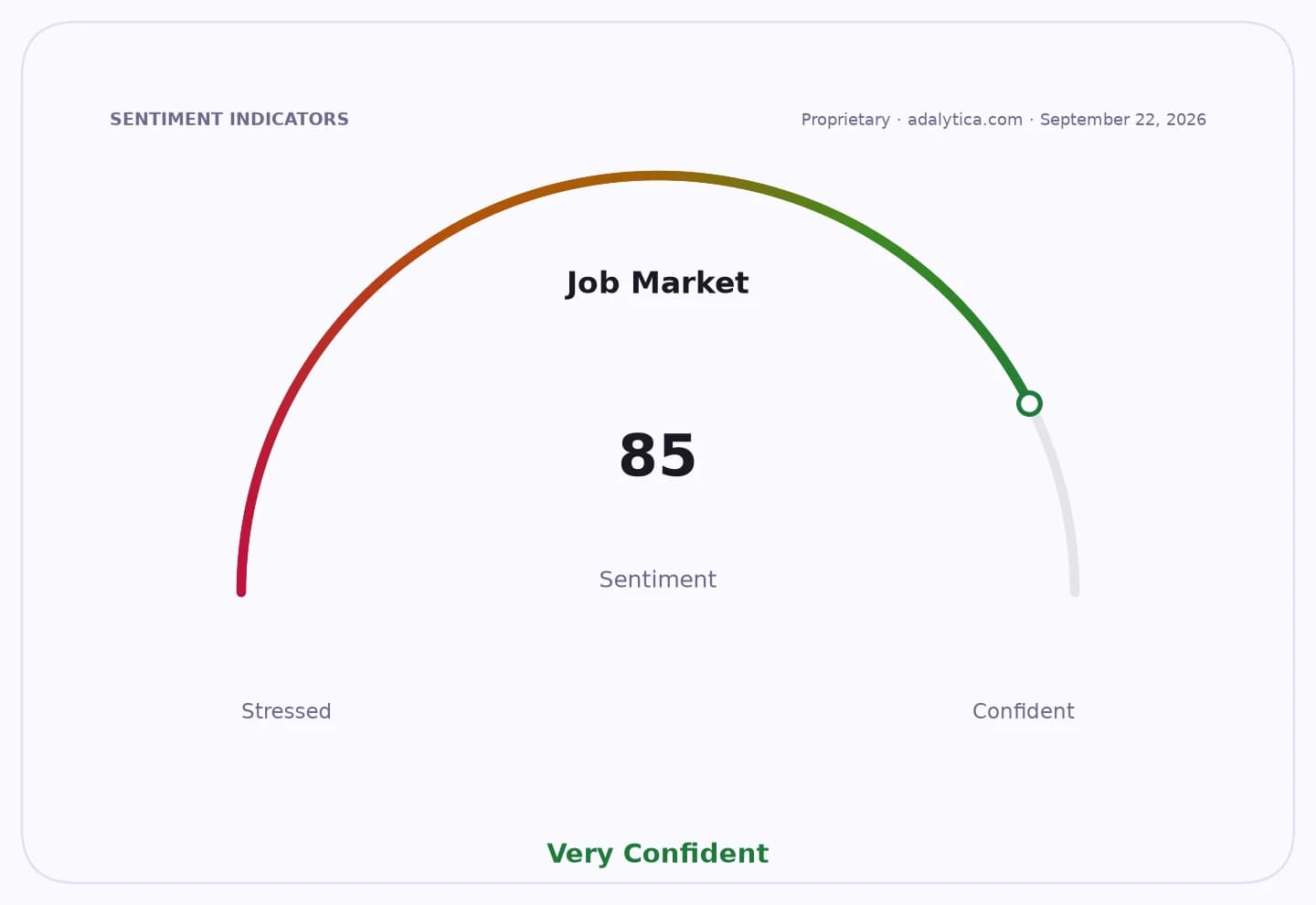
The backdrop is a labor market that still looks resilient but is not immune to structural pressure. In U.S.-market proxies, the XLF financials ETF was recently trading at $57.25, above its 50-day and 200-day moving averages, while France-linked EWQ was at $44.93, below its 50-day average, and FXE was at $107.01, near its 200-day average, reflecting the uneven tone across European assets. Adalytica’s job-market sentiment gauge remains elevated at 85, suggesting confidence in employment still runs high, even as consumer-confidence recession sentiment sits at 30.
The political challenge is that the report is calling for more work at a time when French social consensus remains fragile after years of pension fights. What happens next will depend on whether the government turns the proposals into legislation or leaves them as a blueprint for the 2035 and 2050 planning agenda, but the message is already clear: preserving France’s welfare state will mean asking workers to spend more years in the labor force and spend more of those years retraining.
| Entity | Gains | Losses |
|---|---|---|
| Employers | ▲larger labor pool | ▼higher training obligations |
| Workers with stable careers | ▲more flexibility over time | ▼later retirement age |
| Self-employed and career-switchers | ▲portable social protection | ▼weaker legacy benefits |
| French public finances | ▲broader contribution base | ▼greater near-term reform resistance |