AI’s advance into publishing is no longer a distant policy question at the Frankfurt Book Fair; it is a live commercial fight over who controls content, who gets paid for it and which jobs survive. That makes the industry’s debate in Frankfurt economically important well beyond books, because it pits the value of human-made intellectual property against the efficiency gains promised by machine-made text and audio.
Frankfurt Book Fair Debates AI Licensing

At the fair’s opening, historian Jill Lepore warned that AI firms were threatening reading, writing and the democratic role of books, framing the issue as one of cultural ownership as much as technology. Her argument reflects a broader backlash building across publishing, where more than 40 publishers including Agence France-Presse and The Economist have formed a coalition to block AI companies from using or monetizing their content without permission.
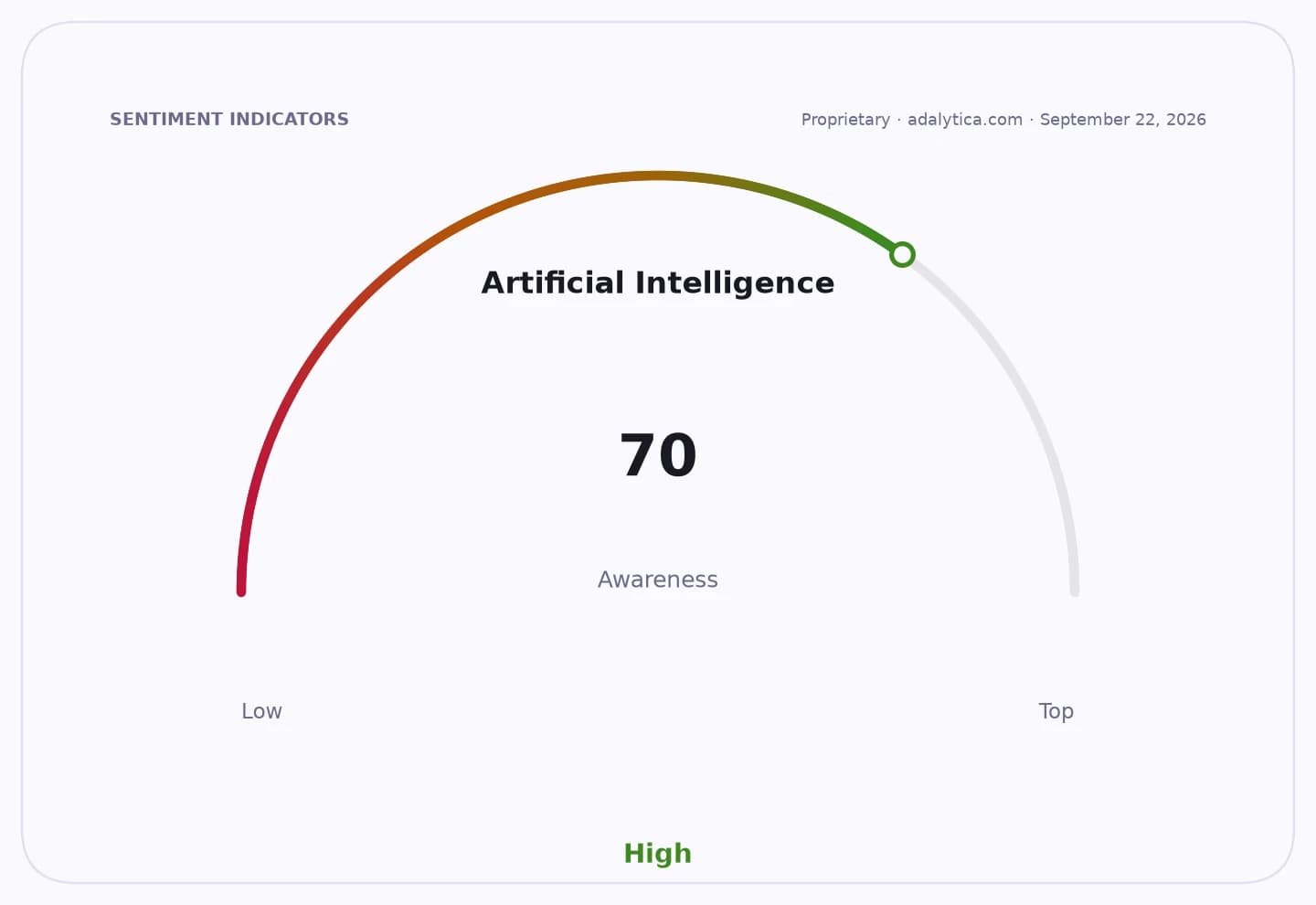
Sentiment IndicatorsⓘProprietary · adalytica.com · October 13, 2026
This is a snapshot — live sentiment, awareness and momentum for 130+ markets update continuously in the dashboard.Open AlphaPulse

The money at stake is not abstract. Publishers depend on copyright to preserve pricing power over books, articles and licensed excerpts. If generative AI systems can ingest that material without compensation, the industry risks losing both direct revenue and the scarcity value of its archives. That explains why the debate in Frankfurt has shifted from ethics to enforcement: who can train models on editorial content, under what terms, and how human authorship is verified in an AI-saturated market.
The fair also showed the labour-market implications. Nigel Newton, founder of Bloomsbury, said AI will reshape jobs but not replace people outright, arguing that basic tasks are most exposed while editorial judgment and commissioning still require humans. Sarah Arbuthnot of Supadu and Suzanne Collier, founder of bookcareers.com, said employers will need to retrain staff for hybrid roles that combine marketing, metadata and audience management. For publishers, that means AI is not only a cost pressure but a restructuring tool that could widen the gap between firms investing in workflow automation and those relying on legacy staffing models.

Investors should read that as both a risk and an opportunity. Companies with strong rights management, differentiated content libraries and the ability to license rather than litigate may be better placed to monetize AI. Those without clear control over their archives face margin pressure if legal disputes drag on or if creators demand stronger royalty protections. The market has already begun to assign a premium to firms that can turn proprietary data into product, a theme visible across large-cap technology names even as their filings flag legal and reputational risks tied to AI.
The audiobook debate sharpened the commercial divide. Storytel’s Helena Gustafsson likened AI narration to fast food versus fine dining, suggesting synthetic voices can serve some customers but not replace premium human performance. Horbuch Hamburg said it uses only human narrators for its roughly 500 audiobooks a year, while Blinkist abandoned AI voice narration after customer backlash over quality and trust. That matters because audiobooks have been one of publishing’s fastest-growing categories, and the choice between synthetic and human narration will determine whether AI expands margins or erodes the premium that listeners pay for voice talent and production quality.
For listed technology groups heavily exposed to AI infrastructure and model deployment, the Frankfurt debate is a reminder that the next phase of AI growth will be judged less on hype than on permissions, provenance and product quality. Microsoft, Alphabet and Meta have all disclosed legal and reputational risks tied to AI use, and publishers’ push for consent-based licensing could become a template for other content owners. The upside case is a market in which AI helps publishers scale discovery, metadata and translation. The downside is a rights war that slows adoption, raises compliance costs and forces the industry to prove that machines can add value without hollowing out the human work that gives books and audio their price.
| Entity | Gains | Losses |
|---|---|---|
| Publishers with strong rights libraries | ▲Licensing leverage | ▼Uncompensated scraping |
| AI companies | ▲Faster model training | ▼Higher legal risk |
| Human narrators and editors | ▲Demand for premium work | ▼Synthetic substitution |
| Readers/listeners | ▲More formats and choices | ▼Lower trust if quality slips |