Google’s launch of Lyria 3.5 into the Gemini app and API pushes AI music from a novelty into a product that can be distributed, monetized and regulated at scale, intensifying the fight over rights, royalties and what counts as human-made music.
Google Lyria 3.5 launch in Gemini app and API
The model can generate full songs with verses, choruses and bridges, produce 44.1kHz stereo audio from text or image prompts, and embed SynthID watermarking in every track. That combination matters because it lowers the friction for creating broadcast-quality music while giving Google a mechanism to identify AI-generated output as the industry faces a flood of synthetic tracks.
Sentiment IndicatorsⓘProprietary · adalytica.com · September 5, 2026
This is a snapshot — live sentiment, awareness and momentum for 130+ markets update continuously in the dashboard.Open AlphaPulse
For investors, the launch underscores a widening commercial arena around generative audio, but also the legal and competitive risks attached to it. The AI music market is already crowded, with reports saying more than half of new uploads to Deezer are AI-generated and roughly 90,000 fully AI tracks are being produced daily. Yet those tracks still account for only 1% to 3% of actual listening, suggesting usage is rising faster than monetization.
That gap is the central investment question. If AI music becomes a discovery and production layer rather than a direct consumer substitute for licensed catalogs, platforms such as Google can deepen engagement in their AI ecosystems without immediately displacing incumbents. If, however, synthetic music continues to scale into mainstream listening, labels, publishers and streaming services could face pressure on catalog value, royalty structures and anti-fraud controls.
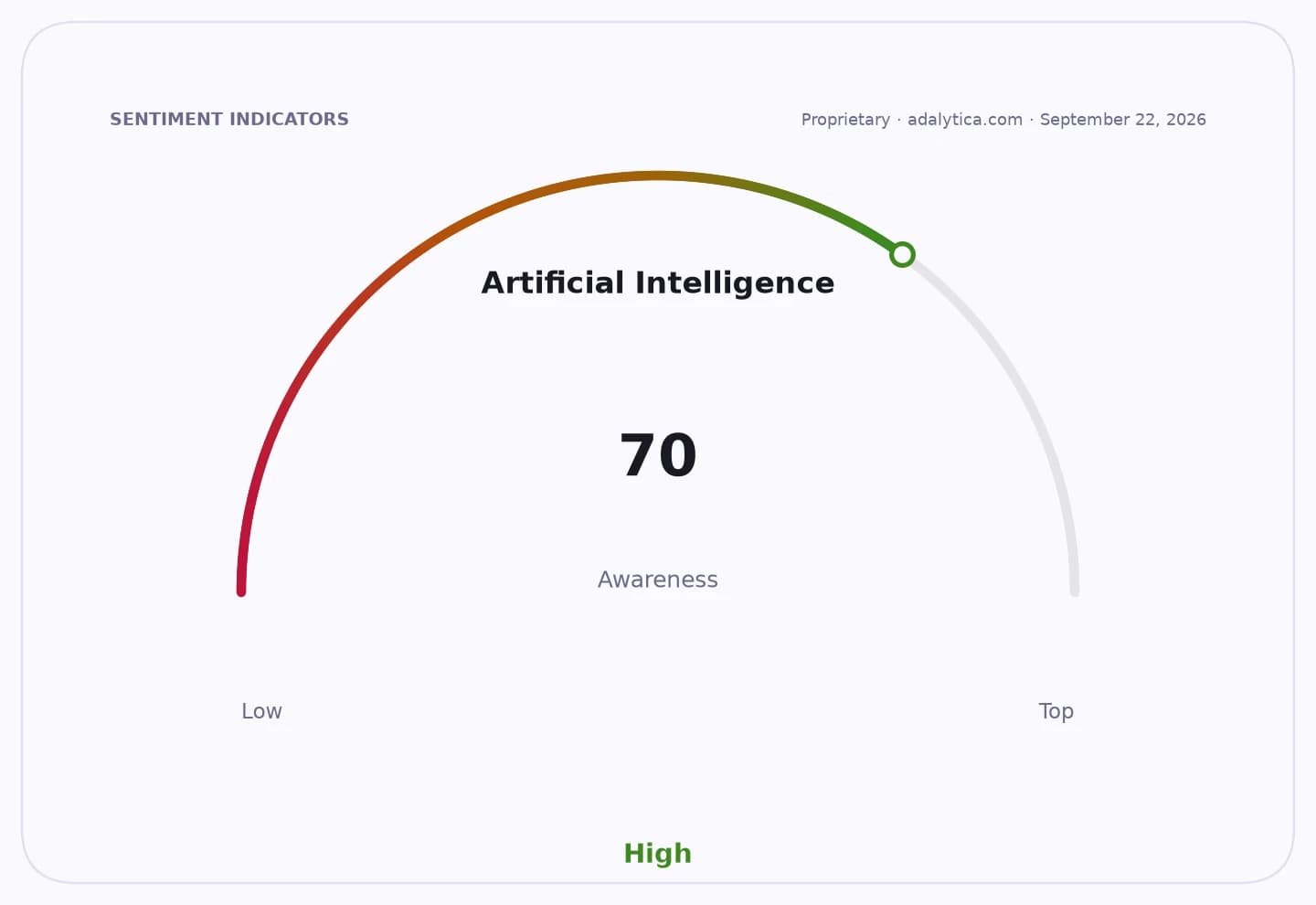
Artificial Intelligence — 30-day sentimentadalytica.com
Explore this data interactively — full history, time series and cross-market comparisons.Open AlphaPulse
The launch also lands against a tightening regulatory and industry backdrop. Australia’s ARIA has banned fully AI-generated songs from chart eligibility and awards, while major labels including Sony and Warner Music have taken legal action over training data use. Google’s decision to watermark Lyria tracks with SynthID appears designed to make the model more defensible, but it does not remove the broader question of who owns the inputs, outputs and commercial rights.
Alphabet’s shares have been trading close to the upper end of their recent range, with the stock at $338.46 on Sept. 4, above its 200-day moving average of $335.50 but slightly below its 50-day average of $348.35. The stock’s relative strength and MACD readings have softened recently, suggesting investors are watching whether the company can convert AI product launches into durable revenue without adding fresh margin risk from heavy model investment.
For Google, Lyria 3.5 is less about music alone than about proving that its AI stack can touch consumer creation tools, developer APIs and media workflows at once. The near-term upside is clearer engagement and another AI use case inside Gemini. The longer-term test is whether Google can keep the product inside a legal framework that satisfies rights holders while still making generative audio commercially meaningful.
| Entity | Gains | Losses |
|---|---|---|
| Google / Alphabet | ▲Gemini usage, AI product breadth | ▼Legal and compliance risk |
| Developers / creators | ▲Faster song generation, new tools | ▼Less differentiation, rights uncertainty |
| Labels / publishers | ▲Watermarking and traceability | ▼Training-data and royalty pressure |
| AI music rivals | ▲Market validation | ▼More competition from Google |