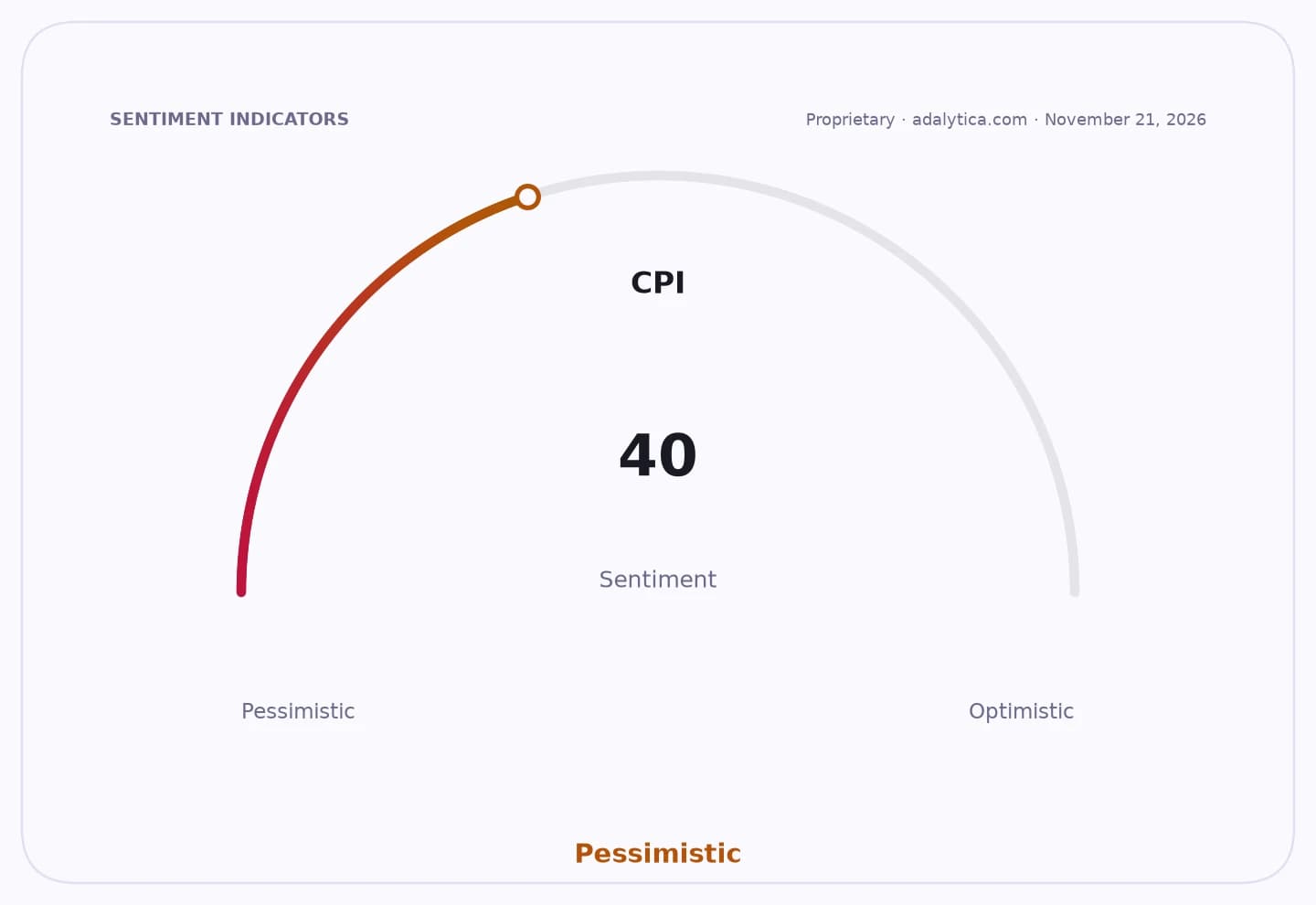
Greece’s government has raised its inflation forecast for this year to 4% in the final 2027 budget it is submitting to parliament, underscoring how persistent energy costs are still eroding household purchasing power even as Athens keeps leaning on investment-led growth and rapid debt reduction.
Greece raises 2027 inflation forecast in budget

The higher price outlook, up from 3.8% in the draft budget, matters because it feeds directly into wages, pensions and the broader fiscal backdrop. Inflation is also now seen at 2.8% in 2027, versus 2.6% previously, bringing the government closer to the European Commission’s more cautious view that Greek inflation will remain above the euro area norm.
Sentiment Indicators
CPI
That matters for consumers first. Officials say the latest surge in energy prices is filtering through to production costs, transport and services, keeping prices elevated and squeezing real incomes. The inflation revision also affects the formula used to calculate main pension increases, which is tied to 50% of GDP growth and 50% of the previous year’s inflation.
On those assumptions, and with growth projected at 2% in 2026, pensions in 2027 would rise about 3%, though the government still has to clarify how it will handle the increase. The budget also includes 1.9 billion euros in tax cuts and income support announced at the Thessaloniki Fair, including a 400-euro payment for pensioners over 65 and rent rebates for more than 1 million households.
For investors, the more important message is that Athens is still presenting Greece as one of the euro area’s stronger growth stories. The budget pegs 2027 GDP growth at 2.3%, versus 2% this year, which would mark a seventh straight year above the eurozone average, forecast at 1.2%.
Investment remains the main engine. The government expects capital spending to rise 7.9% in 2027, after 7.7% this year, while the public investment program increases to 11 billion euros from 9.8 billion euros as the recovery fund winds down. Exports of goods and services are seen rising 3.1% in 2027, with imports up 4%.
The fiscal numbers are also supportive. Athens is now targeting a primary surplus of 4% to 4.1% of GDP in 2026, above the 3.6% penciled into the draft, before easing to 3.3% in 2027, or 9.1 billion euros. Nominal GDP is projected to reach 274.592 billion euros in 2027, from 262.012 billion euros in 2026.
Debt reduction remains the core investment narrative. Public debt is expected to fall to 136.7% of GDP in 2026 from a pandemic peak of 209.4% in 2020, then to 128.8% in 2027. The government also plans further early repayments of first-bailout loans, with 12.8 billion euros due to be prepaid in 2026, reinforcing Greece’s effort to lock in lower financing risk over time.
The next test is whether the government can keep growth above the euro area while inflation stays contained enough to protect real incomes. Eurostat will confirm the 2026 surplus in April, and the path for energy prices will remain the biggest short-term risk to both household demand and the budget’s assumptions.
| Entity | Gains | Losses |
|---|---|---|
| Greek government | ▲stronger surplus path | ▼higher inflation credibility risk |
| Greek households | ▲tax relief and transfers | ▼weaker purchasing power |
| Bondholders | ▲faster debt decline | ▼inflation-driven spending pressure |
| Pensioners | ▲2027 increase formula support | ▼delayed relief from prices |