Greece’s 1.4 million self-employed workers are set for another rise in mandatory social security contributions in 2027, with the smallest increase likely to be about 3.5%, or roughly in line with inflation, and potentially higher if the government opts for a broader adjustment.
Greece self-employed face 2027 social security rise
The increase matters because it will raise fixed monthly costs for freelancers, small business owners and independent professionals at a time when many are already coping with elevated energy bills and sluggish income growth. Under the inflation-linked scenario now being discussed, the monthly charge for main pension and healthcare cover would rise by about 9 to 24 euros depending on category, implying an annual increase of 105 euros to 284 euros for the lower and upper brackets. If the adjustment follows a larger wage-based formula, the extra burden could climb as high as 446 euros a year for those in the sixth insurance class.
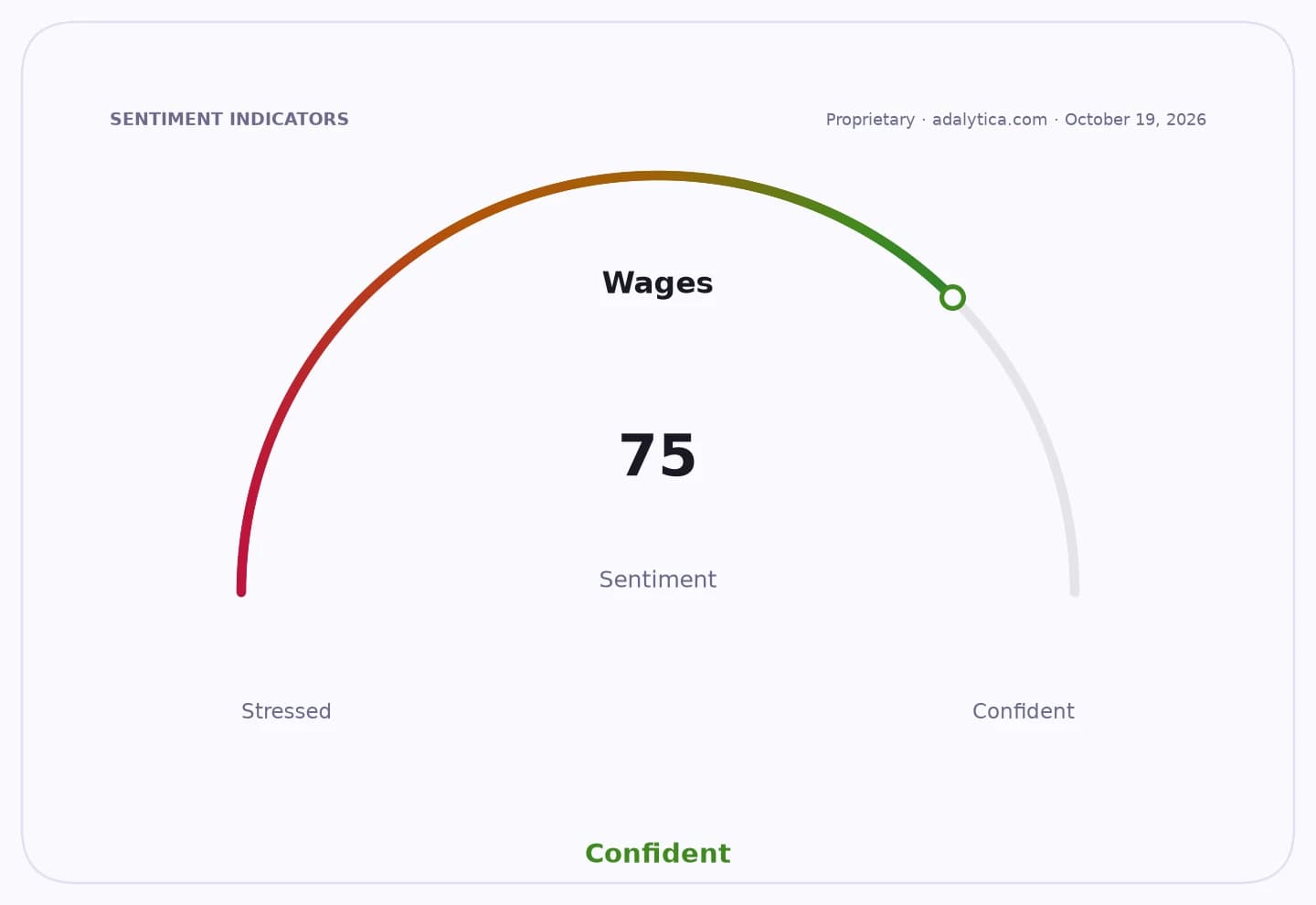
Sentiment IndicatorsⓘProprietary · adalytica.com · October 21, 2026
This is a snapshot — live sentiment, awareness and momentum for 130+ markets update continuously in the dashboard.Open AlphaPulse
The issue has become a test of policy judgment for the labour ministry. Greek law envisages linking contributions to the change in wages, but that mechanism has already been delayed twice, with inflation used instead in 2025 and 2026. For 2027, the legal and technical path remains open, but the balance of probabilities now points to another postponement of the wage index, not least because the relevant committee has not met and the statistics agency has yet to complete the indicator needed for the new formula.
For the government, the choice is as much political as technical. Using inflation as the base would soften the hit to the self-employed, many of whom choose the lowest insurance class. But it would also extend a transitional regime that was supposed to be temporary, leaving unresolved the broader question of whether contributions should eventually track wages, which tend to grow faster than prices in periods of solid economic expansion.
The difference is not trivial. In the first insurance category, the monthly contribution for main pension and healthcare would rise from 250.77 euros to 259.55 euros under a 3.5% adjustment, or 261.43 euros under a 4.25% increase. A 5.5% move, though considered unlikely, would push it to 264.56 euros, before the separate 10-euro unemployment levy and any supplementary pension or lump-sum contributions.
At the top end, the sixth category would rise from 675.87 euros to 699.53 euros at 3.5%, or 704.59 euros at 4.25%, before additional levies. That makes the policy especially relevant for higher-earning professionals, but the larger macroeconomic impact falls on the broad base of smaller operators who already face thin margins and irregular cash flow.
The debate also has a retirement consequence. Remaining in the lowest category eases immediate pressure on household budgets, but it can depress future pension entitlements, since insured earnings feed into the calculation of the contributory pension. That creates a structural trade-off between present liquidity and future income that many self-employed workers cannot easily avoid.
For investors, the direct market impact is limited, but the policy is part of a wider Greek inflation-and-income story. A larger contribution burden would weigh on disposable income and small-business operating costs, potentially slowing consumption among a key domestic cohort. It would also reinforce the sense that inflation, rather than wage growth, is still the main policy yardstick in Greece’s social insurance system.
The most likely outcome is another inflation-based adjustment, which would keep the increase contained but preserve the government’s flexibility. The risk for policymakers is that repeated deferrals of the wage-linked formula eventually turn a temporary compromise into a permanent feature, leaving the self-employed with rising mandatory charges but no corresponding rise in income.
| Entity | Gains | Losses |
|---|---|---|
| Greek government | ▲Avoids a larger social backlash | ▼Defers wage-linked reform |
| Self-employed workers | ▲Smaller hit under inflation formula | ▼Higher mandatory monthly costs |
| Higher-income insured | ▲Predictable, capped increase | ▼Bigger absolute contribution rise |
| State pension system | ▲Steadier contribution revenue | ▼Political pressure over fairness |