ICE launches gold futures in London, a move that could reshape how one of the world’s deepest physical bullion markets prices and hedges precious metals exposure.
ICE Launches London Gold Futures

For investors, the significance is bigger than a new product line. Intercontinental Exchange is trying to turn London’s $190 billion-a-day over-the-counter gold market and roughly $1.4 trillion of vaulted bullion into a more transparent, exchange-traded venue — the kind of market structure that tends to pull in more hedging activity, tighter pricing and, eventually, more fee revenue for the exchange operator.
Sentiment IndicatorsⓘProprietary · adalytica.com · October 7, 2026
This is a snapshot — live sentiment, awareness and momentum for 130+ markets update continuously in the dashboard.Open AlphaPulse
That is the real prize. London has long dominated physical gold trading but never built a major futures market to match New York’s established contract business. ICE is now attempting to fill that gap with futures linked to London’s daily gold price auctions, while also adding silver, platinum and palladium contracts. If the launch gains traction, it would give miners, refiners, banks and portfolio managers a cleaner way to manage price risk without shifting immediately into the physical market.
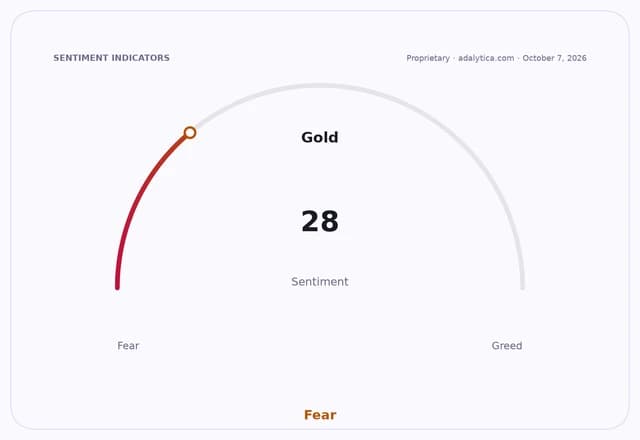
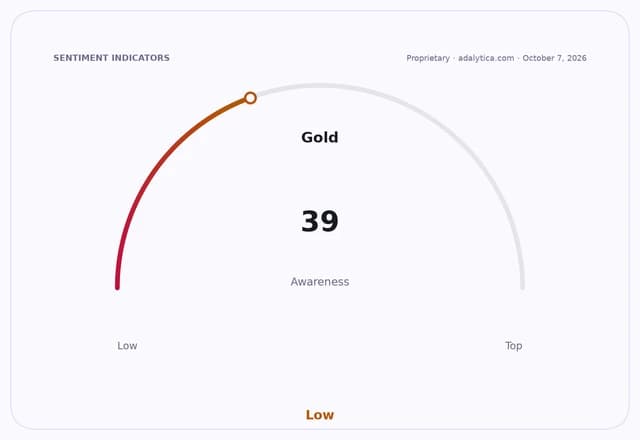
The timing matters. Gold has become a more central macro asset as investors navigate volatile growth, a shaky dollar and higher-for-longer interest rates that keep real-yield sensitivity front and center. Adalytica’s Gold Fear & Greed Index shows sentiment at 28, in fear territory, even after a sharp day-to-day rebound in awareness, underscoring how quickly positioning can reset when the market senses a new catalyst. In that environment, a London-based futures venue could draw incremental volume from participants who already trade bullion there and want a local hedging tool rather than routing risk through New York.
For ICE, the launch is also a classic exchange play: own the plumbing, collect the tolls. The company is not betting on gold direction so much as on transaction velocity, open interest and market migration. That makes the opportunity asymmetric if London’s physical market embraces the contract. Exchange operators often win when they can convert fragmented over-the-counter activity into standardized futures, especially in a globally important asset with recurring hedging needs.
The competitive backdrop is straightforward. Previous attempts to establish a durable London gold futures market failed, including an early 1980s venue that closed after three years and a London Metal Exchange effort that later dropped its gold contract. That history means ICE still has to prove liquidity can stick. But it also suggests the addressable market is large enough to keep attracting challengers, which is usually the setup before a real market forms.
Investors should view this as a potential long-duration growth lever for ICE rather than a one-off product launch. The more precious-metal flow migrates into exchange-traded contracts, the more ICE can deepen its derivatives franchise, especially if banks and physical-market participants use London pricing as a benchmark for global trade. The stock is already trading near its 50-day and 200-day moving averages, which means the market has not fully priced a successful London expansion.
My thesis is simple: this is a pick-and-shovel opportunity inside the next phase of commodity market modernization. If London futures gain even modest traction, the beneficiaries are ICE, market makers and hedgers seeking tighter execution. The losers are incumbents tied to fragmented OTC pricing and venues that fail to capture the flow. Watch for volume, open interest and whether this London contract becomes the default hedge for the bullion market. If it does, ICE has just opened a new toll road through one of the world’s most valuable commodities.
| Entity | Gains | Losses |
|---|---|---|
| ICE | ▲New fee stream | ▼Launch risk if liquidity is thin |
| London bullion market | ▲More hedging tools | ▼Fragmented OTC dominance |
| Banks and hedgers | ▲Local price-risk management | ▼Wider execution costs |
| New York gold futures rivals | ▲Potential flow loss | ▼Share erosion if London gains traction |