Central banks may soon have to set interest rates in an economy where artificial intelligence is no longer just a source of productivity gains, but also a potential risk to growth, inflation and financial stability, IMF chief Kristalina Georgieva warned.
IMF Warns AI Boom Could Complicate Central Banks
Her comments matter because they sharpen a dilemma already facing policymakers: AI-driven investment has helped cushion economies from weaker demand and supply shocks, but a slowdown in that spending could hit growth just as inflation remains sticky. That would leave central banks trying to judge whether any cooling in the economy is a benign rebalancing or the start of a broader slowdown.
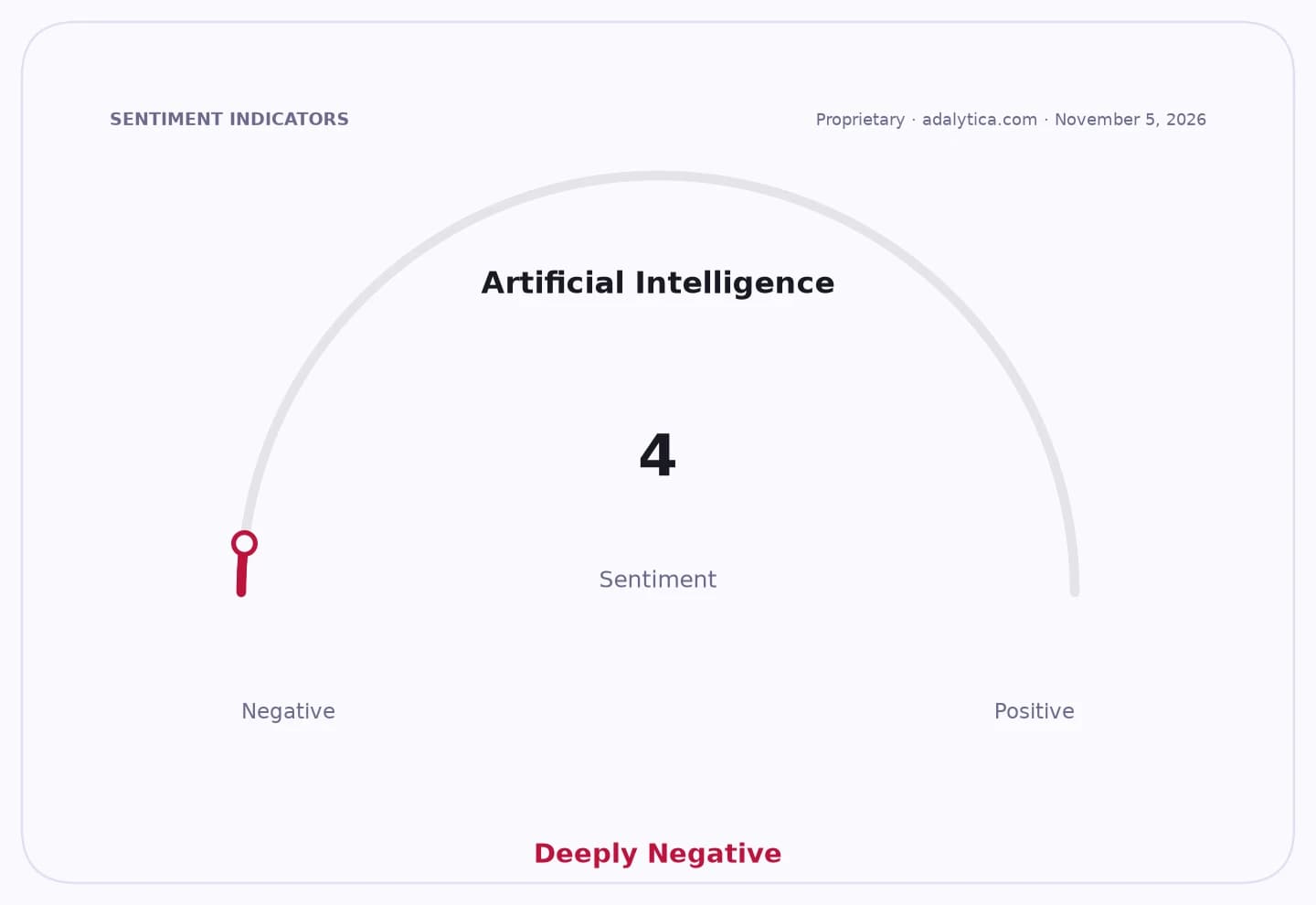
Sentiment Indicators
Georgieva said the AI investment boom has supported growth in some countries and helped offset the oil-supply shock from the Middle East conflict, but it has also pushed up inflationary pressure and heightened concerns over asset valuations and financial stability. She said recent market turbulence showed how dependent sentiment has become on the AI trade.
The warning lands at a sensitive moment for global markets. Tech shares fell sharply on Thursday amid fears that a Democratic victory in the US midterm elections could bring tighter regulation of artificial intelligence and slow data-center construction, driving investors toward safer bonds. The selloff underscored how crowded and fragile the AI theme has become after months of heavy capital inflows into chips, cloud infrastructure and data centers.
For policymakers, the issue is not only whether AI is boosting headline GDP, but whether that boost is durable. The IMF last month said a sharp end to the AI investment boom could reduce global output by 1.1% by 2028 and shave 1.8% off US economic production. That is a meaningful macro risk because a reversal in AI spending would hit a cluster of high-multiple assets, reduce business investment and potentially weaken hiring in one of the economy’s most important growth engines.
The market reaction has already started to show where stress would appear first. Microsoft and Alphabet have both seen their shares come under pressure in recent sessions, while Nvidia has fallen sharply, with its Relative Strength Index deep into oversold territory and its price trading well below its 50-day moving average. That does not by itself confirm a lasting reversal, but it reflects how quickly the market can reassess the durability of AI earnings and capex growth.
There are two competing narratives for investors. The bull case is that AI spending is still early, with cloud providers, chipmakers and power-infrastructure companies likely to benefit for years if enterprise adoption keeps accelerating. The bear case is that returns on the huge build-out of compute capacity are being overestimated, regulation may slow deployment, and any pause in spending could expose valuations that already assume strong growth for a long time.
Georgieva’s message suggests central banks will have to think beyond the usual inflation-growth tradeoff. If AI keeps powering investment, it may keep the economy hotter for longer. If it slows, the growth hit could arrive while inflation is still too elevated to invite easy policy relief. Either outcome raises the stakes for markets positioned around the assumption that AI will keep carrying both corporate earnings and economic growth.
| Entity | Gains | Losses |
|---|---|---|
| AI infrastructure investors | ▲Higher growth and capex | ▼Valuation risk if spending slows |
| Central banks | ▲Potential productivity support | ▼Harder inflation-growth tradeoff |
| Chipmakers and cloud firms | ▲Strong demand for AI build-out | ▼Demand reversal if regulation tightens |
| Bond investors | ▲Benefit from risk-off flows | ▼Lose if growth stays strong and yields rise |