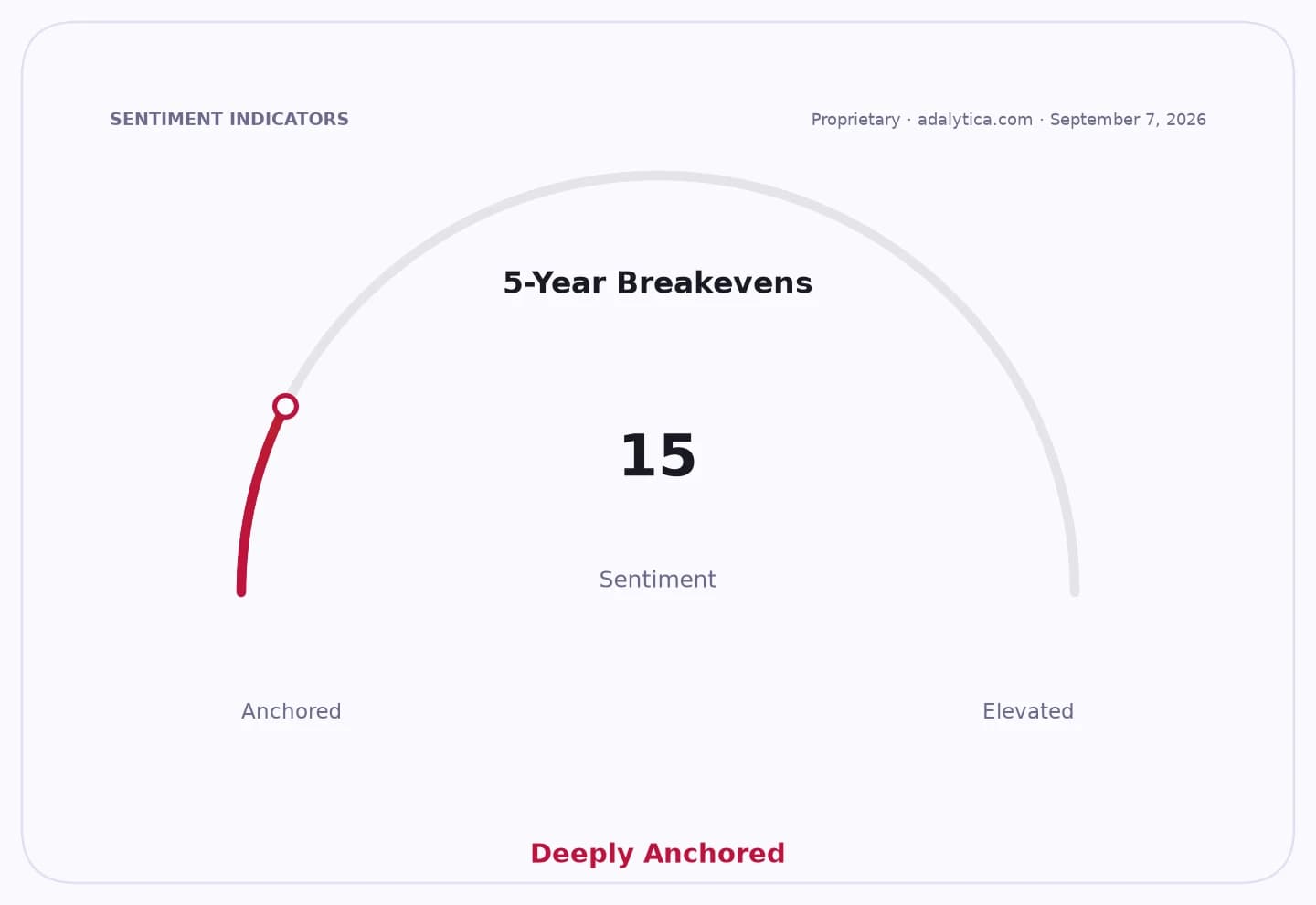
Indonesia's inflation outlook is moving higher, and that matters because the next leg of growth will depend less on speed and more on whether prices stay contained enough for Bank Indonesia to keep policy steady. The Asian Development Bank now expects consumer-price gains in Indonesia to reach 3.3% in 2026, up from 3.0% in its earlier view, with inflation seen climbing further to 3.0% in 2027 from 2.5%.
Indonesia Inflation Outlook Rises as ADB Keeps Growth

For investors, that is an important change even though the ADB left Indonesia's growth forecasts unchanged at 5.2% for both 2026 and 2027. A steady growth outlook with firmer inflation usually means the economy is still expanding, but with less room for easy monetary support. That can influence everything from bond yields and the rupiah to valuations on Indonesian stocks, especially rate-sensitive sectors such as banks, property and consumer names.
Sentiment IndicatorsⓘProprietary · adalytica.com · September 28, 2026
This is a snapshot — live sentiment, awareness and momentum for 130+ markets update continuously in the dashboard.Open AlphaPulse
ADB's message is that the region's growth engine remains intact, but the price of that resilience is getting higher. The bank said developing Asia-Pacific will grow 5% this year and 5.1% in 2027, supported by strong investment, government stimulus and robust technology exports tied to the global artificial intelligence cycle. But for Indonesia and its neighbors, the near-term risk is a less forgiving combination of extreme El Nino and a prolonged energy crisis linked to war, both of which can lift food and fuel costs.
That is the part investors should focus on. Food and energy carry outsized weight in emerging Asia's inflation baskets, so weather shocks and imported energy stress can quickly feed through to household budgets and corporate margins. ADB President Masato Kanda said stronger El Nino conditions are likely to mean smaller harvests and reduced hydropower generation, pushing up prices while hitting the most vulnerable consumers hardest.
Indonesia is not facing a collapse in growth; it is facing a less comfortable mix of decent expansion and stickier inflation. That usually favors companies with pricing power, defensive cash flows and exposure to domestic demand that can absorb higher input costs. It is less friendly to businesses that depend on cheap credit, low commodity costs or fragile consumer purchasing power.
The broader regional backdrop also matters. ADB raised inflation forecasts across developing Asia-Pacific, with 2027 now seen at 3% versus 2.5% previously, underscoring that this is not just an Indonesia story. If energy and climate pressures persist, central banks may have to stay cautious longer than markets would like, even as growth holds up better than many feared.
For long-term investors, the takeaway is simple: Indonesia still looks like a growth market, but the inflation path has become a little less benign. That keeps Bank Indonesia in a balancing act and makes selectivity more important than ever. The economy can still compound over years, but only if prices do not get ahead of incomes and policy stays credible.
| Entity | Gains | Losses |
|---|---|---|
| Indonesian lenders | ▲Wider margin discipline | ▼Slower rate cuts |
| Consumers | ▲Steady growth backdrop | ▼Higher food and fuel prices |
| Defensives with pricing power | ▲Better cost pass-through | ▼Margin pressure for weak businesses |
| Bondholders | ▲None | ▼Higher inflation expectations |