Indonesia’s push to place more migrant workers abroad is shifting from a headcount exercise to a value-and-placement model, after officials said 216,236 of 292,471 active overseas vacancies remain unfilled and many openings are stuck not for lack of demand, but because the system cannot yet convert interest into qualified, deployable workers.
Indonesia migrant worker vacancies remain unfilled
That gap matters economically because migrant work is one of Indonesia’s most direct channels for remittances, foreign-exchange inflows and job creation for a labor market that still needs higher-value opportunities. If vacancies exist but candidates cannot move through training, certification, visa processing and matching, the country is leaving income on the table while foreign employers remain short of labor.
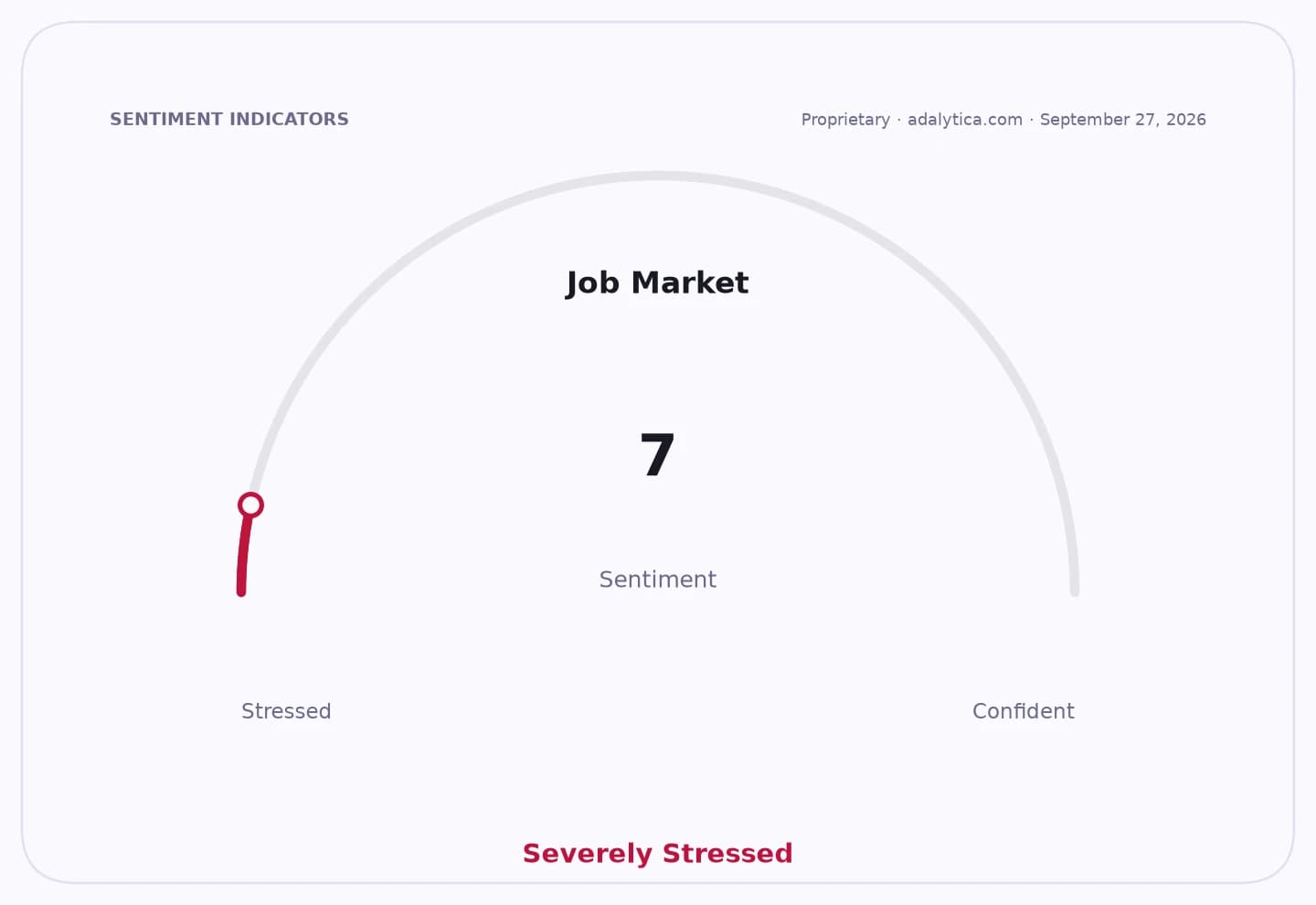
Sentiment IndicatorsⓘProprietary · adalytica.com · September 27, 2026
This is a snapshot — live sentiment, awareness and momentum for 130+ markets update continuously in the dashboard.Open AlphaPulse
The numbers point to a structural bottleneck rather than a simple shortage of demand. Active vacancies tracked in the SIP2MI system stood at 292,471 as of Sept. 20, 2026, with 73.93% still open. Officials said some roles, such as around 30,000 verified requests in Turkey, are constrained by visa-processing capacity of just 12,000-15,000 a year, showing how administrative limits can be as binding as skills gaps.
That is why the government is trying to redesign its Indonesian PMI, or migrant worker, model around measurable outcomes. Deputy minister Christina Aryani said preparation cannot stop at training; skills must connect to industrial demand and end in placement. The policy logic is simple: a program that trains thousands of people but does not place them into suitable jobs does not fully solve the labor-market problem.
For investors, the shift matters because it determines whether Indonesia can turn overseas labor demand into a more predictable, scalable earnings stream for workers and, by extension, consumption at home. Better matching can support remittance growth, while weaker execution would keep the system reliant on volume rather than productivity. The emphasis on placement also suggests the government is increasingly treating migrant labor as a strategic export service, not just a social program.
The clearest sign of that approach is “SMK Go Global,” which had 18,110 registrants and 4,601 trainees as of Sept. 17 against a 2026 target of 40,000 participants. The program covers language, technical skills and certifications aligned to destination-country requirements, with ministers saying curriculum should be built on market data rather than estimates.
That data-first approach could improve policy efficiency, but it also raises the bar. If the government can trace each vacancy to how many candidates were prepared, qualified and ultimately placed, it will be easier to identify where the pipeline is breaking. If candidates are trained but do not depart, the bottleneck is no longer education. If vacancies remain even as applicants are ready, the issue is more likely in documentation, employer matching or host-country processing.
For Indonesia, the broader narrative is a move from asking where the jobs are to proving that its labor system can actually capture them. For investors and employers, the key question is whether that transition can lift placement rates fast enough to turn a large pool of overseas demand into a durable economic asset.
| Entity | Gains | Losses |
|---|---|---|
| Indonesian government | ▲Better labor-market efficiency | ▼Pressure to fix bottlenecks |
| Migrant workers | ▲More targeted placements | ▼Delays from admin barriers |
| Foreign employers | ▲Larger candidate pipeline | ▼Unfilled vacancies persist |
| Training providers | ▲Clearer demand signals | ▼Less room for generic programs |