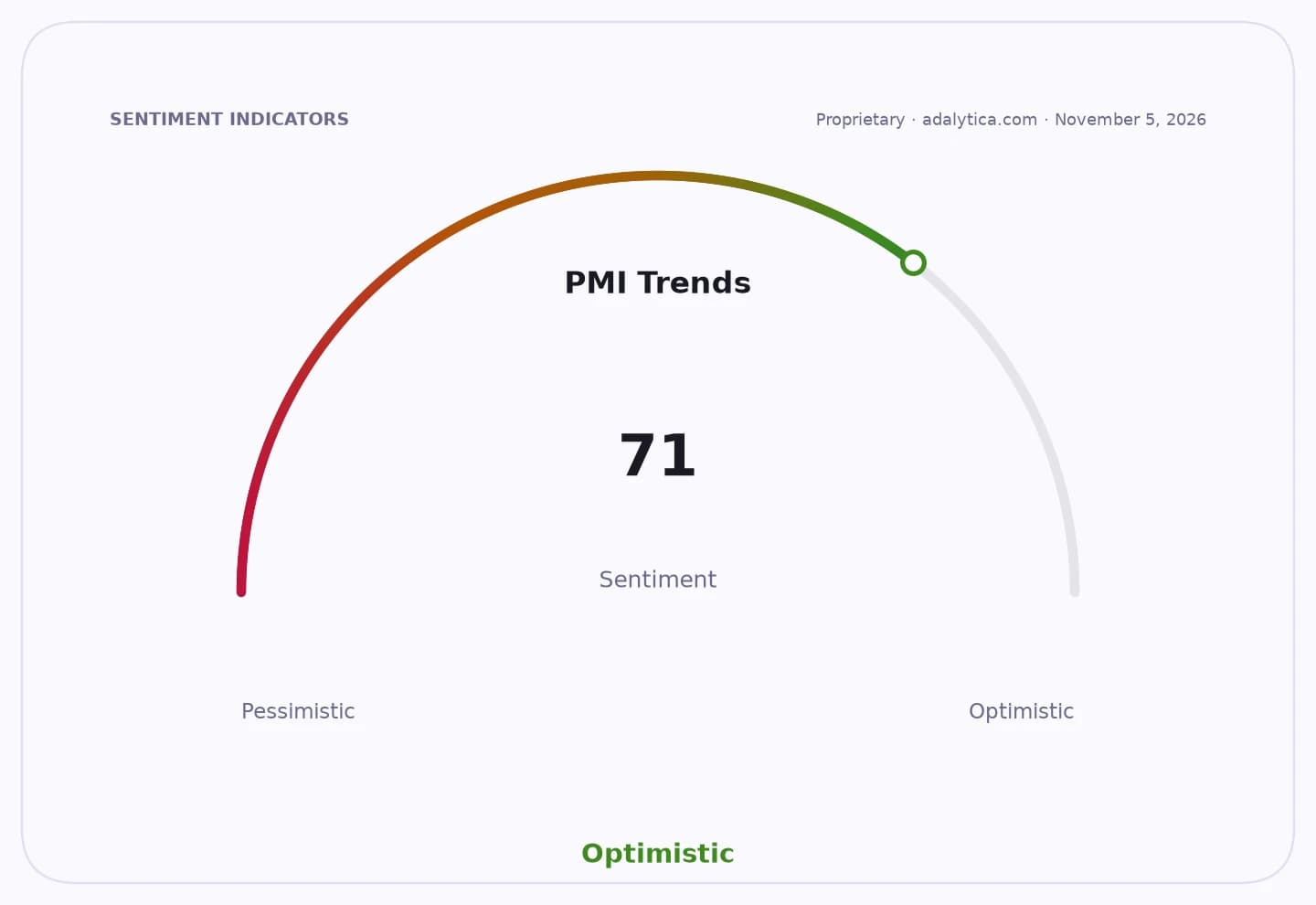
Indonesia is trying to turn labor productivity into a growth lever, and that matters because the country’s long-term competitiveness will hinge less on cheap labor and more on whether workers can keep pace with technology, automation and changing industrial demand.
Indonesia Productivity Push Targets Workforce Upgrading

Manpower Minister Yassierli said innovation and higher productivity must sit at the center of efforts to strengthen human-resource competitiveness, telling a campus event in Bandung that the government wants a “people-centric” transformation where “no one is left behind.” The policy push is notable because it shifts the labor debate away from job creation alone and toward the quality of those jobs, a crucial distinction for an economy that wants to climb the value chain.
Sentiment Indicators
The ministry is backing that message with a more concrete industrial plan: it will refine Indonesia’s national productivity competency standard, expand free certification through the National Professional Certification Agency, professional certification bodies and the Asian Productivity Organization, and convert 43 training and productivity centers into “productivity clinics” and centers of excellence. It is also assembling case studies with 20 companies using appropriate technology to show what productivity gains look like in practice.
That matters economically because Indonesia’s productivity gap remains the core constraint on wage growth, industrial upgrading and investment returns. The latest production and labor data in the context point to an economy that is growing, but still needs stronger efficiency gains to sustain it. Industrial production has risen to 103.4 in the latest readings, while unemployment has held near 4.1% to 4.2%, suggesting the challenge is not simply creating jobs, but making each worker and each factory hour more valuable. If productivity improves, companies can absorb higher wages, defend margins and expand output without relying solely on hiring.
For investors, the message is that labor efficiency is becoming a tradable theme, not just a social-policy slogan. The beneficiaries are the training providers, HR technology platforms, certification-linked service companies and industrial groups that can squeeze more output from existing staff. That is exactly why the market tends to reward firms that pair digital tools with workforce discipline. In the U.S., payroll and human-capital leaders such as ADP and Paychex have made technology innovation and cost-efficient scaling central to their models, while uniform and facilities company Cintas has shown how operational productivity can support premium valuations. Indonesia is earlier in that cycle, which is why the opportunity is asymmetric.
The broader narrative is a familiar one across emerging markets: governments want growth without simply adding more labor, and companies want margin protection without endless headcount expansion. That creates a powerful second-order demand for upskilling, certification, workflow software and industrial technology that can lift productivity per worker. It also explains why the market should pay attention to the 43 centers of excellence and the 20-company showcase program — those are the first signs of a policy framework that can scale.
My view is that investors underestimate how quickly productivity policy can translate into capital spending and service demand. If Indonesia succeeds in building a workforce that is more adaptable, more certified and more technology-ready, the winners will be the companies that sell the tools of efficiency, not just the employers that talk about it. The next catalyst will be whether the ministry’s pilot programs become a national template — and that is where the real investable upside begins.
| Entity | Gains | Losses |
|---|---|---|
| Indonesian workers | ▲Better skills, higher employability | ▼Low-skill wage pressure |
| Indonesian industrial firms | ▲Higher output per worker | ▼Legacy inefficiency |
| HR tech / training providers | ▲More demand for upskilling | ▼Manual labor models |
| Employers resisting change | ▲Short-term cost savings | ▼Long-term competitiveness |