Israel’s government has approved an $840 million budget cut, shifting money away from education, health and social welfare so it can move faster on defense procurement at a time when regional security risks are rising.
Israel budget cut shifts funds to defense procurement

That makes this more than a routine fiscal adjustment. For investors, the key question is not just where the money comes from, but what kind of economy Israel is leaning toward: one that is increasingly shaped by defense needs, higher public spending and less room for civilian priorities. In a country already balancing war-related reconstruction costs, election politics and a potentially wider security confrontation, budget choices can quickly become market-moving signals about deficits, borrowing needs and policy trade-offs.
Sentiment IndicatorsⓘProprietary · adalytica.com · October 22, 2026
This is a snapshot — live sentiment, awareness and momentum for 130+ markets update continuously in the dashboard.Open AlphaPulse
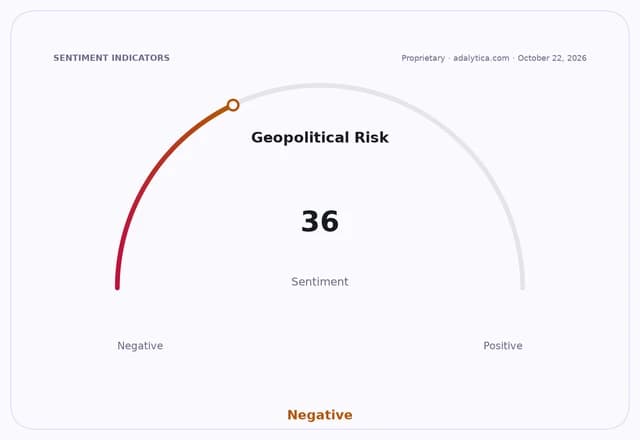
The cut was approved nine days before scheduled parliamentary elections, underscoring how security concerns are still driving fiscal policy even in a politically sensitive moment. Government and security officials said delaying the decision until after a new government was formed could jeopardize “essential security needs,” a phrase that speaks to how urgent the spending decision has become.
Officials did not say what equipment or services would be bought, but the broad direction is clear: defense is taking precedence over social spending. That matters economically because reallocating funds from civilian ministries can limit near-term growth benefits from education, healthcare and welfare spending, while also putting pressure on a budget already exposed to elevated military outlays and reconstruction demands.
Geopolitical Risk — 30-day sentimentadalytica.com
Explore this data interactively — full history, time series and cross-market comparisons.Open AlphaPulse
The broader backdrop is a region still defined by instability, with Israel facing ongoing security concerns and the fiscal drag of prolonged conflict. The Bank of Israel has already warned about the possibility of higher deficits and defense spending, and those worries are important for bond investors in particular. More military spending can support defense contractors, but it can also mean more government borrowing, tighter fiscal room and, eventually, higher interest costs.
For equity investors, the split is straightforward: defense-linked businesses may see stronger demand, while sectors tied to public services and domestic consumption could face a less supportive fiscal environment. For long-term investors, the bigger lesson is that geopolitical risk is not just a headline issue in Israel — it is becoming part of the country’s budget math.
If security conditions stay strained, more spending shifts are likely. That keeps defense procurement, sovereign financing and the health of Israel’s broader public finances firmly on the watchlist for anyone with exposure to the region.
| Entity | Gains | Losses |
|---|---|---|
| Defense suppliers | ▲More procurement demand | ▼— |
| Israel government | ▲Faster security funding | ▼Less fiscal flexibility |
| Education, health and welfare ministries | ▲— | ▼Reduced budgets |
| Bondholders | ▲— | ▼Higher deficit risk |