JPMorgan Chase & Co. says South Korea’s Kospi looks cheap after its sharp rout, but the bank sees no clear sign yet that the market has found a floor.
Kospi Looks Cheap as JPMorgan Sees No Clear Bottom

That matters because the sell-off has pushed valuations to levels JPMorgan says are near historic lows, even as foreign investors keep pulling money out and domestic institutions have not stepped in with enough force to stabilize prices. For investors, the call frames Korea as a potential value opportunity — but one that still carries near-term timing risk.
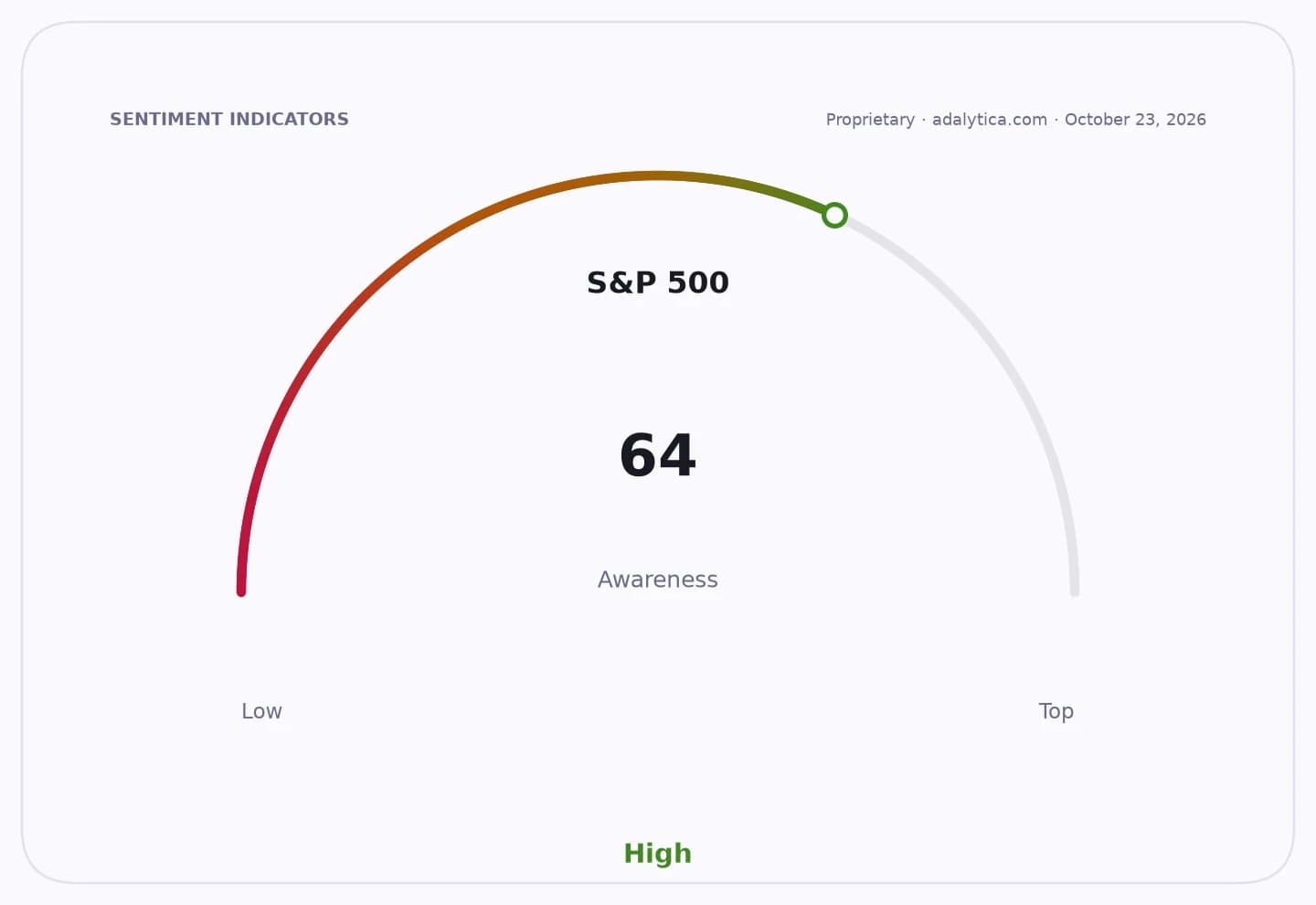
Sentiment IndicatorsⓘProprietary · adalytica.com · October 24, 2026
This is a snapshot — live sentiment, awareness and momentum for 130+ markets update continuously in the dashboard.Open AlphaPulse

The bank said the Kospi’s forward price-to-earnings ratio has fallen to around 4, a level it described as a historic low. Even stripping out memory-chip and other large-cap names that distort the index, the forward P/E stands at 8.4, in the lowest 11% of its historical range. JPMorgan also pointed to the Kospi’s forward price-to-book ratio, which has approached 1, as further evidence that the market has been marked down aggressively.
The caution is that cheap does not yet mean settled. JPMorgan said market breadth had been weakening before the latest slide, with fewer stocks participating in gains, while share buybacks from Samsung Electronics and SK hynix have ended, removing a source of support for the benchmark. Foreign investors remain net sellers, domestic pension funds and securities firms are buying only limited amounts, and retail sentiment is fragile.
That backdrop helps explain why the Kospi has struggled to stabilize even after looking washed out on valuation screens. The benchmark closed at 5,550.3 on Oct. 23, after dropping to 5,533.77 the prior session, and its relative strength index is down to 19.3, a reading that typically indicates deeply oversold conditions. Technical indicators suggest the index remains under heavy pressure, with price still below both the 50-day and 200-day moving averages.
JPMorgan said the next catalysts will likely come from memory-chip earnings, results from hyperscalers, disclosures by AI model developers and a possible easing in volatility, alongside the end of the U.S. midterm election period. Over the next six to 12 months, the bank still sees Korea’s fundamentals as constructive, citing AI-related capital spending and potential corporate-governance gains, but it left its Kospi target unchanged.
The message to investors is straightforward: Korea is getting cheaper, but not yet safer. A durable rebound likely needs either a turn in foreign flows or evidence that earnings and buybacks can absorb the selling pressure now hitting the market.
| Entity | Gains | Losses |
|---|---|---|
| Long-term value investors | ▲Deeply discounted valuations | ▼Near-term timing risk |
| Foreign sellers | ▲Better exit liquidity | ▼Exposure to further upside |
| Samsung Electronics and SK hynix | ▲Potential AI-cycle recovery later | ▼End of buyback support |
| Kospi bulls | ▲Chance to buy oversold market | ▼No clear bottom yet |