AI is making employees more productive, but for most companies the boost has yet to show up meaningfully in profits, a McKinsey executive said, underscoring a growing gap between individual efficiency and enterprise returns.
McKinsey says AI productivity has not lifted profits
That gap matters because the current AI investment cycle is being justified less by novelty than by economics: companies are spending heavily on models, cloud capacity and workflow tools, yet many are still waiting for margin expansion, faster revenue growth or a lower cost base to follow. Eric Kutcher, senior partner and chairman of McKinsey North America, said on Wednesday that outside a few pockets such as software development, broad-based productivity gains have not yet translated into companywide benefits.
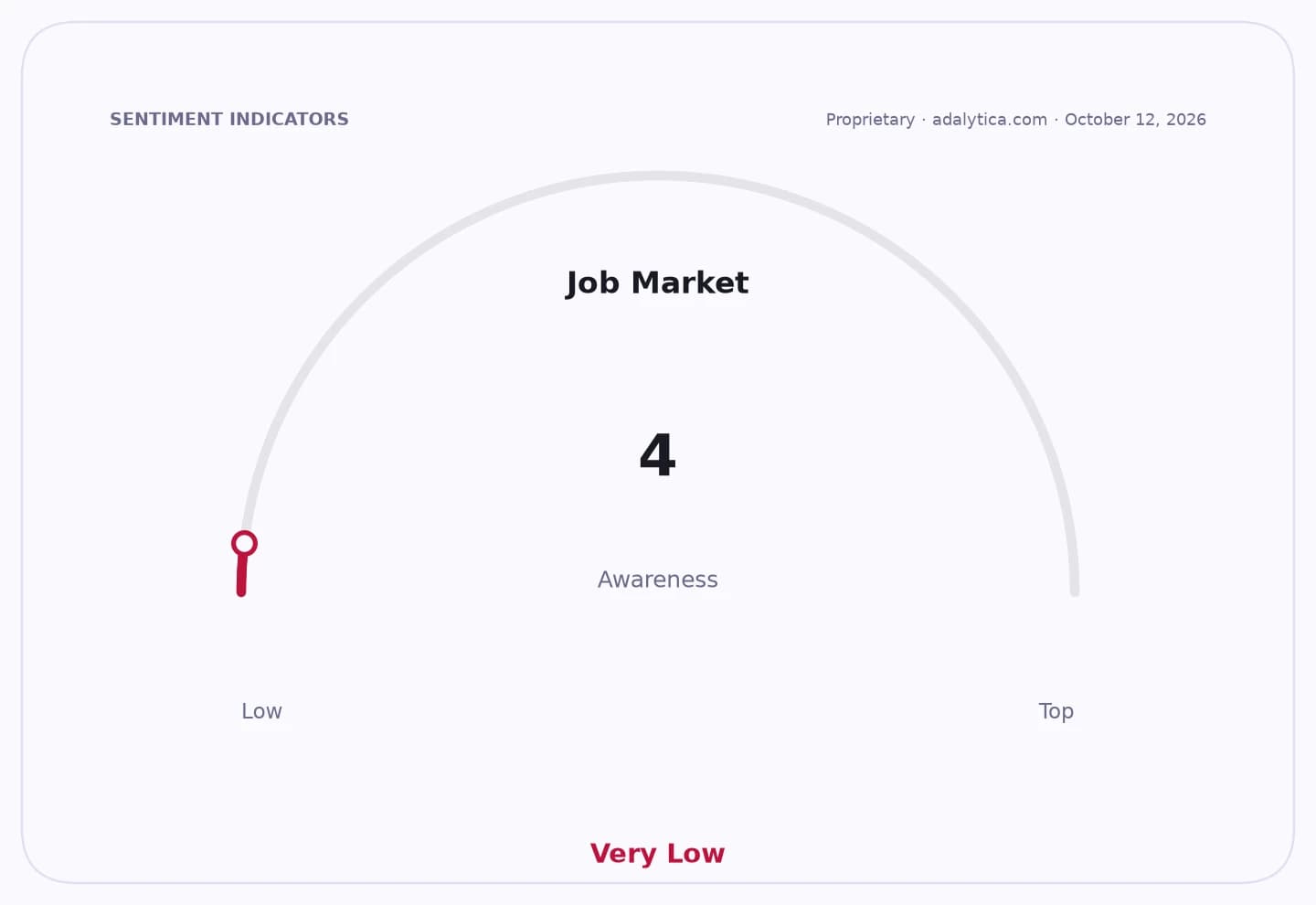
Sentiment IndicatorsⓘProprietary · adalytica.com · October 12, 2026
This is a snapshot — live sentiment, awareness and momentum for 130+ markets update continuously in the dashboard.Open AlphaPulse
“The employees are getting more productive as individuals, but they’re just changing part of their work,” he said, adding that most firms have not yet captured productivity gains at the level of the overall operating model.
The comments go to the heart of one of the market’s biggest questions about artificial intelligence: whether the technology will create measurable returns quickly enough to justify the capital being deployed across the sector. In practice, many companies have started with a simple playbook — giving workers access to tools such as Anthropic’s Claude and OpenAI’s ChatGPT and, in some cases, encouraging them to use the tools as much as possible. Kutcher said some firms have even tracked who consumes the most AI tokens, “without realising that these tokens cost money.”
McKinsey’s own data illustrate the disconnect. In an August survey by the consultancy’s QuantumBlack AI unit, eight in 10 respondents said AI had improved their productivity. But the share saying AI had contributed to profits from their core business before interest and taxes was 37%, essentially unchanged from a year earlier.
For investors, that spread matters because it suggests AI is still in the adoption phase rather than the monetisation phase for many industries. The winners so far are often the toolmakers, cloud providers and software vendors selling the infrastructure and applications, while the users may be capturing less visible benefits such as time savings or faster task completion that do not yet show up in reported earnings.
The clearest exception remains software development, where Kutcher said AI has already helped engineers generate more code, speeding the launch of products and features. That is one reason software remains the most convincing near-term use case: the gains are easier to measure, easier to standardise and more likely to flow through to revenue growth or lower development costs.
McKinsey also said more companies are moving beyond experiments and pilot projects. Its survey found the share of AI-using firms entering “scaling mode” rose by six percentage points between 2025 and 2026, suggesting executives are starting to push AI deeper into operations rather than treating it as a side tool for individual workers.
Still, the firm’s message is that productivity at the desk is not the same as productivity on the income statement. To convert AI into profit, companies have to redesign workflows, remove bottlenecks and look at the whole system rather than just the employee using the chatbot.
That makes the next phase of the AI trade less about adoption headlines and more about execution. If enterprises can turn isolated productivity gains into lower costs, faster product cycles and better utilisation of labour and capital, the case for AI-led margin expansion strengthens. If not, investors may keep seeing a technology that improves work without fully paying for itself.
| Entity | Gains | Losses |
|---|---|---|
| AI software vendors | ▲More enterprise demand | ▼Slower monetisation if ROI lags |
| Cloud providers | ▲AI workload growth | ▼Margin pressure from heavy spend |
| Corporate users | ▲Higher individual productivity | ▼Limited near-term profit lift |
| Investors in AI winners | ▲Long-term operating leverage case | ▼Near-term valuation risk |