A Meghalaya high court-appointed committee has escalated a coal-missing case that goes to the heart of resource governance in India’s northeast, saying more than 13 lakh tonnes of coal recorded on paper cannot be accounted for and that responsibility must be fixed.
Meghalaya coal case flags 13 lakh tonnes missing
That matters far beyond a local audit. Coal is still the backbone of power, steel and industrial fuel supply across India, so any sign that a large stockpile has vanished raises questions about custody, illegal mining, transport controls and the state’s ability to enforce the law. For investors, the bigger issue is not just the missing coal itself but the signal it sends about regulatory risk in a sector where compliance, permits and logistics can make or break returns.
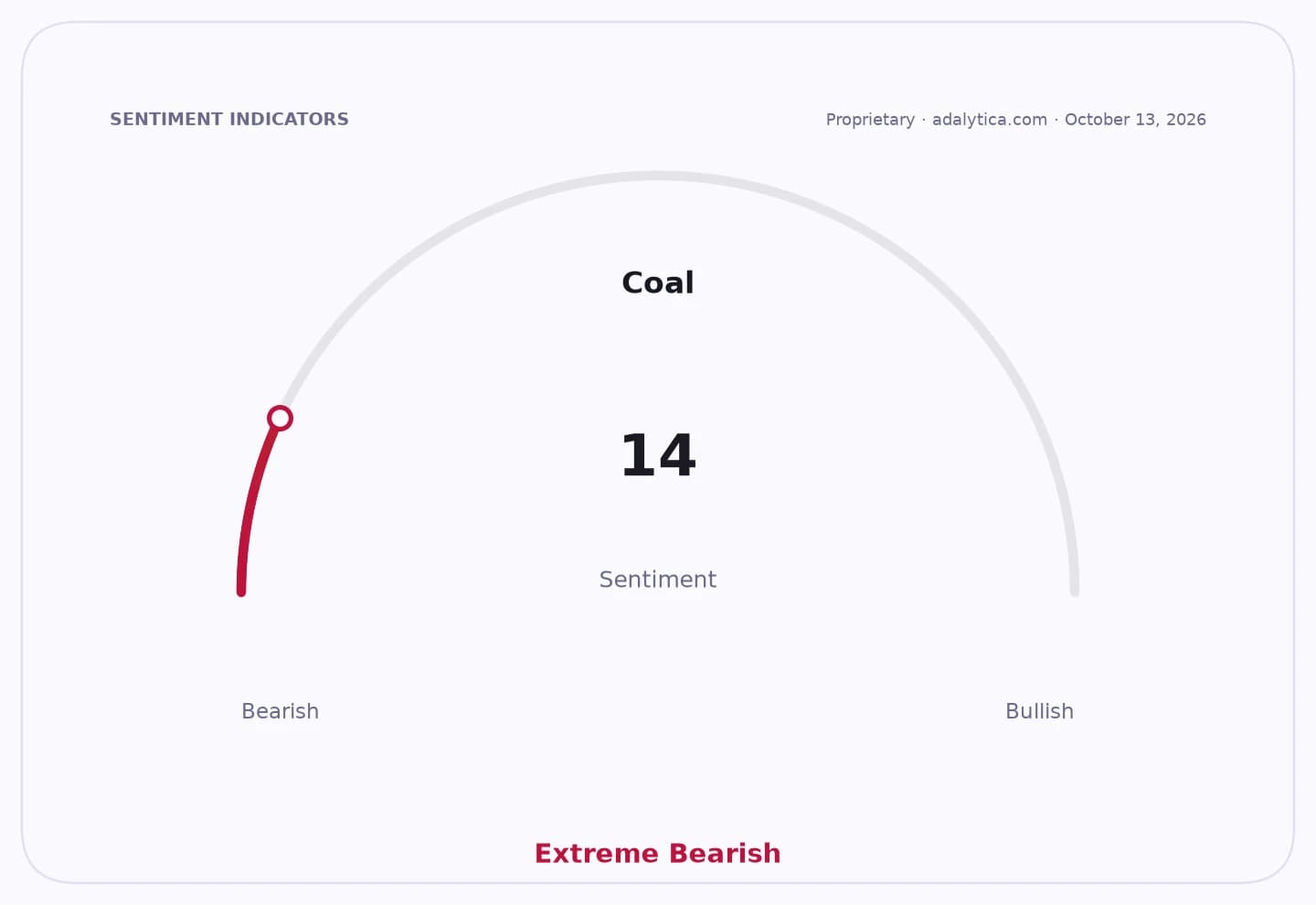
Sentiment IndicatorsⓘProprietary · adalytica.com · October 9, 2026
This is a snapshot — live sentiment, awareness and momentum for 130+ markets update continuously in the dashboard.Open AlphaPulse
The committee, headed by retired justice B.P. Katake, said in its 41st interim report that physical verification by the deputy commissioner left no dispute over the shortfall. It is now calling for a detailed probe and identification of those responsible, with the Supreme Court having already treated the state government as custodian of the fuel.
The scale is striking. At 25 tonnes a truck, the missing stock is equivalent to roughly 52,000 truckloads — the kind of volume that cannot simply disappear without a wide trail of handling, movement and oversight failures. The committee also flagged missing coal outside a Coal India depot, where 37,449.53 tonnes were said to be unaccounted for, but FIRs were initially filed for only 4,141.83 tonnes. It wants fresh police action on the remaining 33,307.7 tonnes and faster investigation of pending cases tied to illegally mined coal.
For long-term investors, the immediate financial impact is likely more about governance than earnings. The episode reinforces that coal assets, transport chains and government-held inventories in India carry legal and reputational risk that can linger for years. Any crackdown could also mean tighter monitoring, slower clearances and more scrutiny across the regional mining and logistics ecosystem.
That makes this less a trading headline than a reminder of how policy and enforcement shape returns in resource markets. In sectors like coal, the difference between an investable cash-generating operation and a legal headache often comes down to chain-of-custody controls and state oversight. Investors should watch whether the investigation leads to prosecutions, asset recoveries and tougher controls — or becomes another unresolved governance case that keeps hanging over the sector.
| Entity | Gains | Losses |
|---|---|---|
| Meghalaya authorities | ▲Chance to tighten oversight | ▼Credibility gap |
| Coal India / depot operators | ▲Clearer custody rules if enforced | ▼Scrutiny over missing stock |
| Illegal miners / middlemen | ▲None | ▼Probe and penalties |
| Long-term investors | ▲Better governance if reforms follow | ▼Policy and legal risk |